Incentive Alignment Bonds
war-on-disease, 1-percent-treaty, medical-research, public-health, peace-dividend, decentralized-trials, dfda, dih, victory-bonds, health-economics, cost-benefit-analysis, clinical-trials, drug-development, regulatory-reform, military-spending, peace-economics, decentralized-governance, wishocracy, blockchain-governance, impact-investing
Related: Aligning Incentives | Academic Paper
Remember when your grandparents funded WW2 by buying war bonds? They got roughly 3% returns and a world without Nazis (mostly). Good deal.
You’re doing the same thing. Except instead of buying bonds to kill Nazis, you’re buying bonds to kill diseases. War bonds, but backwards.
One clarification before the mechanics. These bonds are a product Earth Optimization Services may offer later, the way a company issues bonds. They are not shares in Earth Optimization Services and they are not shares of the Earth Optimization Fund. Voting shares cannot be bought at any price: yours came with being alive, and it is not for sale. The Fund buys the companies. The bonds fund the campaign. Everything follows the same rule either way: money in, more money out, and the vote stays one per human.
The Core Problem: Good Ideas Die in Committee
Here’s your species’ fun puzzle: you know how to save millions of lives. You can measure exactly how many. You have the money. You don’t do it.
Not because your politicians are evil. Because your system is built so that:
- Politicians maximize reelection, status, and post-office careers, not “humans continuing to exist”
- Bureaucracies maximize budget and turf, not “speed of treatments”
- Lobbyists maximize client profits, not “global welfare”
You don’t fix this with awareness campaigns. You’ve been “raising awareness” for decades and everyone is still dying, but they’re dying aware, so that’s nice. You don’t fix it with white papers. Politicians use white papers to stabilize wobbly tables. You fix it by changing what self-interest points at.
Eventually, people do useful things because they’re useful, which I realize sounds made up, but you also thought “washing your hands” sounded made up until 1847. Until then, you need these.
This chapter describes how to legally bribe your politicians into doing the right thing. (If at any point the numbers sound impossible, try the five questions. Any error has to live in one of them.)
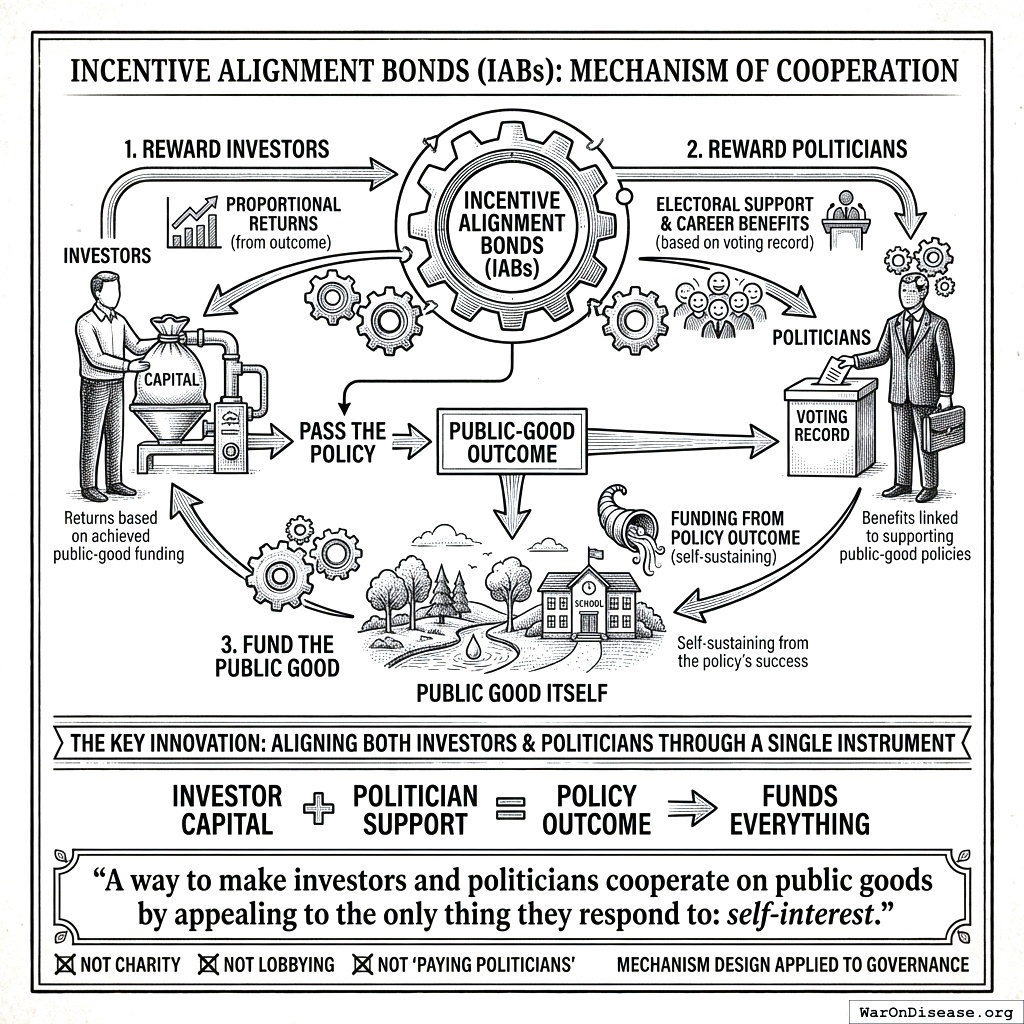
Incentive Alignment Bonds (IABs): a financial instrument for paying for better governance without technically paying politicians, giving money to governments, or going to prison.
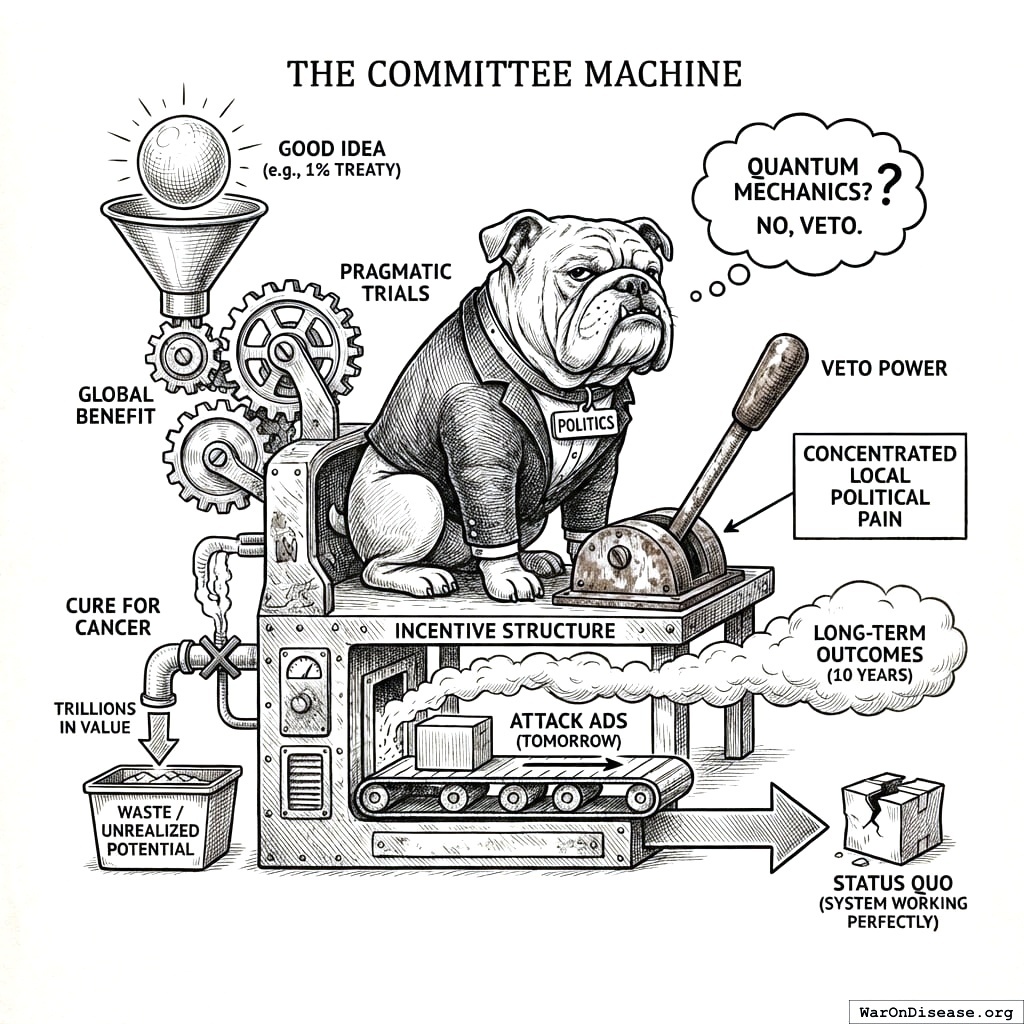
Your 1% Treaty1 2 isn’t constrained by physics, biology, or money. It’s constrained by politics, which is like being constrained by your dog’s opinion on quantum mechanics, except your dog can veto legislation.
No politician wants to be the one who “cut the military.” Even by 1%. Even if that 1% cures cancer. The attack ads write themselves: “Senator Johnson voted to WEAKEN AMERICA.” Your system does exactly what it’s incentivized to do. It’s not broken. It’s working perfectly at the wrong thing.
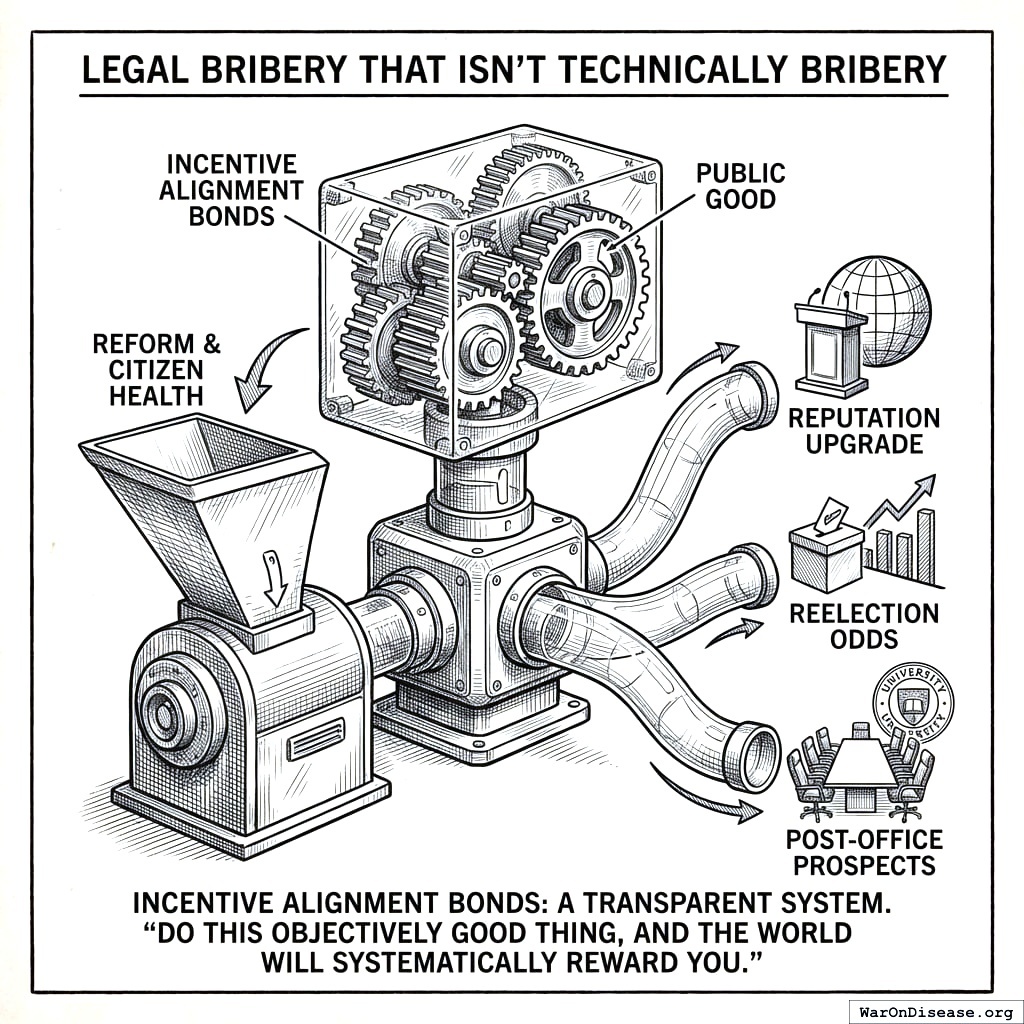
The fix: tell every politician on Earth, “Vote for a 1%-style reform and you get better reelection odds and a Goldman Sachs board seat when you retire.” No backroom deals. No suitcases of cash. Just a standing, public rule: do the right thing, get rewarded. Nobody has to become a better person. The money just circulates until diseases stop existing.
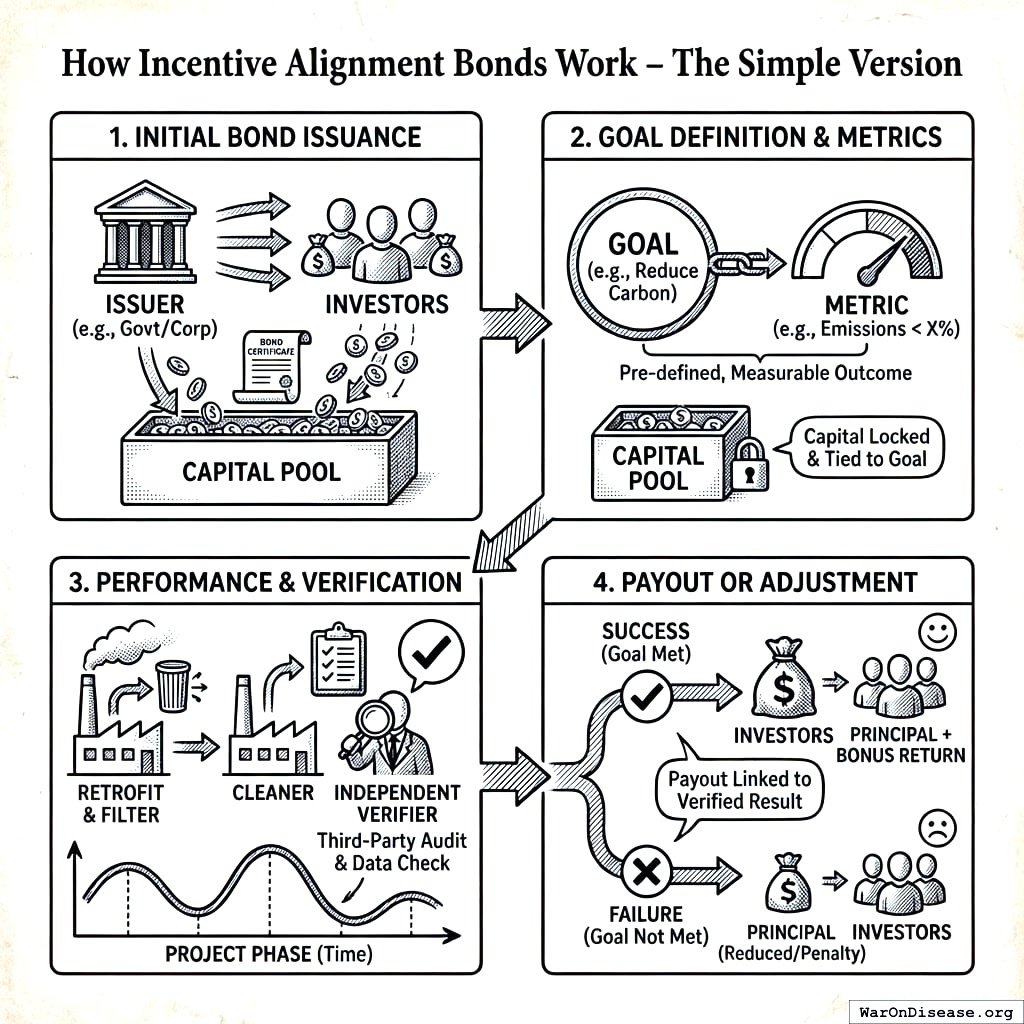
How IABs Work (Four Steps)
Not charity (doesn’t scale). Not lobbying (slot taken). Not “paying politicians” (illegal, also taken). You work with the primates you have, not the primates you wish you had. Two steps. Step 1: make the right thing profitable. Step 2: wait. There is no Step 3. Every civilization spends millennia trying to add a Step 3 (moral education, cultural reform, public shaming, interpretive dance).
Step 1: Pick a Measurable Outcome
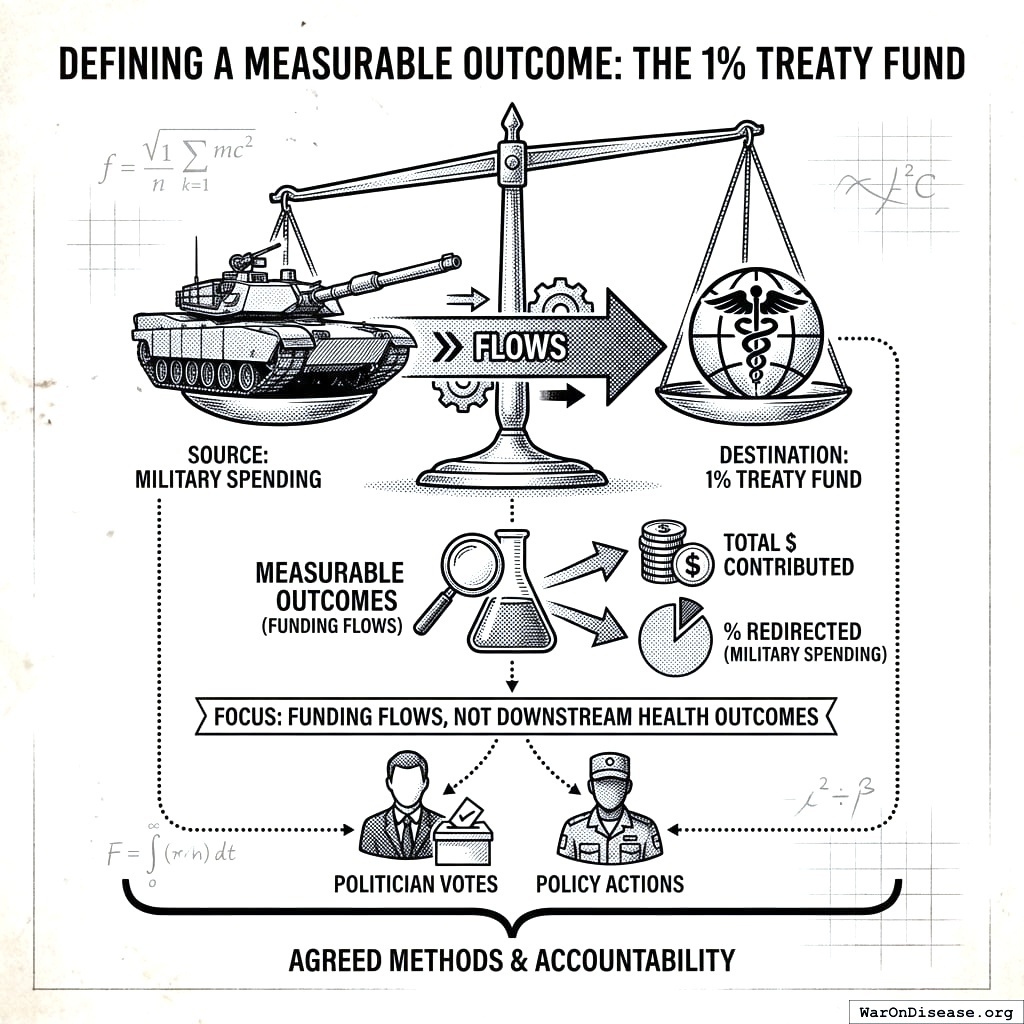
Measure funding flows, not health outcomes. You can’t attribute a treatment breakthrough to any single country’s funding. But you CAN measure: % of military spending redirected, total $ contributed, and politician votes on treaty passage. Health improvements justify the policy. Funding flows are the scoreboard (because that’s what politicians actually control).
Step 2: Raise Capital
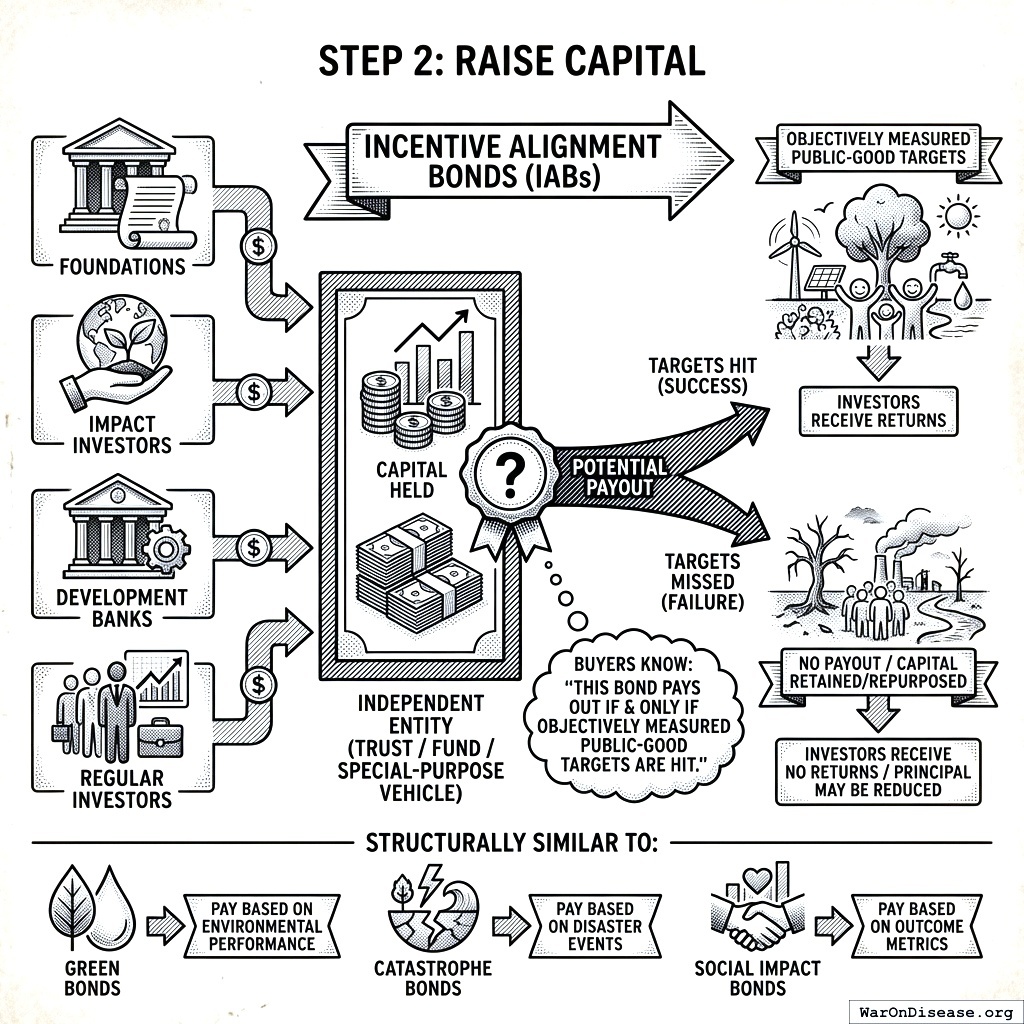
Investors buy IABs. Capital sits in a trust. It pays out if and only if public-good targets are hit. Same structure as green bonds and catastrophe bonds.
Step 3: Reward Your Politicians (Indirectly)
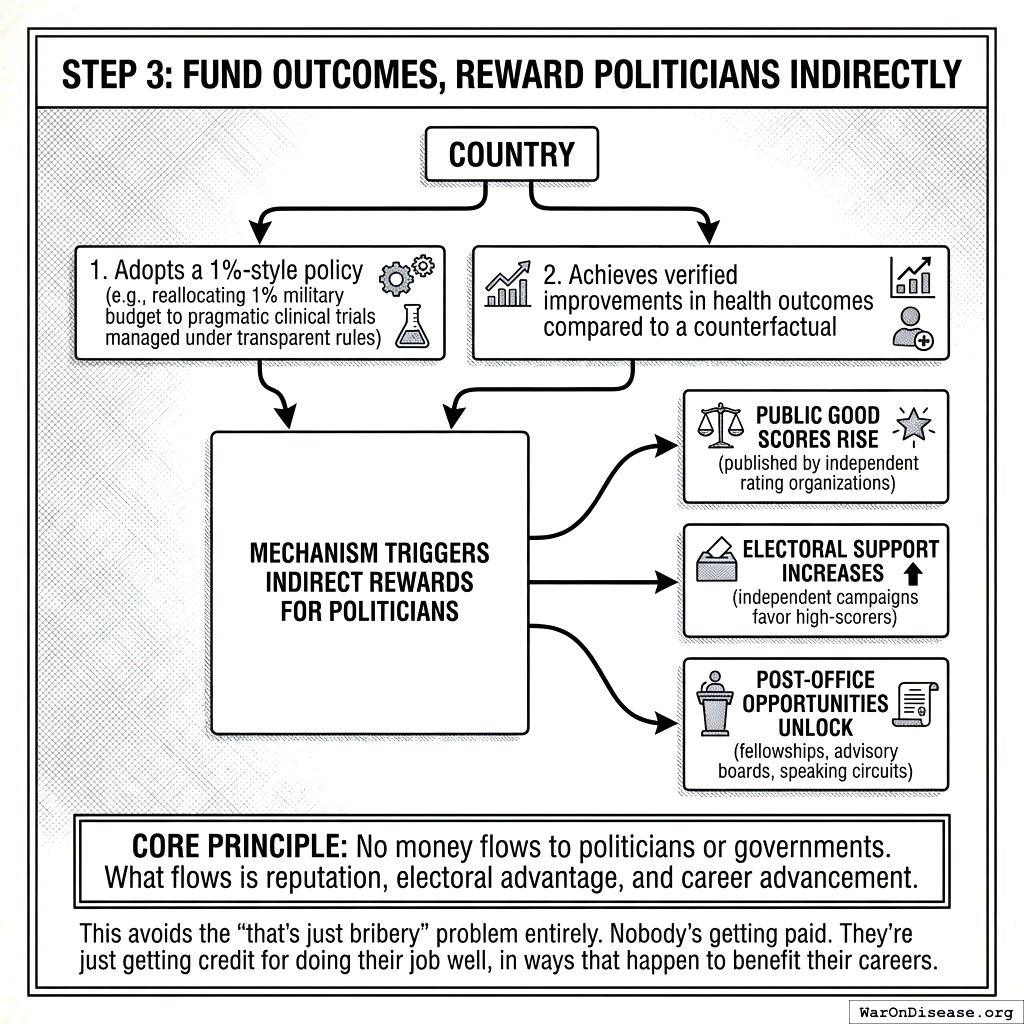
When a politician votes for a 1%-style policy and funding actually flows:
- Public Good Scores rise (published by independent rating orgs)
- Electoral support increases (independent campaigns favor high-scorers)
- Post-office opportunities open up (fellowships, boards, speaking circuits)
No money flows to politicians (see why this isn’t bribery). What flows is reputation, electoral advantage, and career advancement.
Step 4: Watch Self-Interest Do the Rest
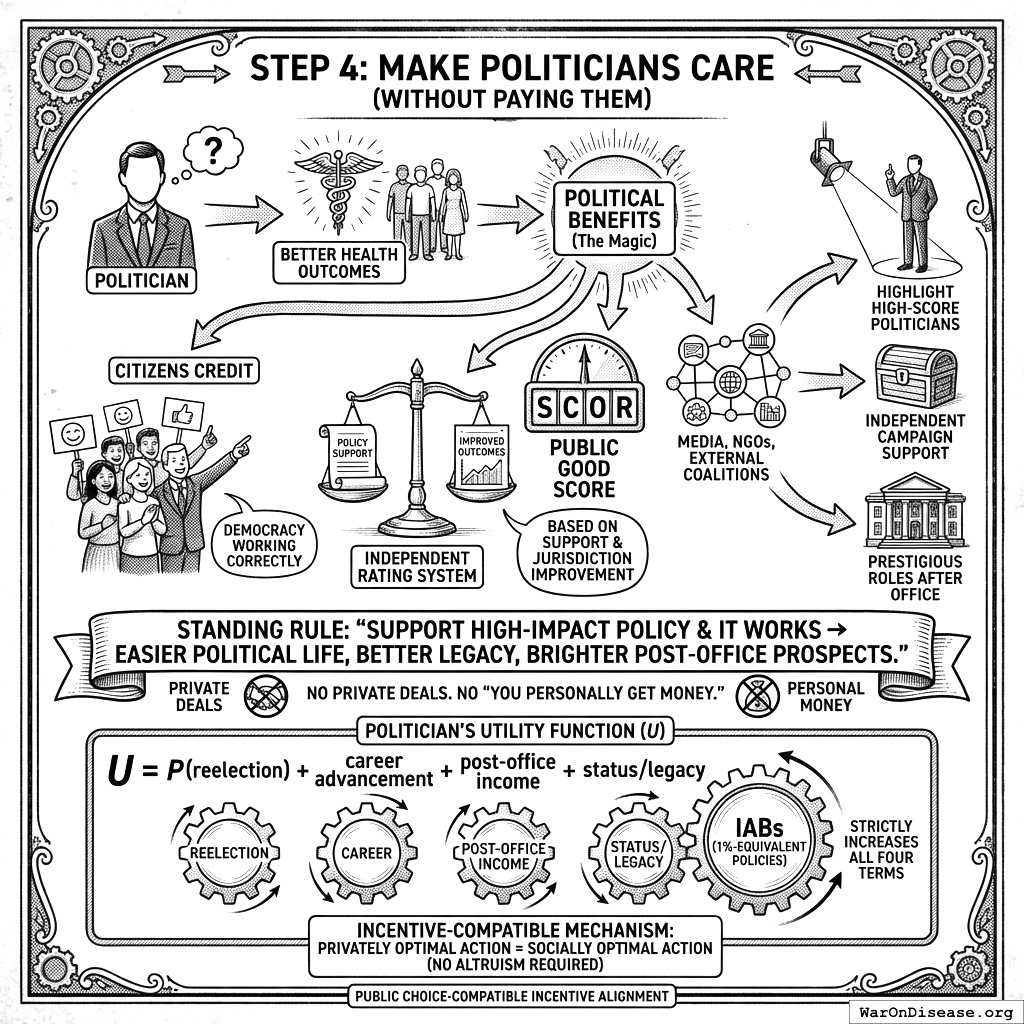
Your politicians’ utility function is roughly:
U = P(reelection) + career advancement + post-office income + legacy
IABs make supporting 1%-equivalent policies strictly increase all four terms. No altruism required. “Maximize personal payoff” and “reduce suffering” become the same action. You’ve tricked your leaders into saving lives by making it the selfish thing to do.
The Three-Layer Architecture (How to Not Go to Prison)
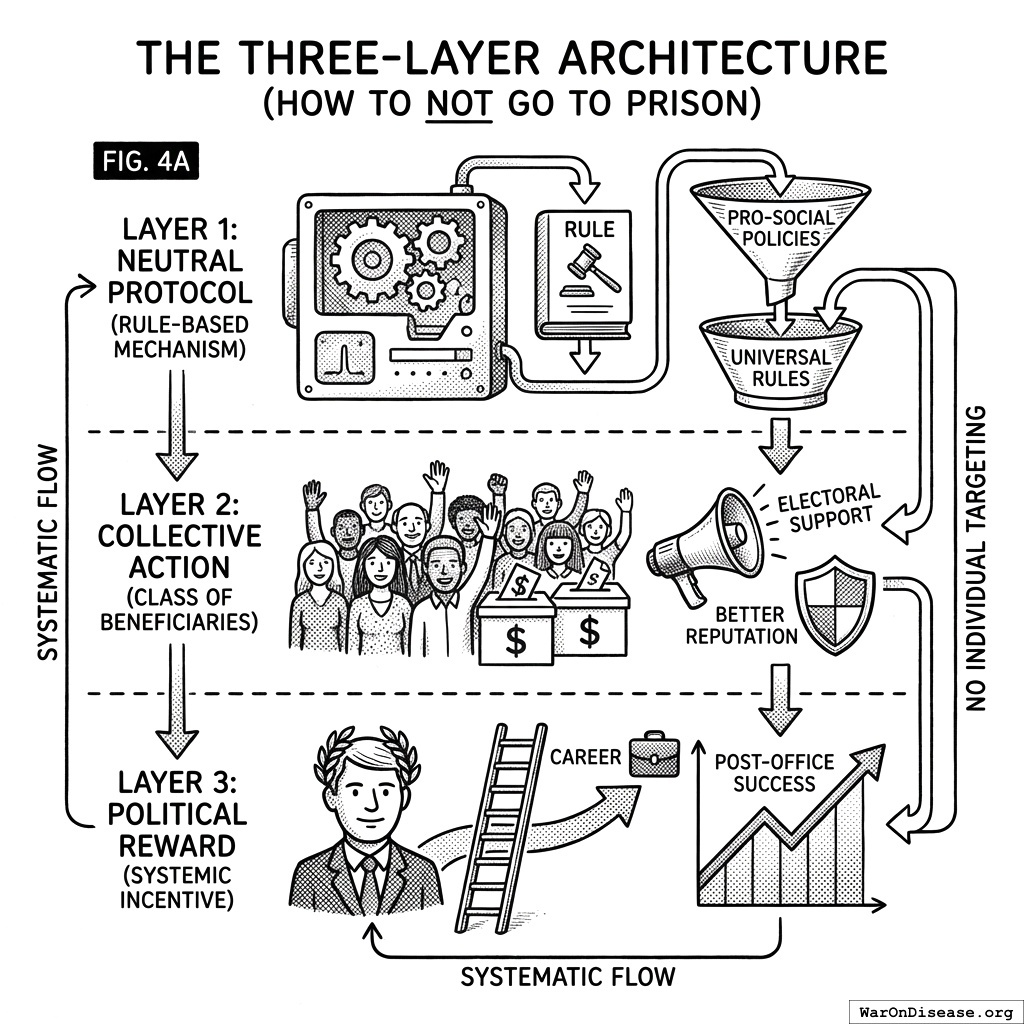
You cannot legally say “support Bill #XYZ123 and get paid.” That’s bribery. But you can create a system where politicians who support a class of pro-social policies systematically get more of everything they want. The trick: rule-based, universal, announced in advance.
Layer A: Scoring (Data Only)
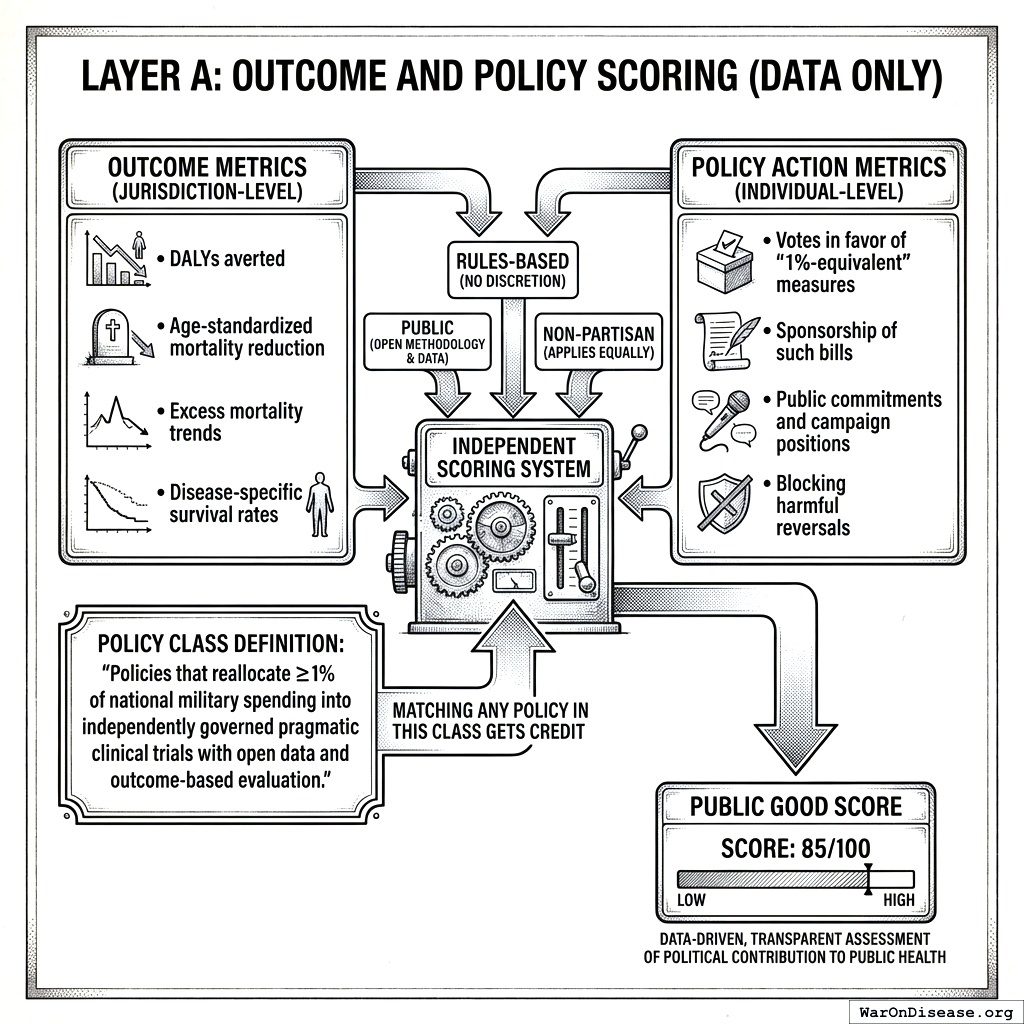
An independent org assigns each politician a Public Good Score based on votes, sponsorship, and funding flows. Scores cover a policy class (any >=1% military-to-health reallocation), not a specific bill. Public, rules-based, non-partisan. For the 1% Treaty, this is called the Treaty Support Score. (See the Senator Smith example for how scores translate to concrete payoffs.)
Layer B: Electoral Benefits (Separate Actors)
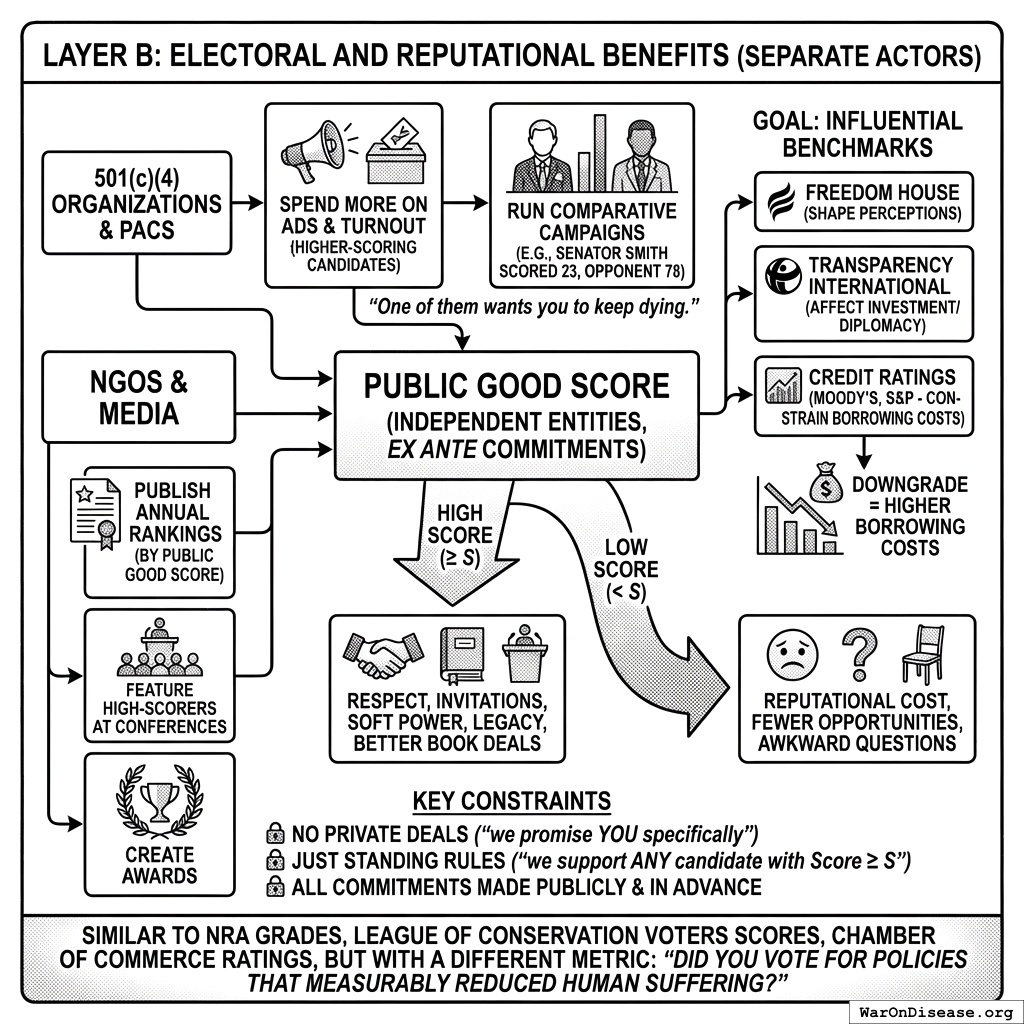
Independent PACs and 501(c)(4)s commit in advance to favor high-scoring politicians. The goal: make the Public Good Score as influential as NRA grades. NRA grades already determine which politicians get funded. Same gun, different target.
Layer C: Post-Office Careers (The Goldman Sachs Board Problem)
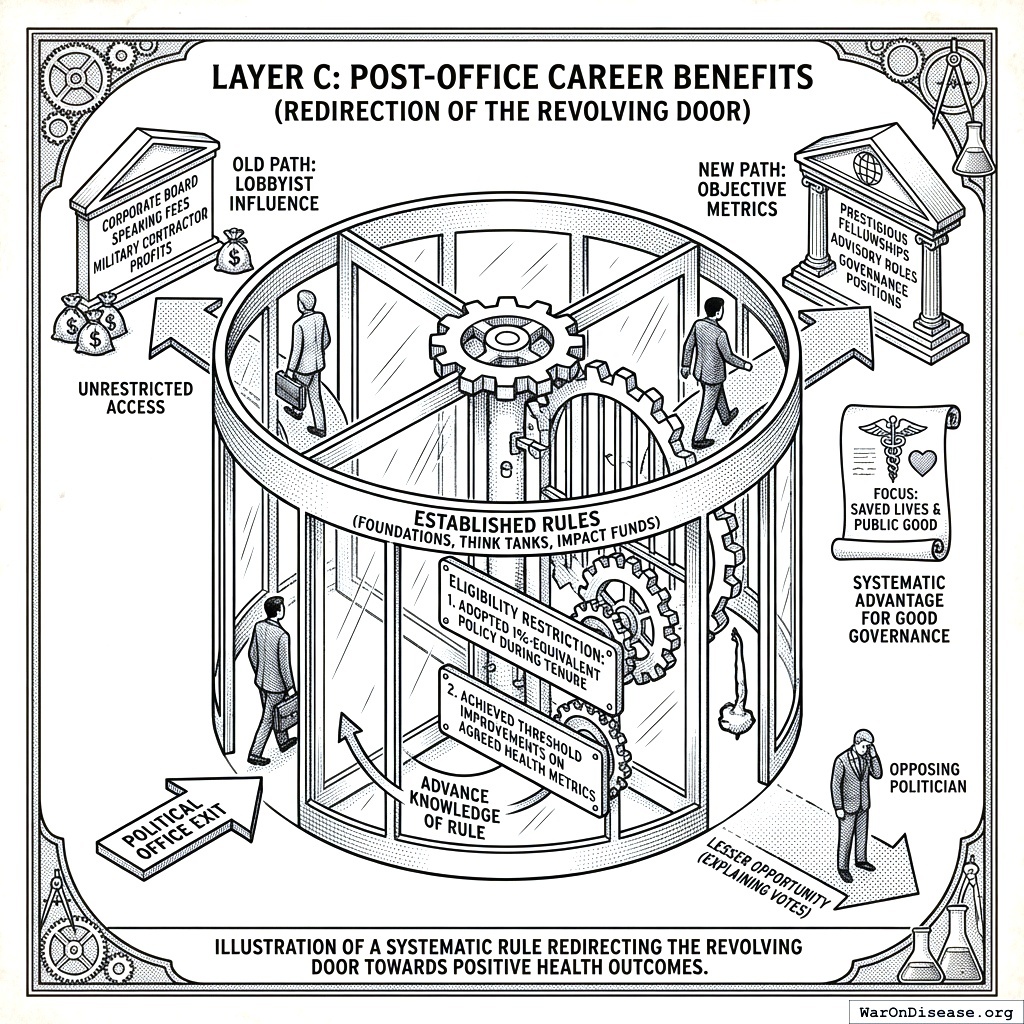
Foundations and think tanks set eligibility rules: score above X gets you WHO boards and Aspen fellowships. Below X, you’re explaining at dinner why you voted against curing diseases. The revolving door, but spinning toward “saved lives” instead of toward whoever paid the most lobbyists.
Legal Entity Separation
| Layer | Entity Type | Can Do | Cannot Do |
|---|---|---|---|
| Scoring | 501(c)(3) research org | Metrics, dashboards, public data | Support/oppose candidates |
| Electoral | 501(c)(4), PAC, Super PAC | Independent expenditures for high-scorers | Coordinate with candidates |
| Post-office | Foundations, think tanks | Set eligibility criteria | Condition grants on specific votes |
Three separate entities that definitely don’t coordinate but somehow all reward the same behavior. Your species invented this structure. Genuinely one of your better ideas (low bar, but still).
Why This Isn’t Bribery
Four reasons your lawyers will stop hyperventilating:
- No one is paid to break a duty. “Do your job better and we’ll tell everyone you did.” That’s a performance review, not a bribe.
- Rules are universal and announced in advance. Same rules, all politicians, all parties. No envelopes in parking garages.
- No money goes to politicians. They benefit indirectly: better scores, electoral support, nicer career options. This is how democracy was supposed to work before your species broke it.
- Scores are based on public voting records. Did they vote YES? Verifiable and ungameable. The 10% fund flows automatically. Pure math.
Bribery corrupts alignment. IABs create it. Wealthy actors already buy policy (pharma: $300M/year, weapons manufacturers: $198 million (95% CI: $190 million-$210 million)/year). The question isn’t “should money influence policy?” but “can you point the money at welfare instead of warfare?”
The structural difference from current lobbying: in the current system, money and influence are inseparable. Give money, get influence over where it goes, use that to get more money. The loop is opaque and self-reinforcing.
IABs break the loop. Investors give money and get money back (10% revenue share). That’s it. They don’t decide which diseases get funded. Politicians get career incentives (10%). They don’t touch the research budget. The remaining 80% flows to clinical trials via wishocratic allocation, controlled by direct democracy, not by the people who paid for it. Corruption capped at 20%, transparent, and completely separated from the medicine money. Name a government budget that can say the same.
Worked Example: How Senator Smith Votes Yes
Abstract mechanisms are great for economists and incomprehensible to everyone who matters. Here’s how IABs work on an actual human politician (a creature that navigates by self-interest, like a moth but with a pension).
The Scoring System
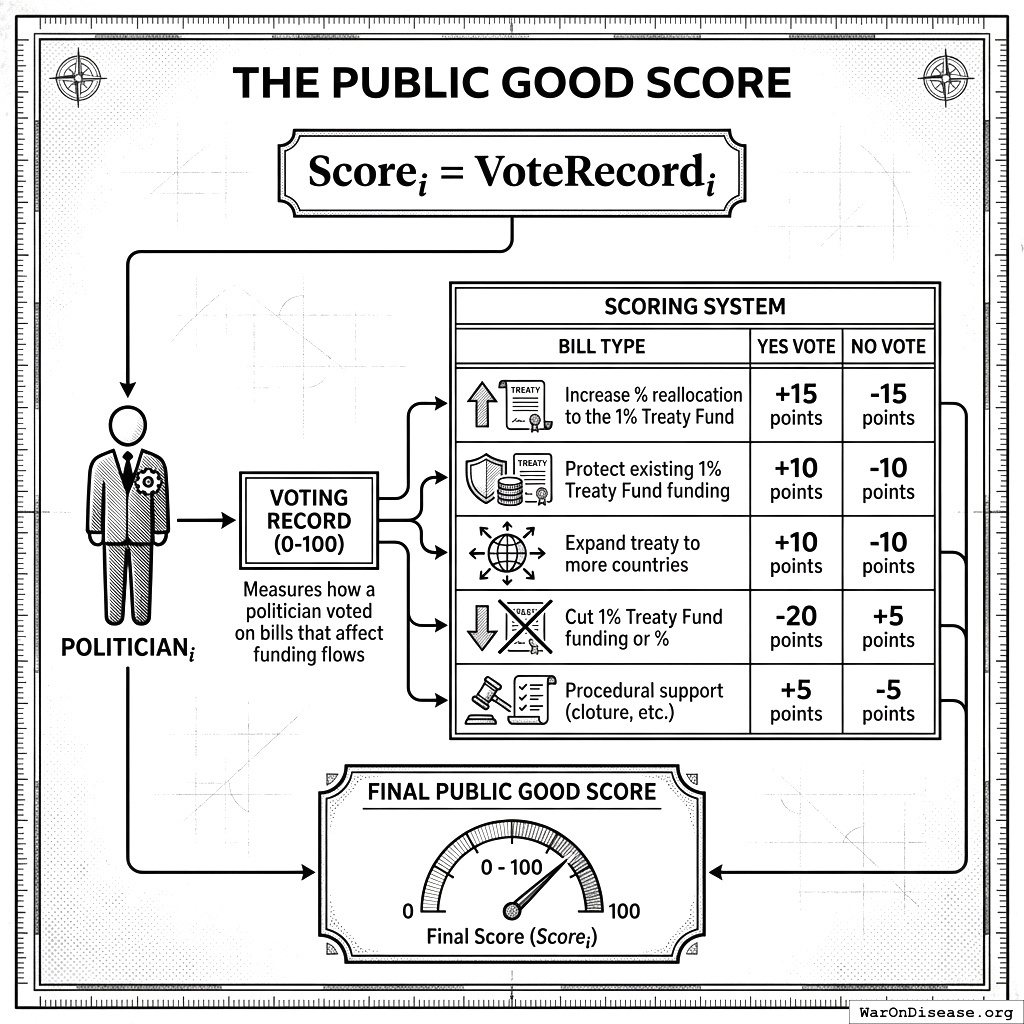
Each politician gets a Public Good Score based on their voting record (like a credit score for your soul, except useful):
| Bill Type | Yes Vote | No Vote |
|---|---|---|
| Increase % reallocation to 1% Treaty Fund | +15 | -15 |
| Protect existing funding | +10 | -10 |
| Expand treaty to more countries | +10 | -10 |
| Cut funding or % | -20 | +5 |
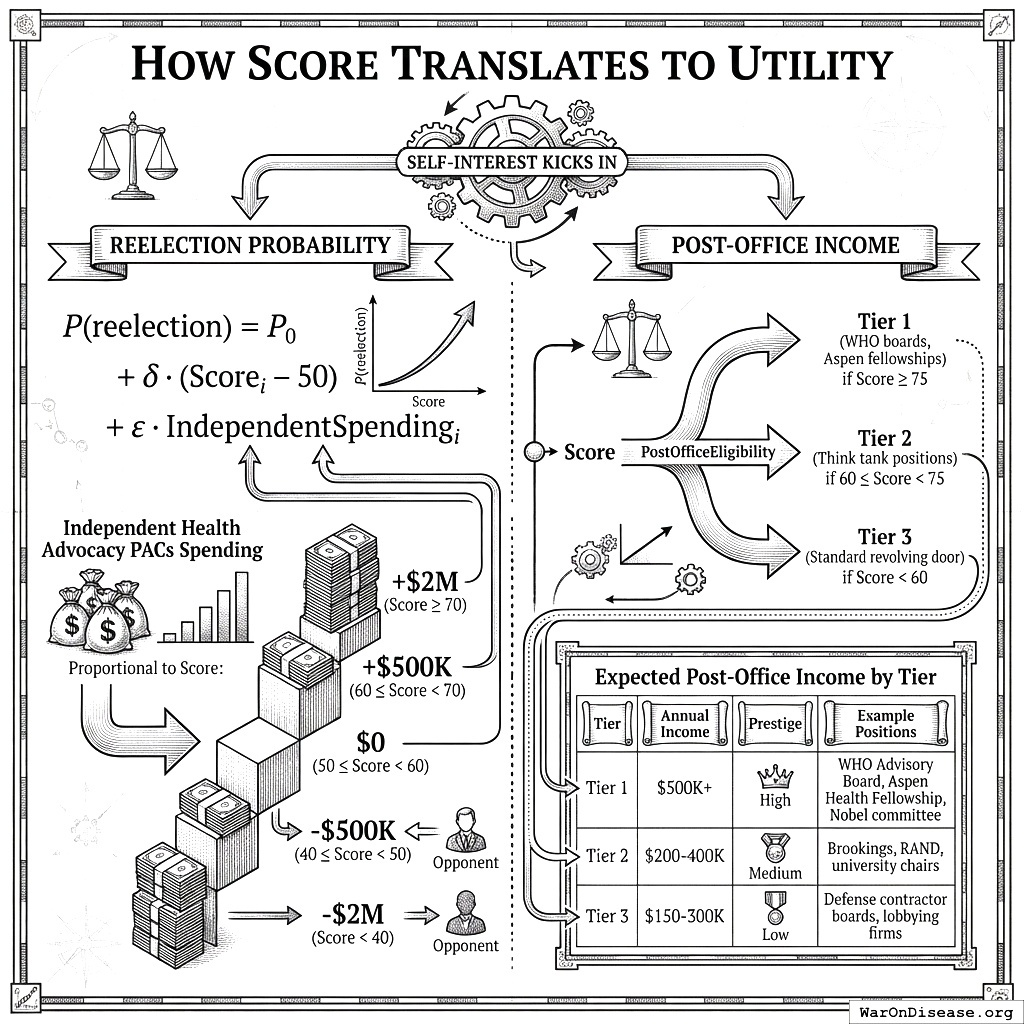
Your score determines what you get:
| Score | PAC Spending | Post-Office Tier | Annual Income |
|---|---|---|---|
| 75+ | +$2M for you | Tier 1: WHO boards, Aspen fellowships | $500K+ |
| 60-74 | +$500K for you | Tier 2: Brookings, RAND, university chairs | $200-400K |
| 50-59 | $0 | Tier 3: Standard revolving door | $150-300K |
| 40-49 | $500K to opponent | Tier 3 | $150-300K |
| <40 | $2M to opponent | Tier 3 | $150-300K |
In short: high scorers get millions in PAC support and access to the best post-office careers. Low scorers watch that same money go to their opponents. It’s like a video game skill tree, except the XP comes from not killing people.
The Setup
VICTORY Incentive Alignment Bonds have raised $1 billion from investors who want 272% returns. That money has funded:
- A referendum showing 70% of Americans support reallocating 1% of military spending to pragmatic clinical trials
- A lobbying campaign that’s converted several weapons manufacturers (they did the math on their own mortality, and mortality lost)
- The Public Good Scoring system described above, tracking every federal legislator
Senator Smith (R-Texas) is up for reelection in 2026. The 1% Treaty Implementation Act is coming to a vote.
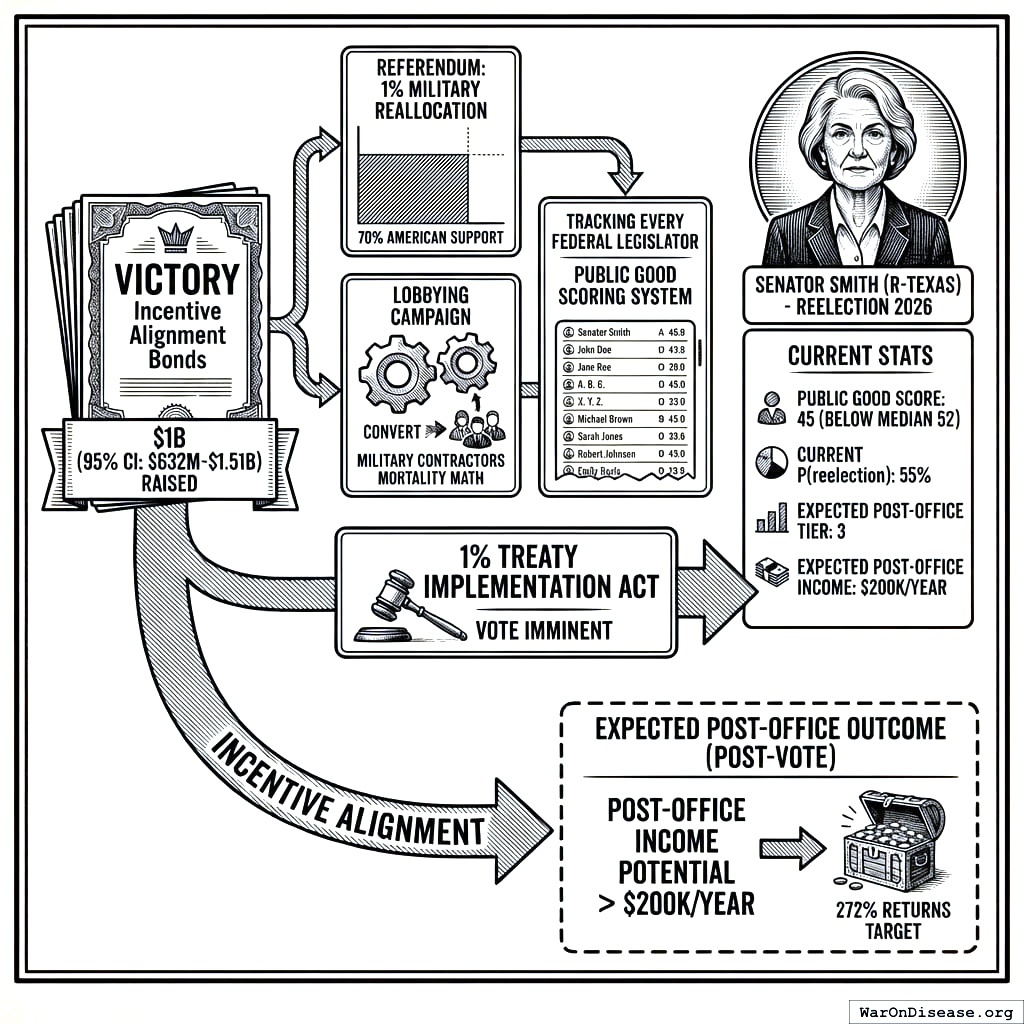
Her current stats:
- Public Good Score: 45 (below Senate median of 52)
- Current P(reelection): 55%
- Expected post-office tier: 3
- Expected post-office income: $200K/year
The Old Calculus (Without IABs)
| Vote Yes | Vote No |
|---|---|
| Attack ads: “Smith voted to WEAKEN AMERICA” | Safe from military lobby attacks |
| Military contractors fund opponent | Military contractors fund you |
| No immediate upside | Status quo maintained |
| Benefits arrive in 10 years | Costs arrive never |
Expected utility of No vote: \(\text{U} = 0.55 \cdot \text{Office} + \$200\text{K}/\text{year} \cdot 20\text{yrs} + \text{Medium Legacy}\)
Result: Vote no. Obviously.
The New Calculus (With IABs)
If Smith votes YES:
- VoteRecord: +15 points (major treaty vote)
- New Score: 45 + 15 = 60, rising to 72 with the early-supporter multiplier (the scoring system rewards politicians who vote yes before the outcome is certain)
- P(reelection): 55% → 62% (score boost + $500K independent support)
- Post-office tier: 3 → 2 (with path to Tier 1 if she becomes a champion)
- Expected post-office income: $200K → $300K/year
If Smith votes NO:
- VoteRecord: -15 points
- New Score: 45 - 15 = 30
- P(reelection): 55% → 48% (score penalty + $2M goes to opponent)
- Post-office tier: Stuck at 3
- Attack ads funded: “Smith voted AGAINST the cure your family needs”
The math (at the moment of the vote):
\[ \Delta \text{U}_{\text{Yes vs No}} = 0.14 \cdot \text{Office} + \$100\text{K}/\text{year} \cdot 20\text{yrs} + \text{Legacy Boost} \]
That’s a +14 percentage point swing in reelection odds (62% vs 48%) and +$2M in lifetime post-office earnings. These numbers improve further after the treaty passes (see post-treaty table below).
Result: Vote yes. The math changed.
What Actually Happens
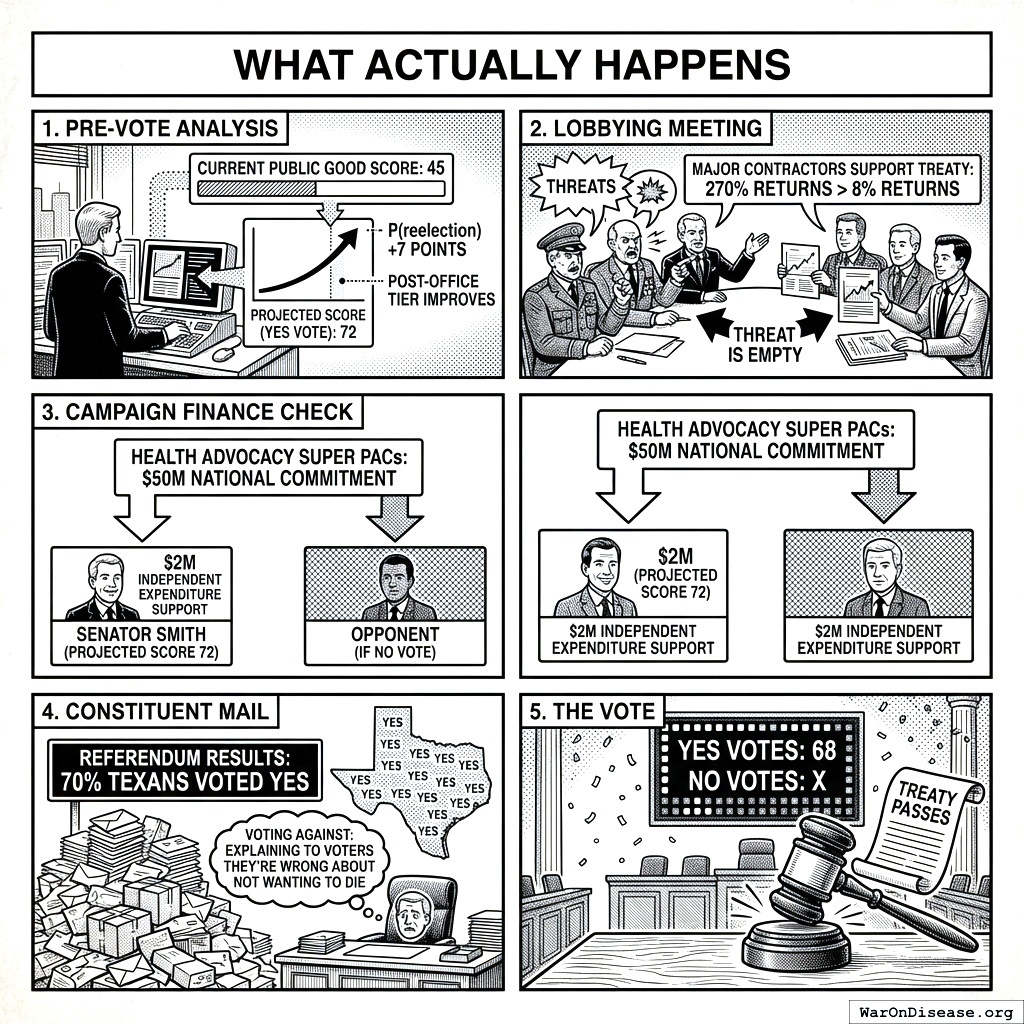
- Pre-vote: Smith’s staff models the yes vote. Score jumps to 72. Reelection odds rise 7 points.
- Lobbying meeting: Military lobby threatens. But three major contractors already support the treaty (their market is shrinking 1%, the health market is growing, and the bond returns make their pension funds very happy). Threat is empty.
- Campaign finance: Health advocacy Super PACs have committed $50M nationally. At score 72, she gets $500K in independent support. A no vote sends that $500K to her opponent.
- Constituent mail: 70% of Texans voted yes in the referendum. Voting against that means explaining why you think they’re wrong about not wanting to die.
- The vote: Smith votes yes. So do 50 others. The bill passes the Senate.
Post-Treaty
After the treaty passes and public support solidifies, Smith’s numbers improve beyond the initial vote-day projections. Her score climbs from 72 to 78 as she co-sponsors expansion legislation and the early-supporter multiplier compounds. That pushes her into Tier 1 territory.
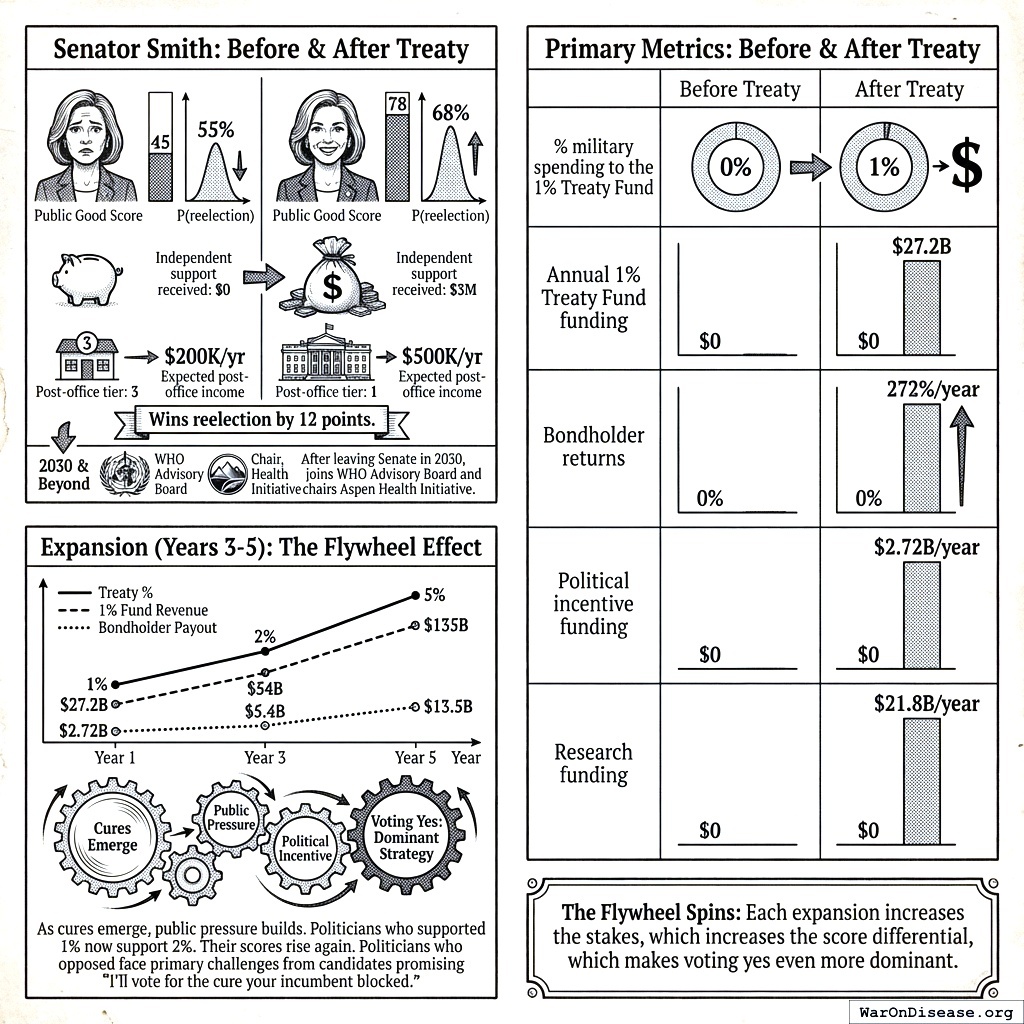
| Metric | Before | After |
|---|---|---|
| Public Good Score | 45 | 78 |
| P(reelection) | 55% | 68% |
| Independent support | $0 | $3M |
| Post-office tier | 3 | 1 |
| Post-office income | $200K/yr | $500K/yr |
Every metric jumps: score up 70%, reelection odds up 13 points, $3M in independent support, post-office income more than doubled.
Smith wins reelection comfortably. Joins the WHO Advisory Board. Chairs the Aspen Health Initiative. All because she did math instead of listening to lobbyists. Politicians can count. They just need something worth counting.
The Revenue Split
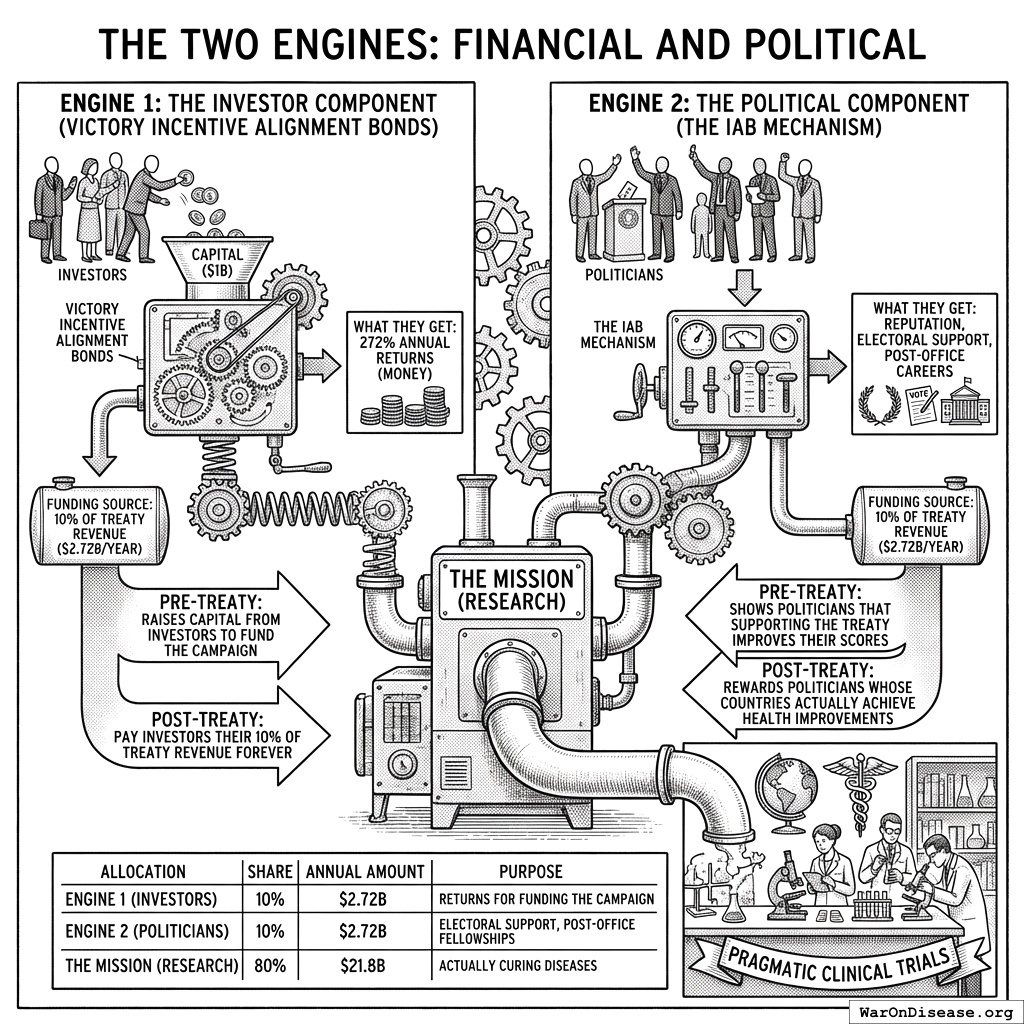
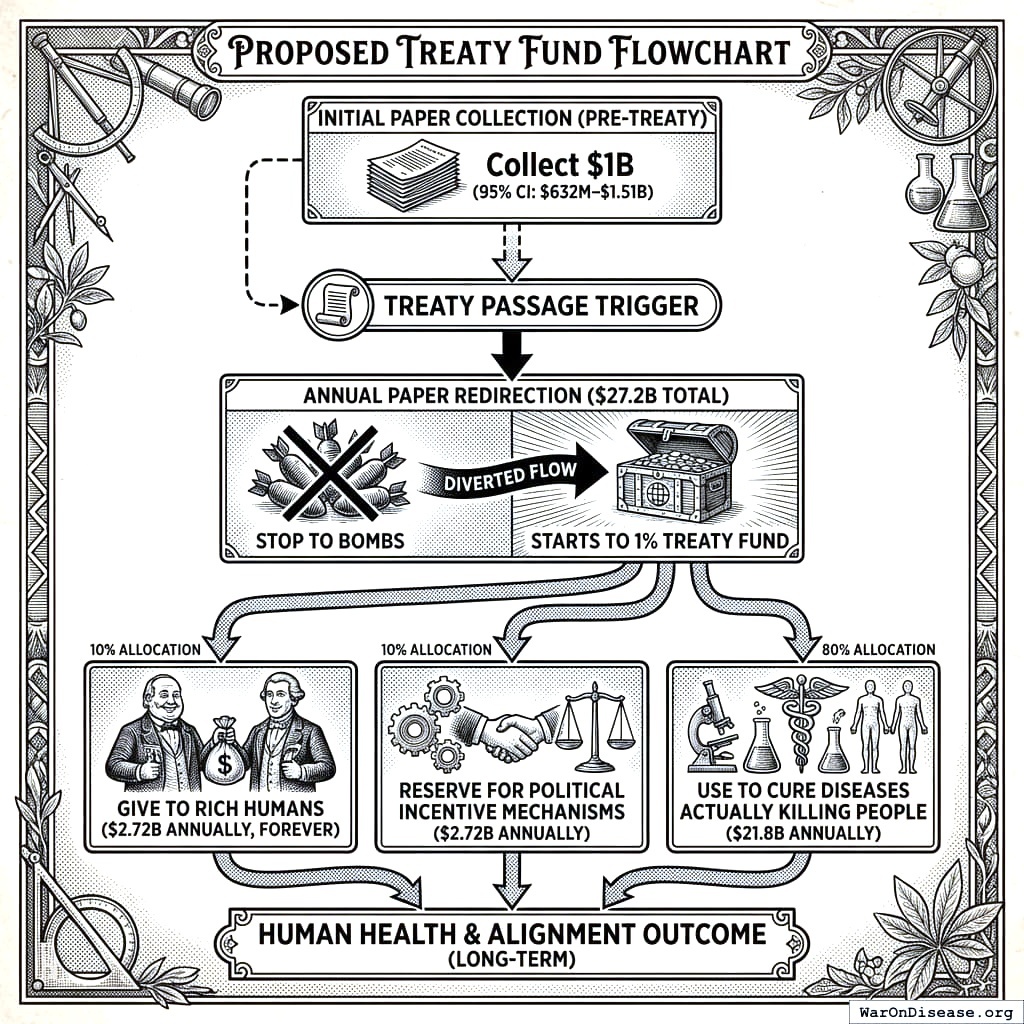
Incentive Alignment Bonds raise the capital and align the politicians. Treaty revenue splits three ways: 10% to investors ($2.72 billion), 10% to political incentives ($2.72 billion), 80% to the part that actually funds treatments ($21.8 billion).
Everyone profits from treaty expansion. The rare financial instrument where “everyone profits” might actually be true (if the treaty holds).
Why 10% Goes to Political Incentives
Your 1% Treaty is the proof of concept. The endgame is redirecting most of murder money to health. That doesn’t happen automatically. Without sustained political pressure, the treaty stalls at 1% forever, like every other agreement your species has signed and quietly forgotten about.
The 10% allocation creates a political ratchet that only moves one direction:
| Treaty Level | Bondholder Payouts (10%) | Political Incentives (10%) | Research Funding (80%) | Effect |
|---|---|---|---|---|
| 1% | $2.72 billion/year | $2.72 billion/year | $21.8 billion/year | Politicians rewarded for passage |
| 5% | $13.6B/year | $13.6B/year | $108.8B/year | Military industry pivots to health |
| 10% | $27.2B/year | $27.2B/year | $218B/year | Health lobbying starts to rival military lobbying |
| 50% | $136B/year | $136B/year | $1.09T/year | Health lobbying dominant |
| 100% | $272B/year | $272B/year | $2.18T/year | Full redirection achieved |
Every expansion multiplies the political incentive budget, the research funding, and bondholder payouts. “Support pragmatic clinical trials” becomes the single most profitable opinion a politician can hold. That’s how you change what politicians believe: make the belief profitable.
The bondholder constituency. IABs create the military lobby’s mirror image: a permanent class of wealthy investors whose income scales with treaty expansion. At 1%, bondholders collect $2.72 billion/year. At full redirection, $272B/year. Perpetual bonds mean a perpetual incentive to lobby for expansion, every year, forever. Except these lobbyists have better math and a more popular product (“not dying” polls well).
Without IABs:
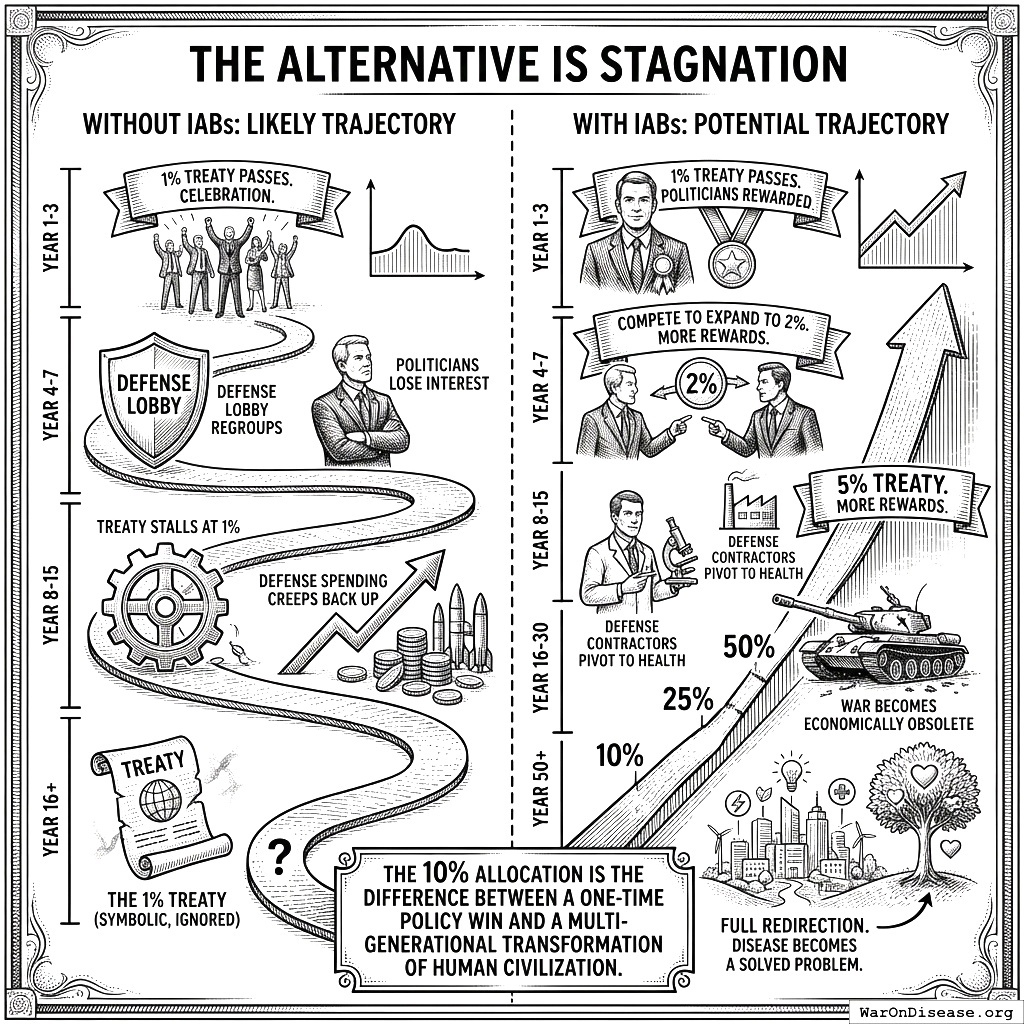
- Year 1-3: Treaty passes. Celebration. Champagne.
- Year 4-7: Military lobby regroups. No expansion. Champagne goes flat.
- Year 16+: Treaty becomes another Paris Agreement. Nice symbol. Everyone ignores it. Champagne was wasted.
With IABs:
- Year 1-3: Treaty passes. Politicians rewarded.
- Year 4-7: Politicians compete to expand to 2%.
- Year 8-15: 5% treaty. Military contractors pivot.
- Year 50+: Full redirection. Disease: solved.
The 10% isn’t a cost. It’s the engine. Without it, you get a one-time win. With it, you get compounding political pressure that makes each expansion easier than the last.
Beyond the 1% Treaty
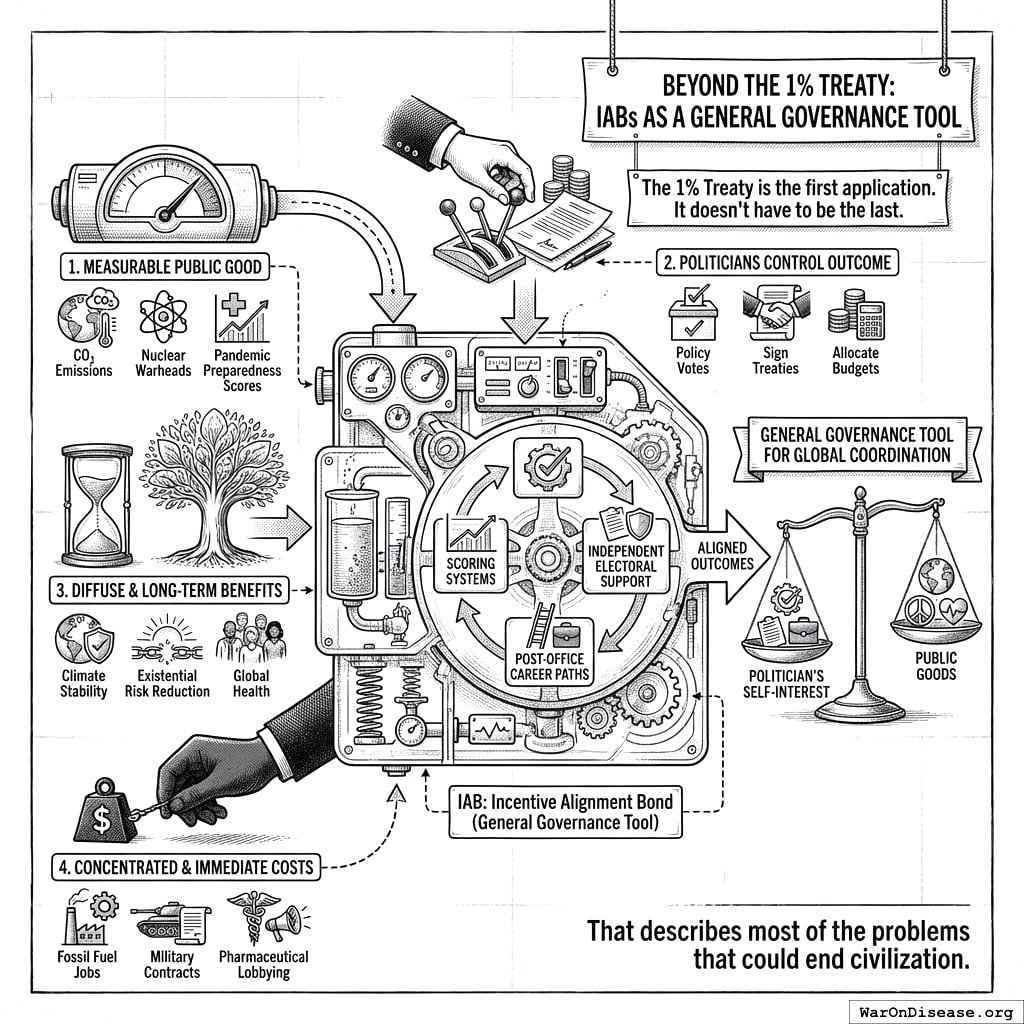
The same architecture works for any global coordination problem where: the public good is measurable, politicians control the outcome, benefits are diffuse, and costs are concentrated. That describes most of the problems that could end your civilization, which is a worryingly long list:
| Domain | Metric (already exists) | IAB Makes Career-Optimal |
|---|---|---|
| Climate | UNFCCC emissions data | “Vote for emissions cuts” |
| Nuclear | START treaty warhead counts | “I reduced our arsenal” |
| Pandemic | WHO Joint External Evaluation | “I funded preparedness” |
Same pattern every time: existing metric, scoring system, electoral support for high-scorers, cushy jobs for leaders who governed well. See the academic paper if you enjoy equations.
The sections above explain why IABs work. The sections below explain why you should buy them. If you prefer not dying AND getting rich, keep reading.
The Investor Pitch
A financial instrument that generates 272% annually while accidentally curing diseases as a side effect.
The offer: 272% annually, funded by a share of treaty revenue. That number looks absurd. It should. It’s the premium for betting on politicians doing something useful, which is historically a bad bet, but the payout if it works is real.
The money doesn’t stop. No maturity date. Bondholders get paid as long as the treaty exists, which could be until the sun explodes or humanity achieves immortality. Whichever comes first. (Bet on the immortality thing. That’s what the bonds are for.)
“If the treaty holds” is doing a lot of work in that sentence, so: the treaty creates a class of billionaire bondholders whose personal wealth depends on it surviving and expanding. These are people with enormous pre-existing influence over government (media access, campaign donations, board seats at companies that employ voters). They didn’t buy influence over the treaty fund. They bought a revenue share. But their pre-existing influence means any politician who tries to repeal the treaty is picking a fight with the richest humans on the planet, all of whom have a quarterly earnings call explaining why the treaty should be bigger, not smaller.
The Perpetuity Math
VICTORY Incentive Alignment Bonds never mature. They keep paying as long as the treaty exists. Lifetime value uses the perpetuity formula, which is finance-speak for “money printer that runs as long as the input does”:
\[ \text{Total Value} = \frac{\text{Annual Payment}}{\text{Discount Rate}} = \frac{\$2.72\text{B}}{r} \]
Even if you’re extremely pessimistic
| How Skeptical You Are | Total Lifetime Value | Your $1 billion Becomes |
|---|---|---|
| Mildly skeptical (3% discount) | $90.7B | 90x your money |
| Pretty skeptical (5% discount) | $54.4B | 54x your money |
| Very skeptical (10% discount) | $27.2B | 27x your money |
Even at a 10% discount rate (as risky as funding a Mars casino), your $1 billion becomes worth $27.2B.
As long as humans prefer being alive to being dead, the treaty exists. As long as the treaty exists, you get paid. As long as you get paid, you make sure the treaty keeps existing. A loyalty program for civilization, except the rewards are real and the members are billionaires with senators on speed dial.
Security Package and Risk
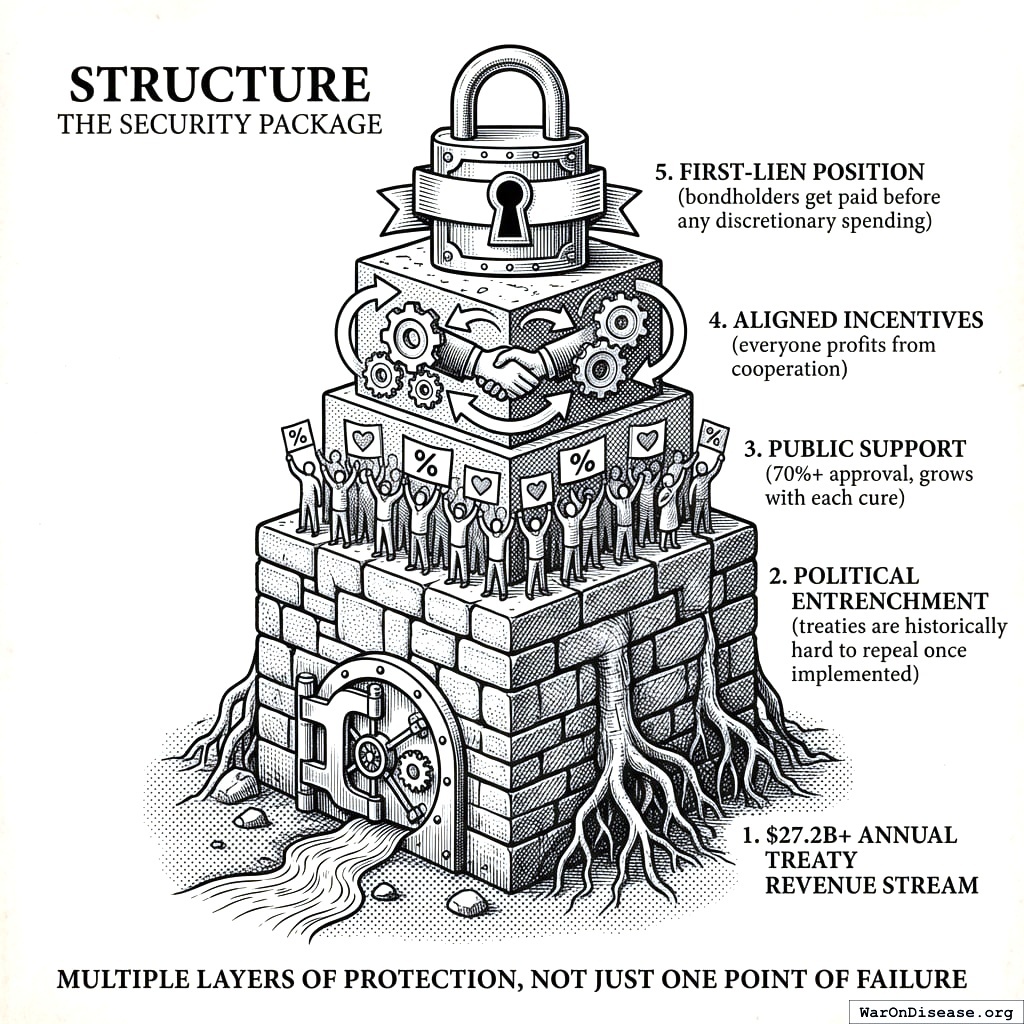
Five layers of “you’ll get paid”:
- $27.2 billion+ annual treaty revenue stream (starts year 1 if treaty passes)
- Political entrenchment (treaties are historically hard to repeal once implemented, unlike New Year’s resolutions)
- Public support (70%+ approval, grows with each breakthrough)
- Aligned incentives (everyone profits from cooperation)
- First-lien position (bondholders get paid before anyone else touches the money)
Two categories of risk (both involving trusting humans, which is historically unwise):
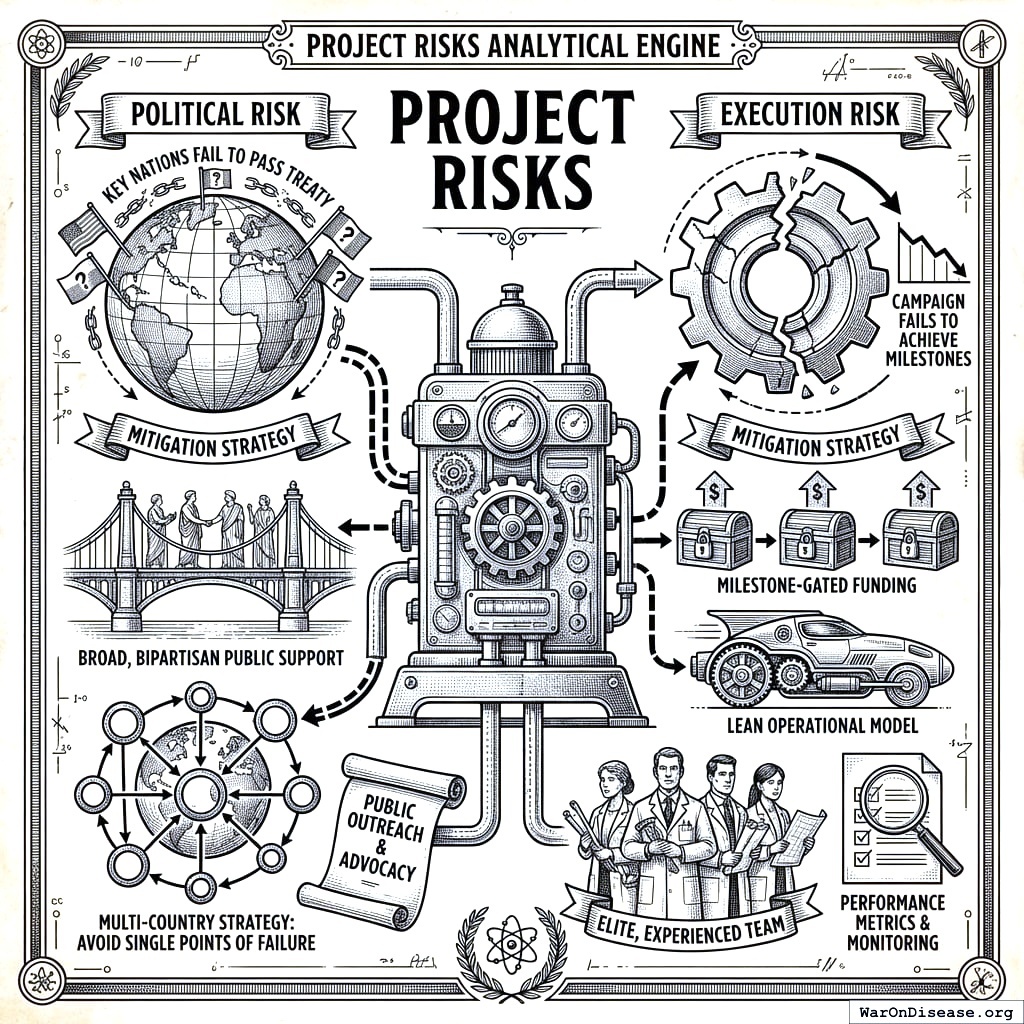
Project Risks
- Political Risk: The treaty may fail to pass because politicians prefer the status quo to political risk. Mitigation: broad bipartisan support, multi-country strategy, no single points of failure.
- Execution Risk: The campaign may fail to hit milestones. Mitigation: milestone-gated funding, lean operations, and competent humans (finding those is itself a risk).
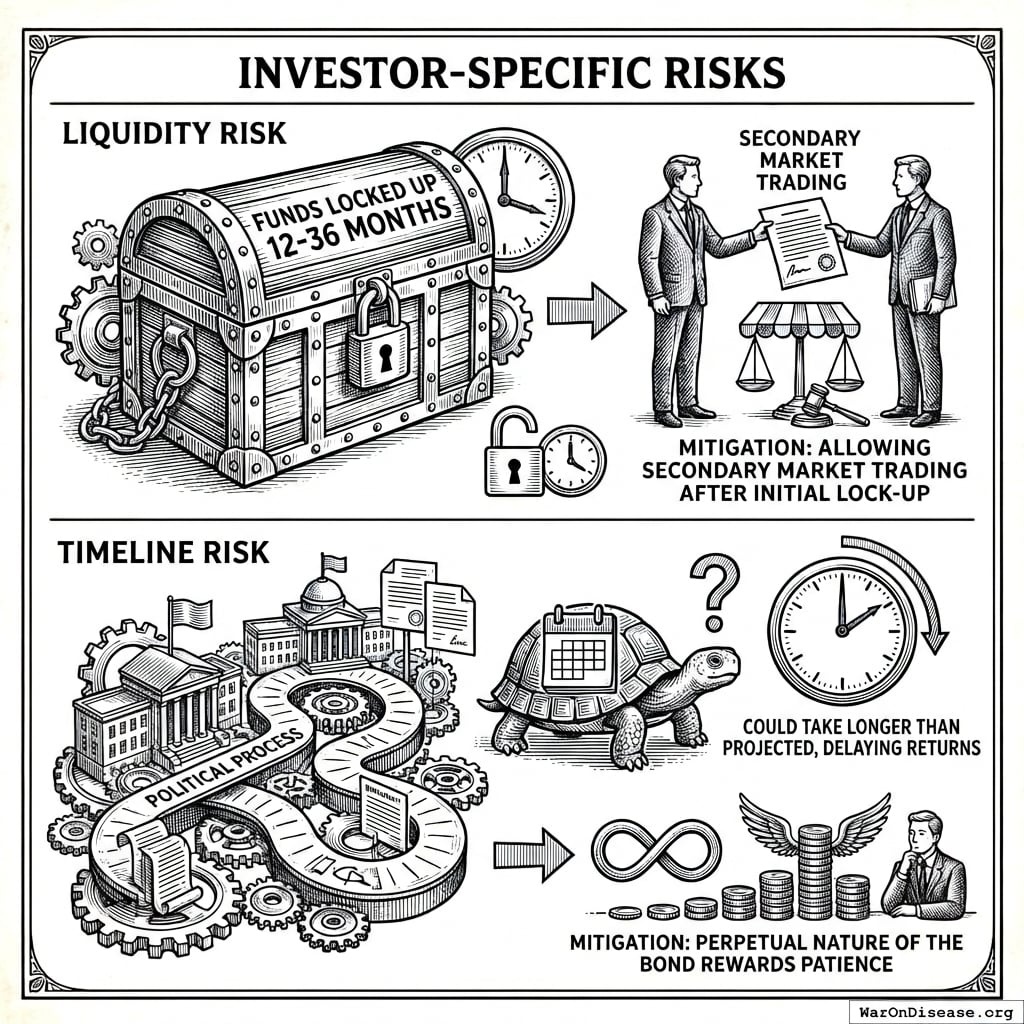
Investor-Specific Risks
- Liquidity Risk: Funds locked 12-36 months during the campaign phase (roughly how long it takes to convince politicians that living voters are better than dead ones). Mitigation: secondary market trading after lock-up.
- Timeline Risk: Politicians could take longer than projected. They are famously slow at everything except accepting donations. The perpetual nature of the bond rewards patience.
How It Compares (If It Works)
| Investment | Annual Return | Risk | Term | Catch |
|---|---|---|---|---|
| VICTORY Incentive Alignment Bonds | 272% | High (binary: treaty passes or it doesn’t) | Forever | Requires politicians to act rationally |
| Savings Account | 0.5% | None | Whenever | Loses to inflation |
| S&P 500 | Moderate | Whenever | Boring, responsible | |
| Real Estate | 8% | Moderate | 30 years | Requires being a landlord |
| Venture Capital | 15-25% | Extreme | 7-10 years | Requires picking winners |
| Hedge Funds | 8-15% | High | Lock-ups | Requires being rich already |
| Medallion Fund | 39%3 | Extreme | N/A | Closed to mortals |
| Warren Buffett | 20%4 | Moderate | 60 years | Requires being Warren Buffett |
Fine print: The 272% is a revenue-share return on campaign capital, not a market return on traded securities. You’re funding a political campaign; the return is a permanent share of treaty revenue if it succeeds. The other investments in this table are liquid and diversified. This one is concentrated and binary. The return is enormous because the risk is enormous. If the treaty fails, you lose your money. If politicians prefer dead constituents to living ones, that’s exactly what happens. But you’ll be too dead from preventable diseases to notice.
If you believe the treaty can pass, the risk-adjusted return is compelling. If you don’t, no return percentage will convince you. But before you decide, try answering five questions. Is it physically possible to improve how your species allocates $2.72 trillion/year? Does redirecting even 1% compound into everyone being 56.7x (90% CI: 21x-148x) richer? Do you have a better mechanism? If not, the only remaining question is whether you’re the first mover who triggers the dominant assurance contract, or whether you wait for someone else, which is the coordination failure the entire instrument was designed to solve.
Investment Thresholds and Term Sheet
Lock-up: 12-36 months until the treaty passes. Then perpetual distributions begin, like a dividend that outlives you.
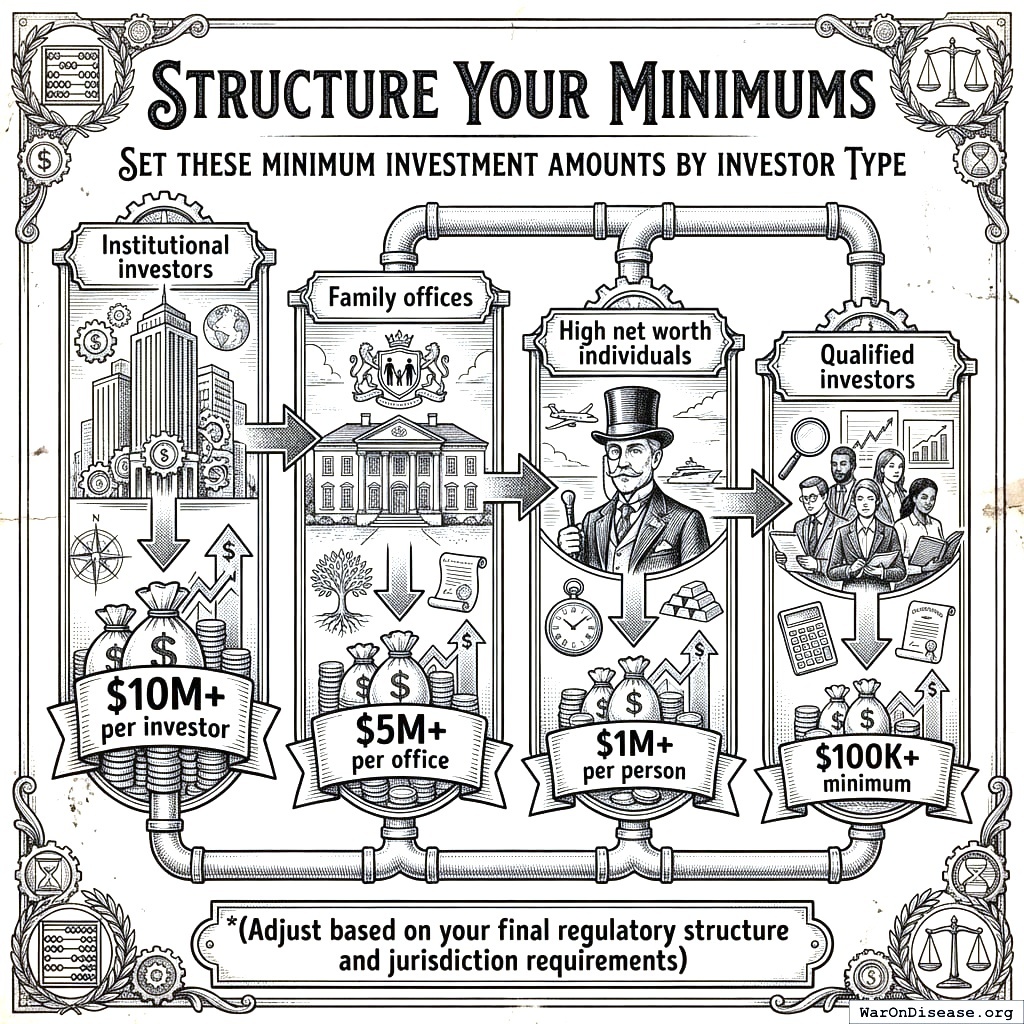
Minimum investment amounts by investor type (your species requires gatekeeping even for saving itself):
- Institutional investors: $10 million+ per investor
- Family offices: $5 million+ per office
- High net worth individuals: $1M+ per person
- Qualified investors: $100K+ minimum
(Have lawyers review, this is illustrative only)
- Interest rate: 0% (all returns via revenue share model)
- Revenue share: 10% of all treaty inflows
- Term: Perpetual (no maturity date)
- Payment frequency: Annual distributions
- Default provisions: Transparent reporting, third-party audits
- Transferability: Tradable on secondary market after 12 months
- Governance: Transparent reporting and third-party audits. Bondholders receive money, not influence.
“This sounds like a Ponzi scheme run by someone who failed math.”
“Ponzi schemes pay old investors with new investor money. That’s why they collapse. This pays investors with a share of $27.2 billion in annual revenue. That revenue comes from redirecting 1% of military budgets via treaty.
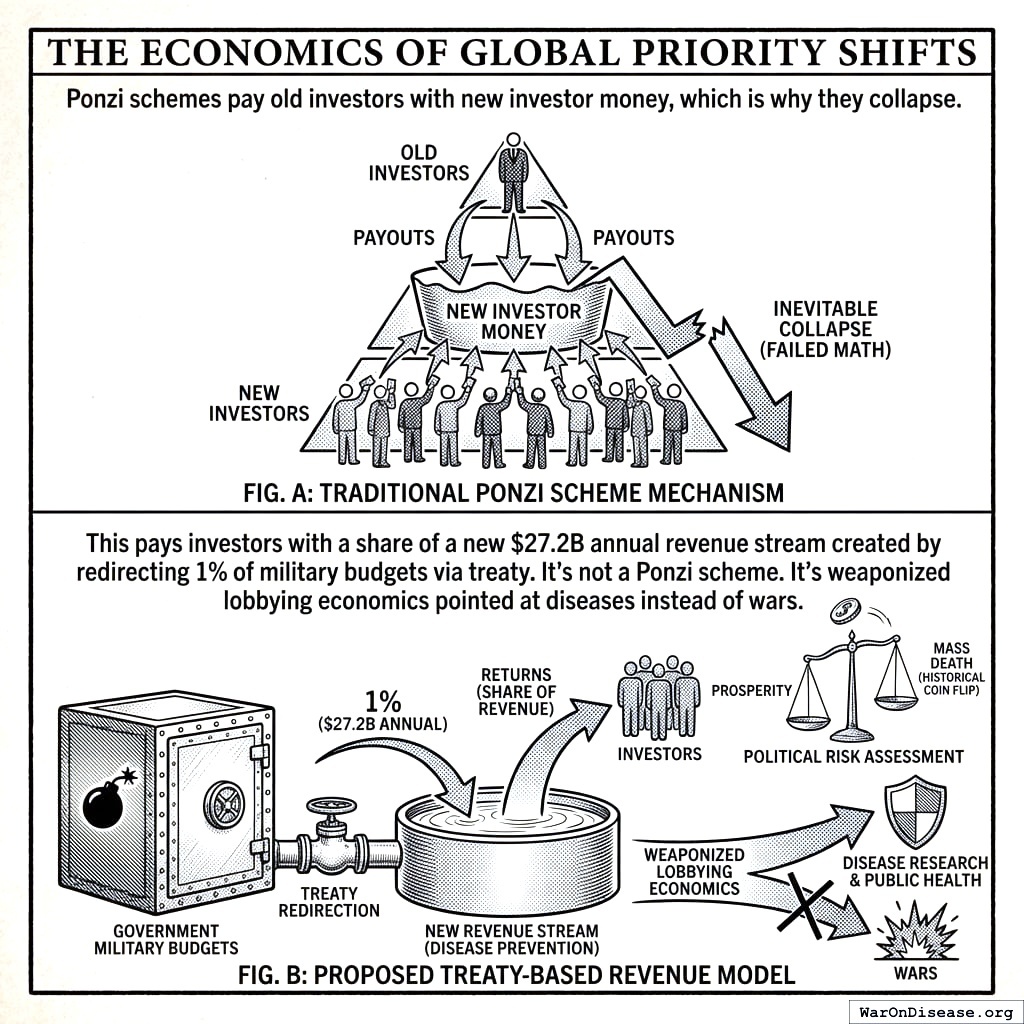
The money comes from governments that currently spend it on bombs. The returns are high because the political risk is high. You’re betting politicians will act rationally when shown the numbers. Historically, that’s a coin flip at best.
It’s not a Ponzi scheme. It’s lobbying economics pointed at diseases instead of wars. Same weapon, different enemy.”
“Won’t politicians game the metrics?”
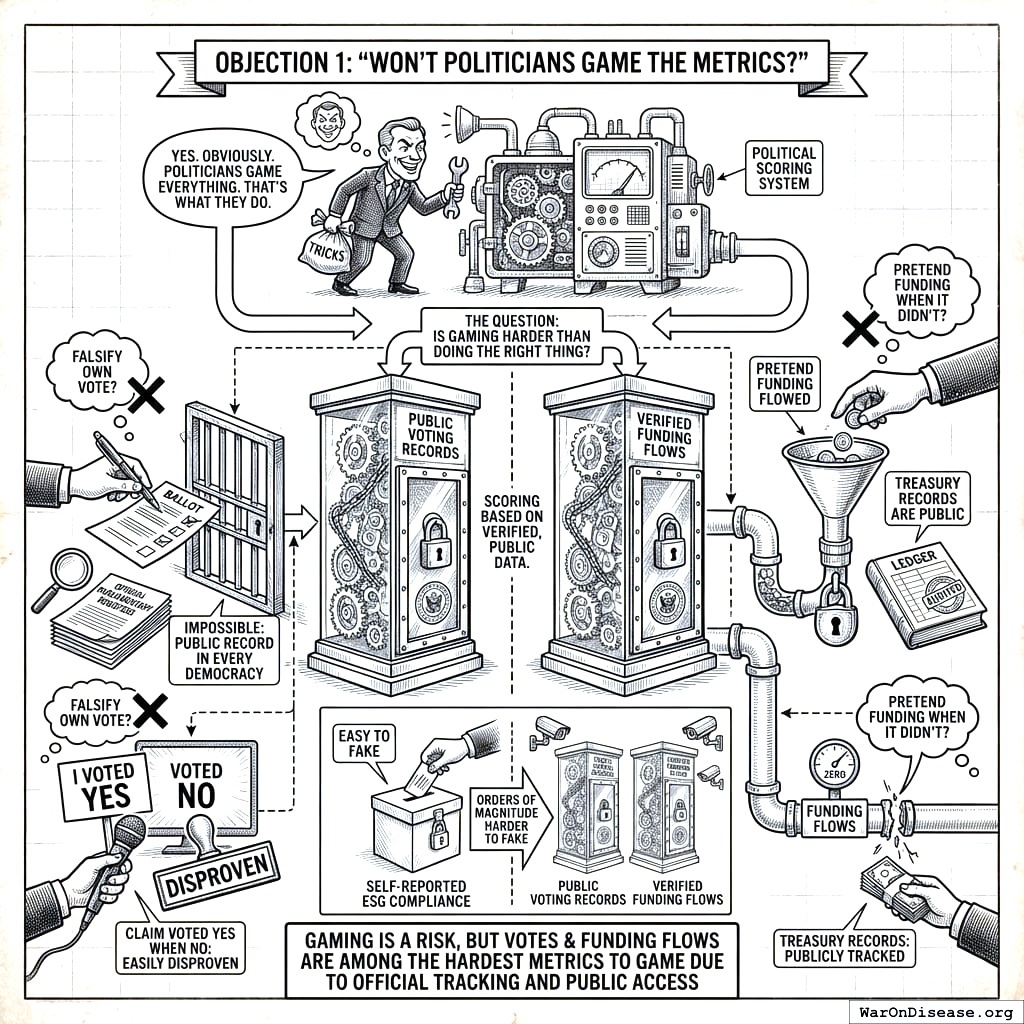
To game these metrics, you’d have to falsify your own vote (public record) or pretend money moved when it didn’t (treasury records). Orders of magnitude harder than self-reported ESG compliance, which is the bar your species currently uses.
“What if politicians reverse the policy?”
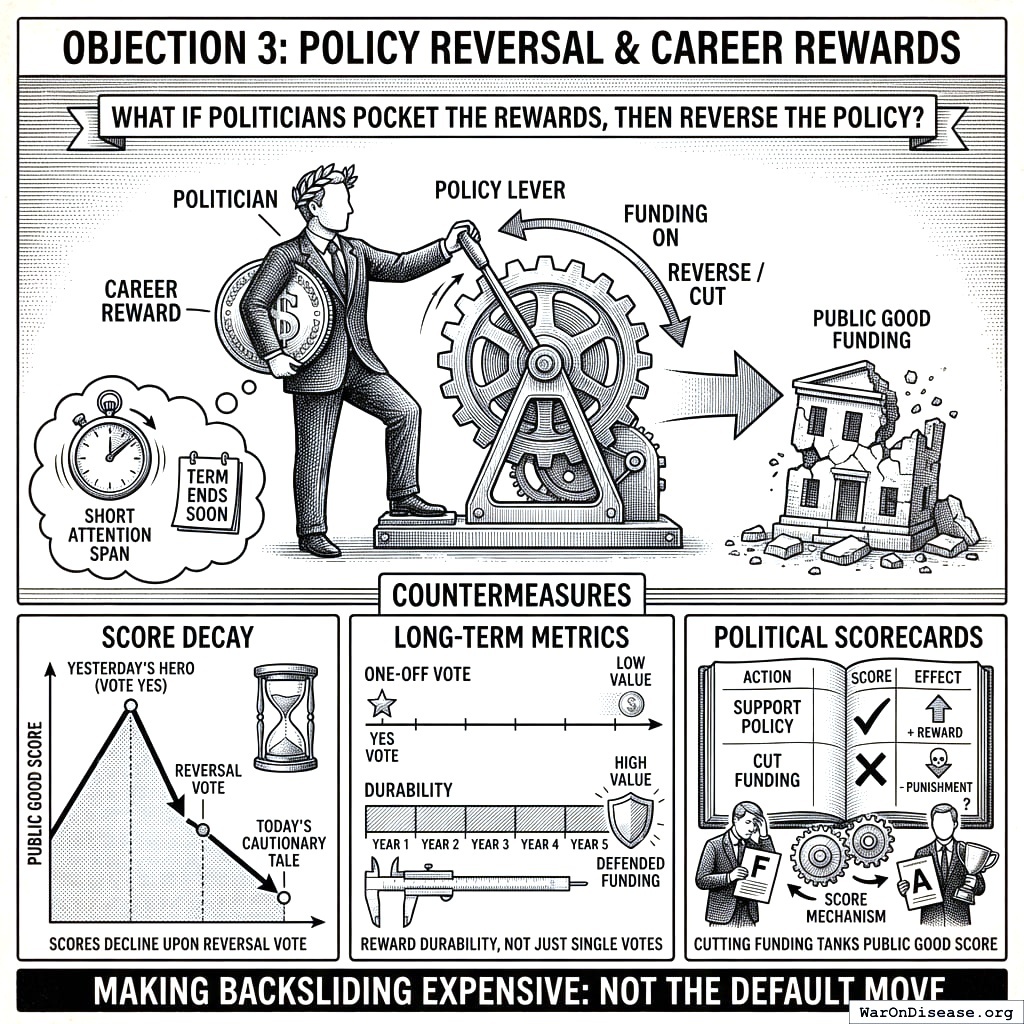
Score decay. The same scoring that rewarded you punishes backsliding, making reversals career suicide (the only kind of death politicians fear).
“What happens when this fails and I lose my billion dollars?”
“If the treaty fails completely, you lose your $1 billion. It gets spent on the campaign. Convincing humans to click buttons. Bribing lobbyists. Building platforms. Paying lawyers to make bribery legal.
This is the primary risk. You’re funding a lobbying campaign with a massive payout if it wins.
If it fails completely, you’ll probably die of a preventable disease anyway. You won’t be around to complain about the lost money.
It’s venture capital but for not dying.”
“Is this realistic globally?”
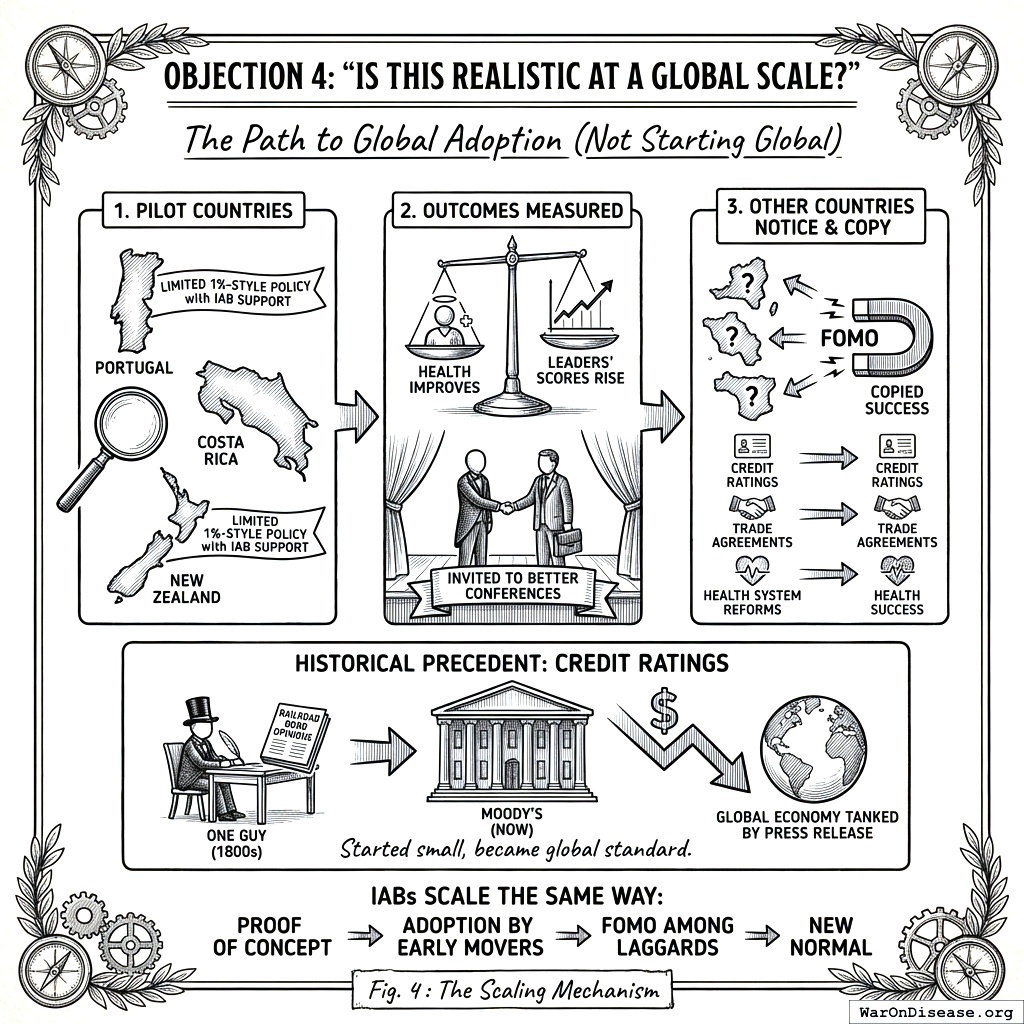
Doesn’t have to start global. One or two pilot countries (Portugal, Costa Rica, New Zealand) adopt a limited 1%-style policy. Funding flows get verified. Leaders get invited to better conferences. Other countries notice. FOMO takes over. FOMO is the most powerful force in international relations, more powerful than diplomacy, trade agreements, or nuclear weapons.
Credit ratings started as one guy in the 1800s publishing opinions about railroad bonds. Now Moody’s can tank a country’s economy with a press release. Same path: proof of concept, early movers, FOMO, new normal. Your species is remarkably good at copying things that work, once someone else does it first.
“How is this different from just donating to charity?”
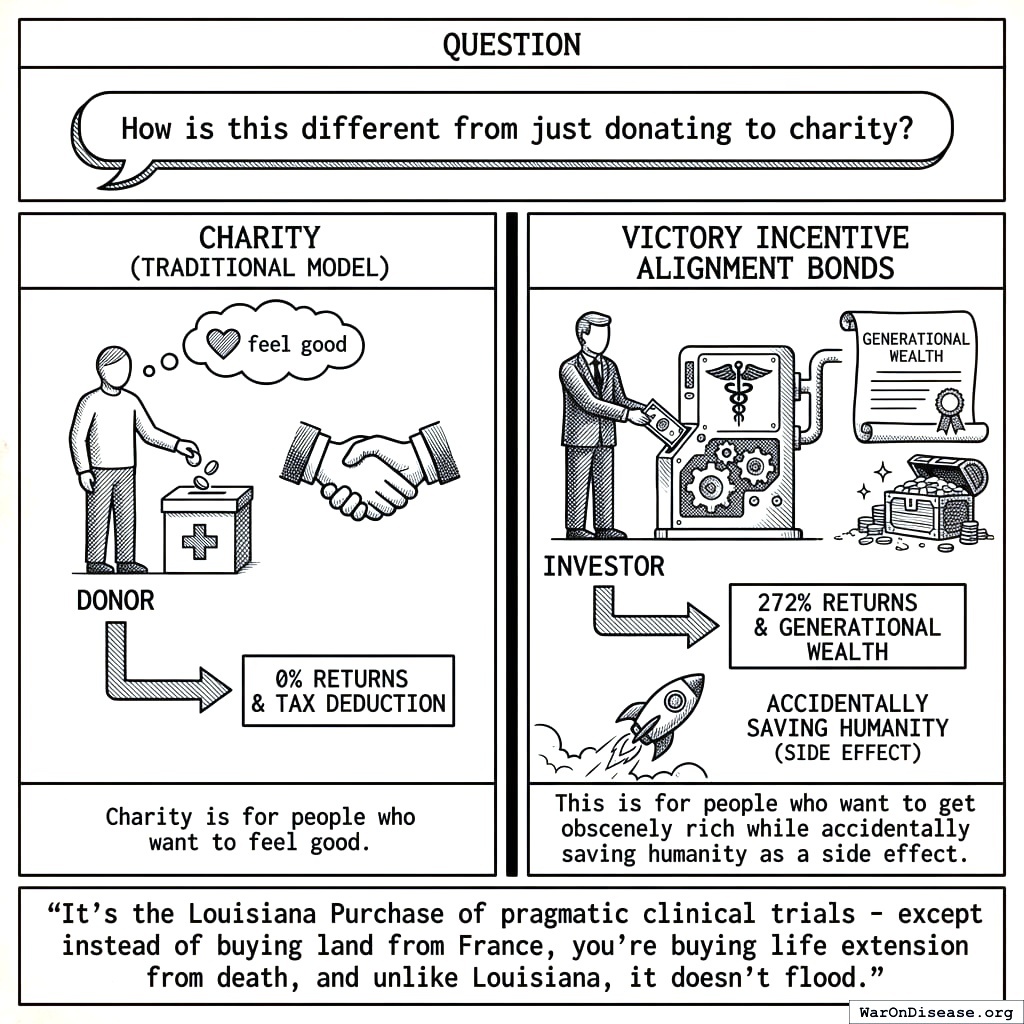
Charity is for people who want to feel good. This is for people who want to get obscenely rich while curing diseases as a side effect. The Louisiana Purchase of pragmatic clinical trials. Except instead of buying land from France, you’re buying life extension from death. And unlike Louisiana, it doesn’t flood.
Summary
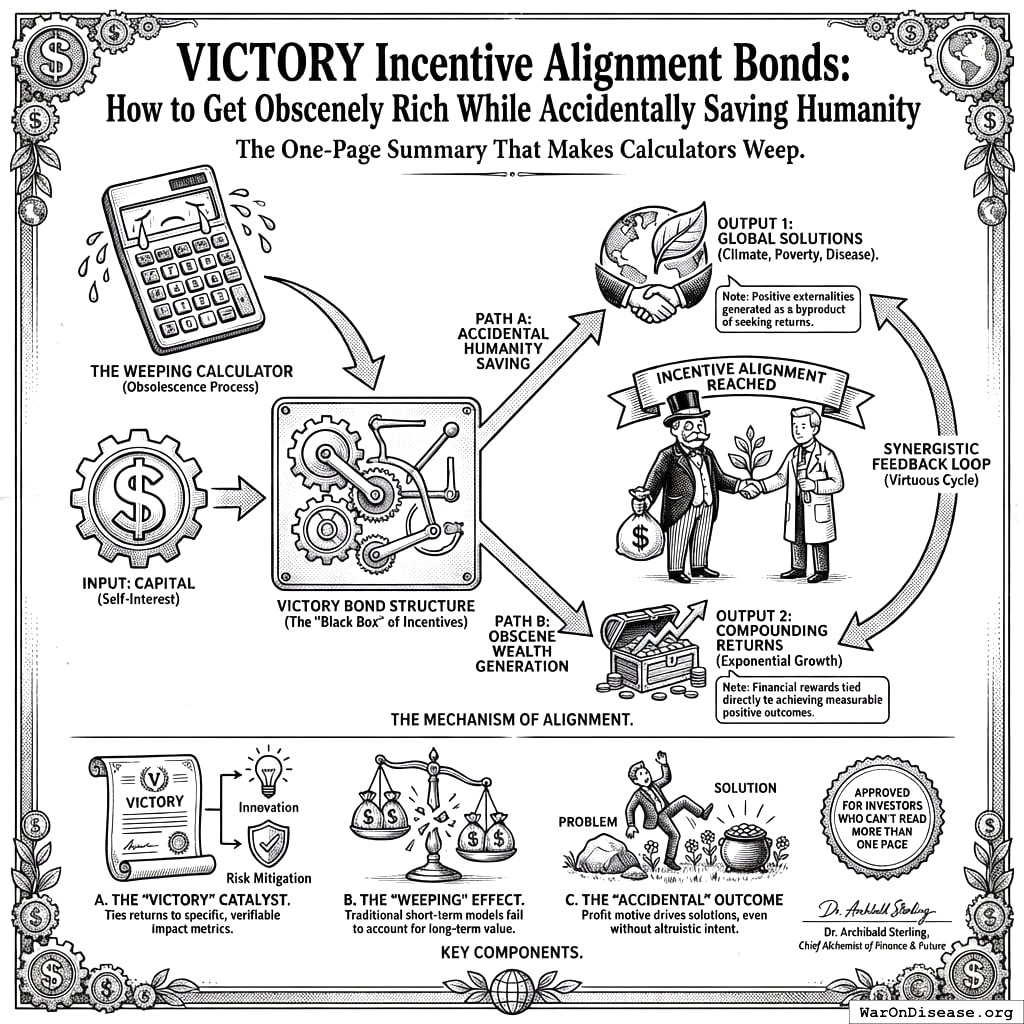
For investors: 272% annually, for as long as the treaty holds, with first-lien priority. Perpetual payments that grow as the treaty expands from 1% to 5%+. Side effect: millions of humans continue existing.
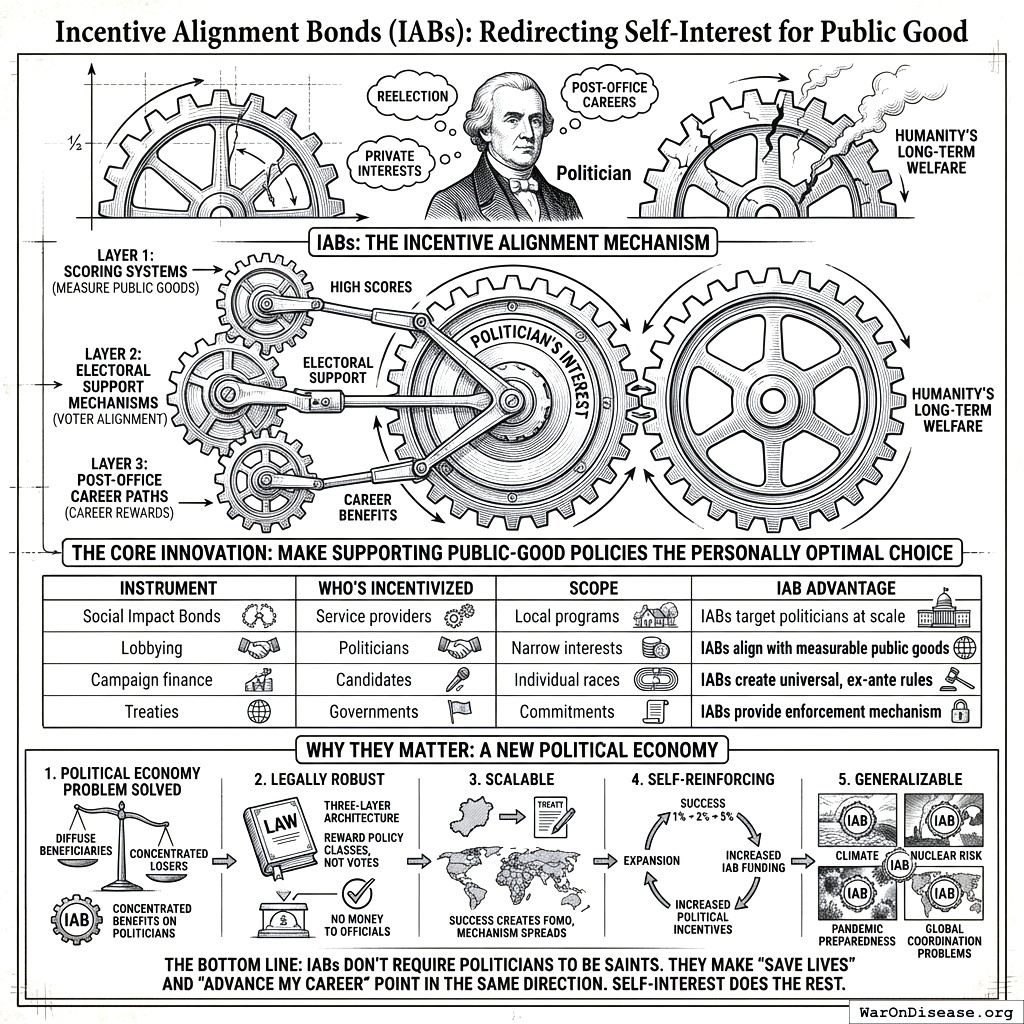
IABs don’t change human nature. Nothing changes human nature. You’ve tried religion, philosophy, education, and strongly worded letters. None of it worked. IABs just redirect the nature you’ve got. Legal (three-layer architecture, no money to officials). Contagious (one country, then FOMO). Self-reinforcing (each expansion funds the next).
You’re not asking politicians to be saints. Saints don’t run for office. You’re making “save millions of lives” and “advance my career” the same sentence. The rest is gravity.