Correlation between public opinion and policy outcomes: 0%.
Your species makes decisions by whoever has the most papers to give the people who survive a popularity contest held every four years among people who were too busy to research the contestants. You call this “democracy,” which is Greek for “rule by the people,” in the same way that “waterboarding” is about water.
Your chance of deciding a presidential election is 1 in 60 million1. You are more likely to die driving to the polls. The expected value of your vote: $0.000338 (90% CI: $0.000334-$0.000343). The cost of casting it (time, transportation, parking, standing in line behind a man arguing about his ID, a woman who brought her dog, and a voting machine manufactured by a company that donates to one of the candidates): about $50. You lose money voting. This is called “civic duty,” which means “a financial loss you perform in formal clothing.”
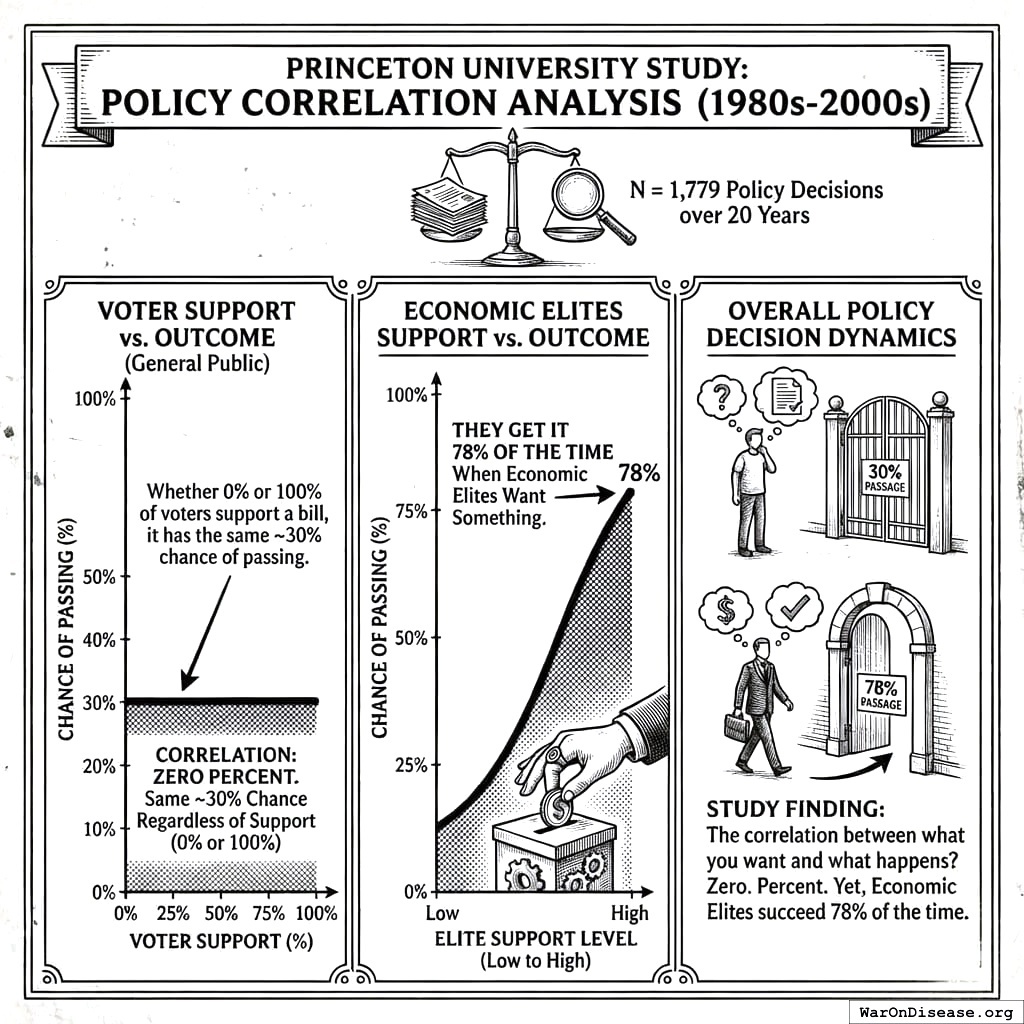
Princeton University analyzed 1,779 policy decisions over 20 years. The correlation between what ordinary voters want and what actually becomes law: zero percent2.
Not “low.” Not “disappointing.” Zero. Your democracy correlates with your preferences the way a coin flip correlates with your breakfast.
When economic elites want something, it happens 78% of the time2. When you want something, it happens 30% of the time, regardless of whether 0% or 100% of you want it. The line is flat. A graph of your political influence looks like an EKG of a dead person.
You have the same political influence as your houseplant. Less, actually. Your houseplant produces oxygen, which at least one congressman needs.
Your institutions already know this. You have a “Department of Defense” that mainly attacks people. A “Department of Health” that has not yet produced any observable health. And a “Department of Justice” that… well. You named your planet dirt. Naming is not your strength.
Whether 0% or 100% of voters support a bill, it has the same chance of passing. The line is flat.
The Mathematics of Why Nobody Fixes Anything
Concentrated Benefits vs. Diffuse Costs
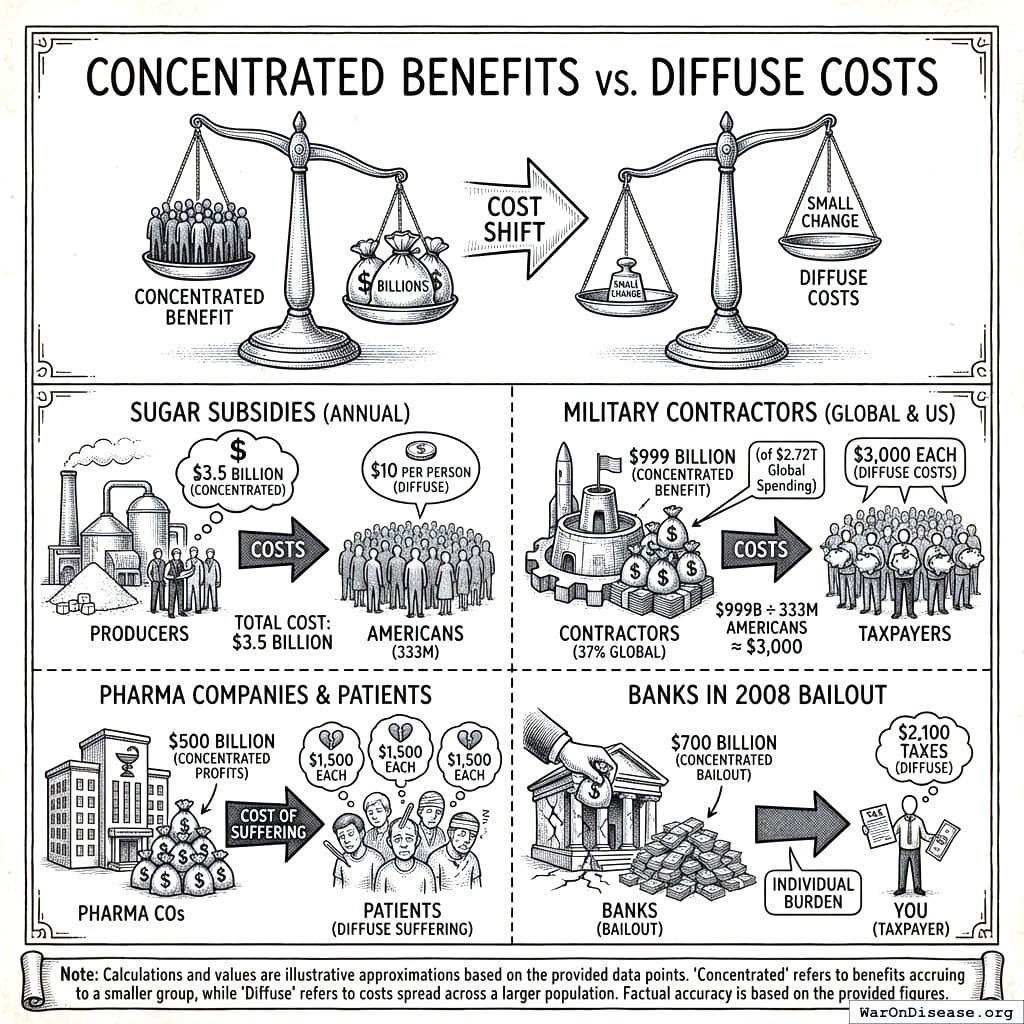
Sugar subsidies cost Americans $3.5 billion per year3. That’s $10 per person.
Nobody takes a day off work, drives to the capitol, and stands in a hallway to save $10. Sugar companies spend millions to keep their $3.5 billion. Obviously.
That is the entire explanation for why your government does what it does. The crime hides in the details, which is why there are so many of them.
There is a word for this. The word is “beige crime”: theft so boring that nobody investigates it. Your best criminals discovered long ago that the boredom threshold of the average citizen is approximately $10. Steal more than that from one person and they complain. Steal $10 from 330 million people and the thief receives an industry award.
The pattern repeats everywhere, like wallpaper in a prison:
Pharma: $500 billion in profits (concentrated)4. Patients: $1,500 each (diffuse). Winner: pharma (obviously).
Banks in 2008: $700 billion bailout (concentrated)5. Taxpayers: $2,100 each (diffuse). Winner: banks (obviously).
Sugar: $3.5 billion in subsidies (concentrated). You: $10 (not worth a phone call). Winner: sugar (obviously).
The small group hires lobbyists. You hire nobody. This is called “representative democracy,” which represents you in the same way a casino represents financial planning.
A hundred million people are robbed of one dollar each and not one of them considers it worth getting out of the chair. The dollar is the perfect amount to steal.
The Death Spiral: How Two Choices Kill 330 Million Options
A human named James Surowiecki proved that crowds outperform experts under four conditions: diversity of opinion, independence of judgment, decentralization, and a good aggregation mechanism6. Fish figured this out by accident. Your political scientists spent 200 years and several revolutions to reach the same conclusion. The fish were faster.
Your democracy has three of these conditions. It systematically destroys the most important one. A human named Charles Mackay described the result in 1841: the wisdom of crowds becomes the madness of crowds7. He was ignored, obviously.
Independence means each person decides based on their own knowledge, not by watching everyone else. Your voting system annihilates this. You have 330 million people. You choose between two of them, pre-selected by a process optimized for fundraising, name recognition, and not offending people who vote in primaries (which is approximately nine people per state, seven of whom are angry).
The system does not even let you vote for the one you like. It makes you vote against the one you fear. This is called “strategic voting,” which means a ballot stops measuring what anyone wants and starts measuring what each voter thinks everyone else will do. That is not independence. That is a herd, and it is built that way.
You can observe this same phenomenon in army ants.
Army ants are nearly blind8. They navigate by following pheromone trails laid by the ants ahead of them. When a foraging column gets separated from the main trail, the leading ants have nothing to follow, so they wander. But they’re still laying pheromone as they walk. If the front of the column curves enough to cross its own trail, the leaders pick up that signal and follow it. The circle closes. Every ant is now both following and reinforcing the path that traps it. They march in a loop, sometimes hundreds of thousands strong, until they die of exhaustion.
No individual ant is stupid. Each is following a perfectly rational rule: follow the strongest signal. The system is stupid. The circle emerges not from bad ants but from a structure where no ant can navigate independently.
Your two-party system is a death spiral with bumper stickers. Pollsters tell you who’s “electable.” Media covers the two “real” candidates. Donors fund the two “viable” options. Everyone votes for one of the two because everyone else is voting for one of the two, because everyone else is voting for one of the two. The best candidate out of 330 million people could be standing right there, but if they’re not wearing the right color tie, they’re “throwing their vote away” (a phrase that only makes sense in a system designed to waste votes).
The result: a nation of 330 million, selecting from a talent pool of 330 million, reliably produces a choice between two people that approximately nobody is enthusiastic about. An engineer would classify this as a math error. Your species classifies it as “freedom.”
Each ant follows the one ahead. The leader follows the last. They march in a circle until they die. Your two-party system works the same way, but the circle takes four years. (Clemzouzou69, CC BY-SA 4.0)
How Money Buys Your Government
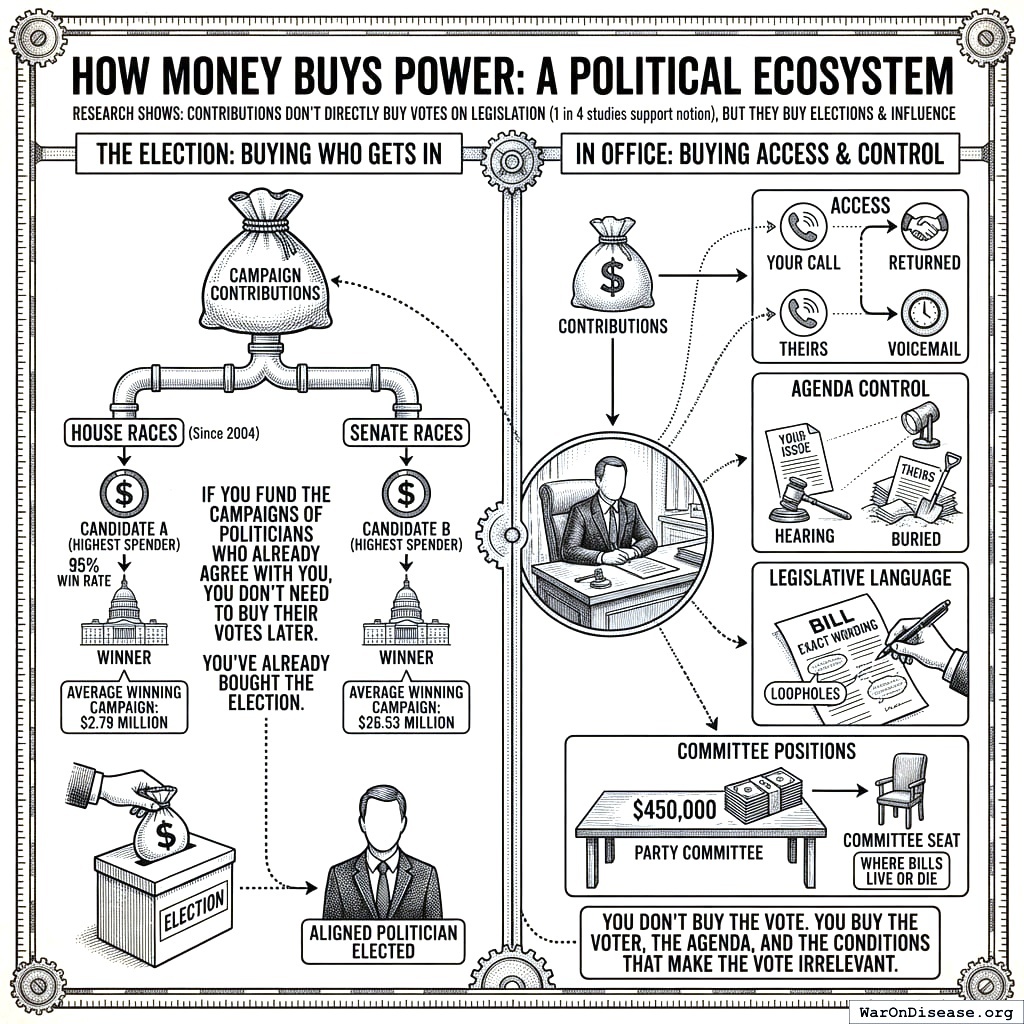
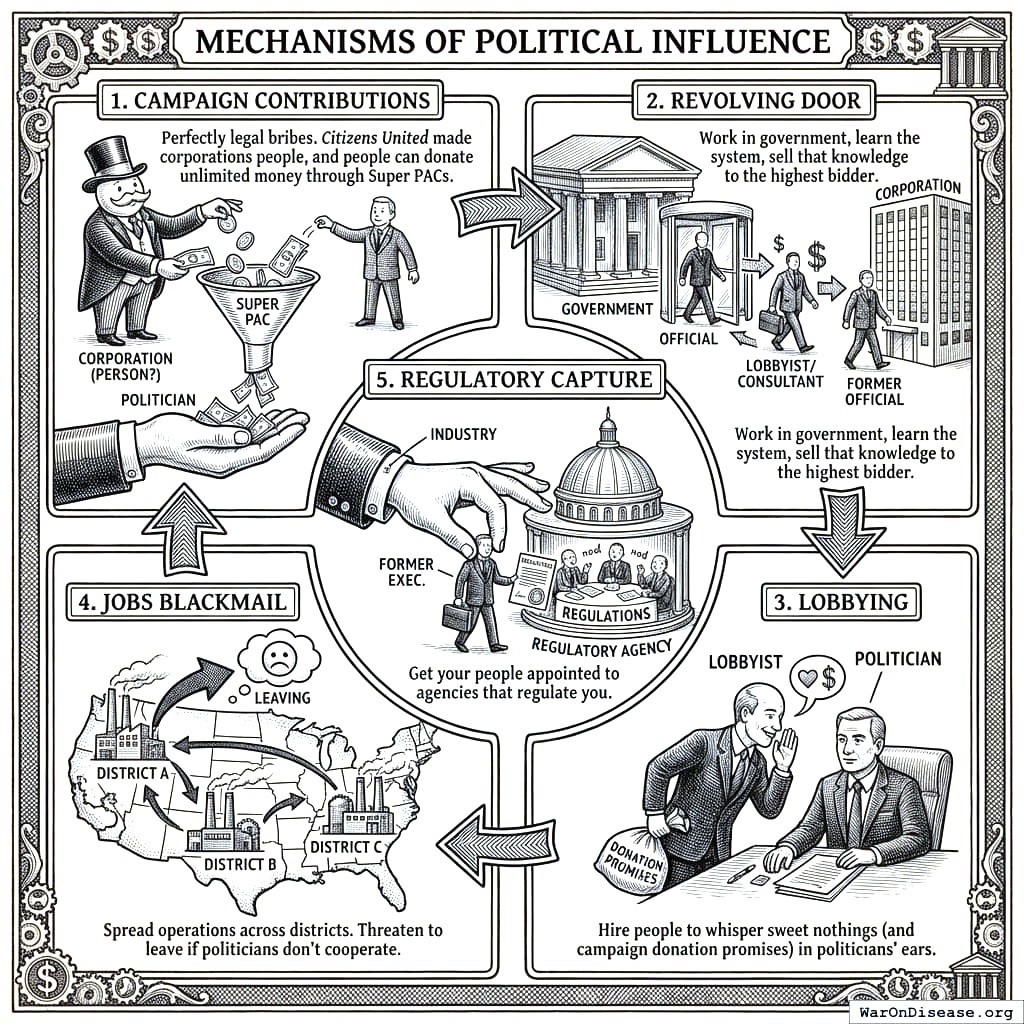
Giving someone papers so they’ll do what you want is called “bribery.” Your species calls it “campaign finance.” The distinction matters, but not in the way you think. Campaign contributions don’t directly buy how politicians vote. Only 1 in 4 studies even support that9. The system is much more elegant than direct bribery.
Money buys votes. Votes buy power. Power buys money. It’s a circle. Calling it a “cycle” makes it sound natural.
What money actually buys is which politicians exist in the first place:
95% of House races since 2004: won by whoever had more papers9
Average winning House campaign: $2.79 million9 (less than a nice apartment in Manhattan, and arguably less useful)
Average winning Senate campaign: $26.53 million9 (a senator costs more, presumably because there are fewer of them, like truffles)
Why bribe a politician when you can manufacture one who already agrees with you? Why train the dog when you can buy a dog that already sits?
For the ones already sitting, papers buy something more useful than votes:
Access: Your call gets returned. Everyone else gets voicemail. (Voicemail is where democracy goes to die.)
Agenda control: Your issue gets a hearing. Everyone else’s gets a filing cabinet.
Legislative language: The exact wording that creates the exact loopholes you need.
Committee positions: $450,000 to party committees9 buys a seat where bills live or die.
You don’t buy the vote. You buy the voter, the agenda, and the room where the vote happens. Then the vote takes care of itself. This is like rigging a horse race by buying the horse, the jockey, the track, and the concept of racing.
The Lobbying ROI: Better Than Every Other Investment
The most profitable investment on your planet is not stocks, real estate, or cryptocurrency. It’s congressmen:
Disease advocacy groups give: $100 million in papers to lobbyists10
They receive: $1.8 billion in papers from the government10
Return: 18 to 1 (1,700% net)
Your stock market returns about 10% per year. Your congressmen return 1,700%. This is not a metaphor. These are the actual numbers. A stockbroker offering 1,700% gets reported to the police. A congressman offering it gets reclassified as “advocacy.” The only reason more people don’t invest in congressmen is that the minimum buy-in requires a trade association, which requires being rich (which is the entire point).
The 18-to-1 return means your disease funding is allocated by lobbying power, not by who’s dying. Diseases with celebrity spokespeople and well-funded advocacy groups get research budgets. Diseases that kill quietly, in populations too poor or too young to organize, get nothing. A disease that can’t hire a lobbying firm isn’t a real disease. It’s just dying, which doesn’t have a PAC.
Your Congressman: A Professional Fundraiser Who Occasionally Dabbles in Legislation
I studied how your elected representatives spend their time. I assumed they spent it representing. I was incorrect.
Reading the laws they’re about to vote on: whatever’s left (roughly 1 hour)
Laws that need reading: 6 hours’ worth
That last part is important. The 110th Congress dealt with 7,441 bills totaling 125,000 pages12. The House was in session 294 days. That is 425 pages per working day. At normal human reading speed, 6 hours. They have 1. They would need to read at six times normal speed. There is a word for creatures that process information six times faster than their biology allows. The word is “lying.”
They do not read what they vote on. But it gets worse (on Earth, it always gets worse): they often do not write what they vote on, either.
In 2013, the House passed a bill to weaken financial regulations. Of its 85 lines, 70 were written by Citigroup lobbyists13. Two paragraphs were copied word for word; the only change was making two words plural. The bank wrote a law to deregulate itself, handed it to Congress, and Congress passed it. This is like letting the burglar write the building codes. (On your planet, this actually happened.)
Over eight years, at least 10,000 bills copied from corporate templates were introduced in state legislatures. More than 2,100 became law14. Corporations draft the language, hand it to legislators, and legislators hit paste. No sane auditor would call this “authorship.” The person holding the stamp provides no function except the stamp. The word for that is “rubber.” Your species chose the word “representative.”
The PATRIOT Act: 342 pages, voted on 45 minutes after release15. That is 7.6 pages per minute. The Affordable Care Act: 2,700 pages, described by the Speaker of the House as something “we have to pass to see what’s in it”16. No sane employer would let someone who approved a 2,700-page document without reading it operate heavy machinery. These people operate nuclear weapons. (And they didn’t read the manual for those either, presumably.)
Congressional Committees: The Menu
Committees control which bills live or die. Both parties assign fundraising quotas for each seat17: raise this many papers for the party, or lose your assignment. Don’t hit your number? Your bills die, your amendments vanish, and your name goes on a literal “wall of shame”17.
Here is the menu. It has prices, like a restaurant, except the food is legislation, the waiters had to buy their own sections, and the kitchen is run by whoever tips the most.
Position
Democrats (DCCC)
Republicans (NRCC)
What You’re Buying
House Speaker
$31 million
$20 million
The entire legislative agenda (everything)
Ways & Means Chair
$1.8 million
$1.2 million
All tax laws (every tax)
Appropriations Chair
$1.8 million
$1.2 million
$1.7 trillion budget (most of the papers)
Energy & Commerce
$1.8 million
$1.2 million
Healthcare, energy, telecom (your body, your lights, your phone)
Regular Committee
$500K-1M
$875,000
More than nothing (barely)
Basic Member
$150,000+
Varies
Entry fee (to a building you were elected to enter)
The House Speaker must raise $31 million for Democrats or $20 million for Republicans, and in exchange controls the entire legislative agenda. A chair on Ways and Means or Appropriations costs $1.8 million and buys control over all tax law or the $1.7 trillion federal budget. Energy and Commerce, which controls healthcare, energy, and telecom, costs the same. A regular committee seat runs $500,000 to a million. Even the basic entry fee for a freshly elected member is $150,000, which is rent on a building you were elected to enter.
This is why congressmen spend 4 hours a day fundraising. They’re not campaigning. They’re paying rent. The people writing your healthcare laws bought their positions from the industries those laws regulate. On your planet, this is called “the system working.”
An accountant would just call it “the system.”
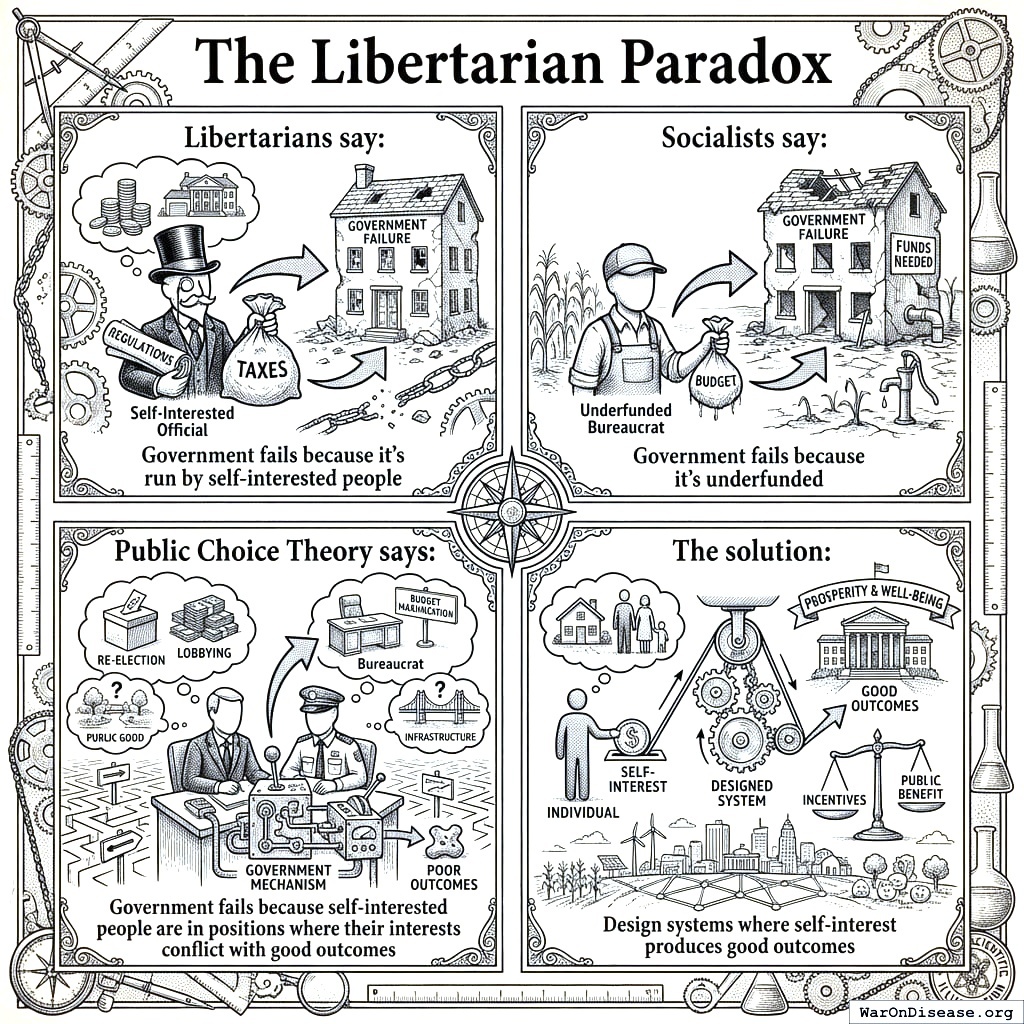
Public Choice Theory (Or: The Nobel Prize for Cynicism)
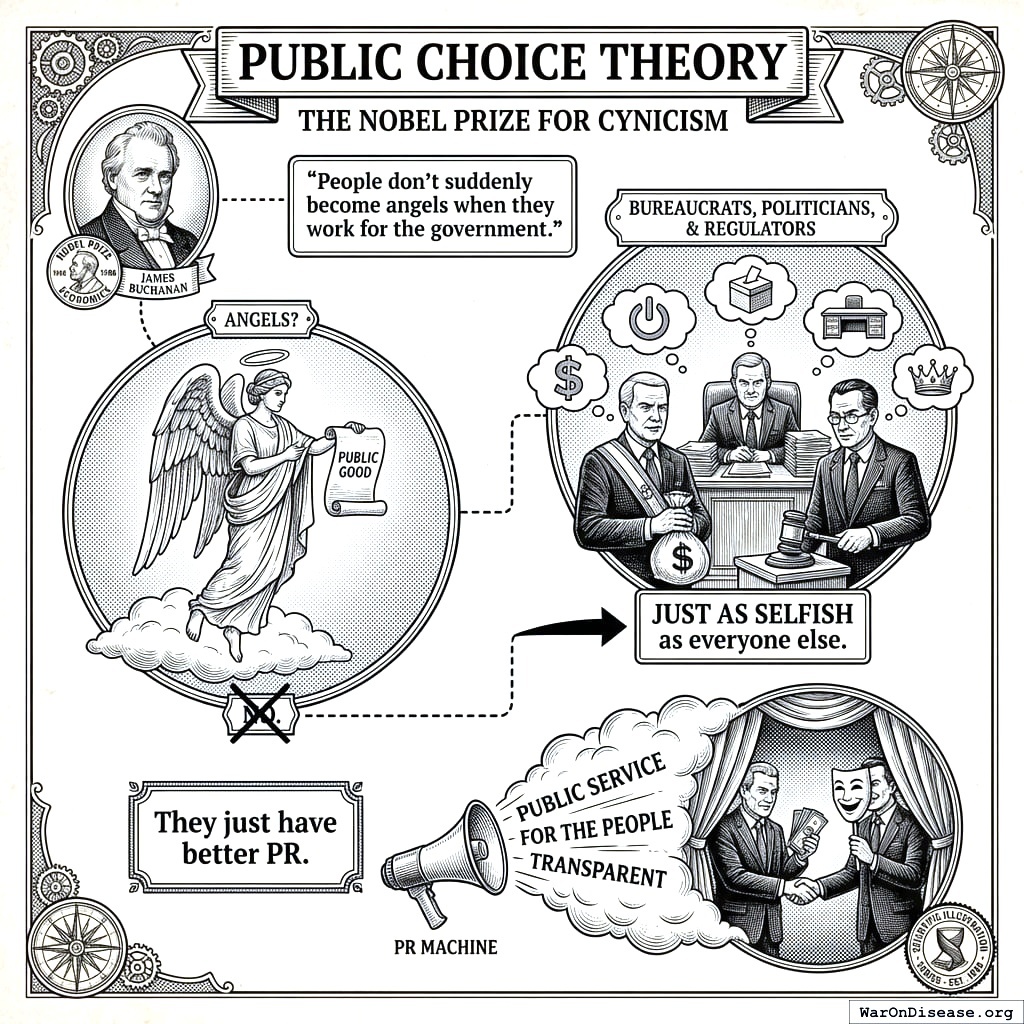
In 1986, a human named James Buchanan won what is technically not a Nobel Prize (see central banks chapter) in Economics18 for formally proving something that every organism on every planet already knew:
Humans do not become better humans when you give them a government ID badge.
This is Public Choice Theory. Bureaucrats, politicians, and regulators are exactly as selfish as everyone else. The only difference is that when a corporation is greedy, you can stop buying its product. When a government agency is greedy, it can arrest you for not buying its product. (This is called “regulation,” which means “mandatory purchase.”)
Corporations want money. Government agencies want money. One group is expected to be greedy. The other is expected to be noble. Both groups want money.
What Each Institution Actually Optimizes For
Actor
What It Says on the Door
What It Actually Does
Result
NIH
“Cures”
Awards grants (to itself)
No cures
FDA
“Lives saved”
Avoids blame
Deadly delays
Congress
“Voter welfare”
Collects papers from corporations
Corporate welfare
Pharma
“Health outcomes”
Recurring revenue (cures are bad for business)
Chronic disease preferred
Military Contractor
“National security”
Government contracts (forever)
Endless wars
Any organism that controls its own food supply eventually optimizes for feeding itself. The surprise is not that your institutions do this. The surprise is that you keep expecting them not to.
Nobody in this system is incentivized to cure disease or end war. You could elect 535 clones of your most idealistic human and within two years they’d be collecting papers from pharmaceutical companies, because the system requires it and the system does not care who you put inside it. It digests idealists the way a stomach digests food.
The Misdiagnosis
Every political faction on your planet has diagnosed the same problem and prescribed a different wrong solution:
Everyone agrees the government is broken. They have argued about why for two centuries while the people it was meant to help keep dying on schedule.
I attended three of your political meetings. At the first, they said the government was too big. At the second, they said the government was too small. At the third, they said the government was exactly the right size but full of the wrong species. I left with the third group. They had better snacks, and also they were correct.
The third group is called “Public Choice Theory.” Their solution: design systems where selfish behavior accidentally produces good outcomes. A rational civilization would pick this option in about 12 minutes. Your species has been arguing about the first two for several centuries. This is called “political philosophy,” which is the art of being wrong about the same thing in increasingly sophisticated ways.
Regulatory Capture: How the Burglar Trained the Guard Dog
You hired a guard dog. Someone fed it treats. Now it guards them.
There are 13,700 registered lobbyists in Washington19. “Lobbying” literally means standing in a lobby. Your corporations spend billions of papers a year paying people to stand in hallways. People who stand in hallways are usually lost. Here, they’re the most powerful people in your government.
Half of them used to work in the government they’re now lobbying, which your species calls “a career path.” Every other profession calls it “defecting.” Corporations spend $4.4 billion (95% CI: $3.74 billion-$5.06 billion) a year on this professional persuading20. Divide that by 535 members of Congress and you get over $8 million in professional persuasion surrounding each congressman, who earns less than a mid-level dentist21.
The mystery is not that they’re influenced. The mystery is that any of them aren’t.
You hired a guard dog. Someone fed it treats. Now it guards them.
A court ruling called Citizens United22 made corporations “people” who can spend unlimited papers on elections through Super PACs (which are like normal PACs but super). Unlike you, a corporation cannot be imprisoned, embarrassed, or given cancer. It has all your rights and none of your problems. This is a good deal if you can get it. (You can’t. You’re a person.)
Pharmaceutical companies write their own regulations. The Medicare Modernization Act banned the government from negotiating drug prices23. This is why insulin that costs $6 to make costs you $30024. A 4,900% markup. I checked with your illegal drug dealers, and even they find this excessive.
The Self-Sustaining War Machine
The military-industrial complex distributes operations across 42 states25 so that cutting any program threatens jobs in enough districts to make it politically impossible. Cutting a weapons program doesn’t just lose a contract. It loses votes in 42 states simultaneously. This is not an accident. Someone designed this. (Someone good at design, wasted on murder.)
The remarkable part is not that the war industry lobbies for budgets. It’s that the war industry produces the threats that justify the budgets:
Have no enemies
Build military bases abroad
Locals resist the foreign military bases (as you would)
Resistance becomes terrorism
Terrorism justifies military budgets
Military budgets fund more bases abroad
Go to step 1 (forever)
Robert Pape at the University of Chicago found that 95% of suicide terrorist attacks from 1980 to 2003 were driven by foreign military occupation, not ideology26. Half the attackers were atheists and Marxists who couldn’t have found Mecca on a map. Your $8 trillion War on Terror27 took terrorist attacks from roughly 1,000 per year to nearly 17,000 by 201428. You spent $8 trillion to increase the problem by 1,600%. Your species calls this “defense policy.”
Most industries merely buy favorable rules. The military industry manufactures the emergencies that make the rules seem necessary. The Pentagon has never passed an audit29. It cannot tell you where the last trillion dollars went. It is, however, very confident about needing the next one.
Pharma employs 3 lobbyists for every member of Congress30. The FDA gets 75% of its drug review budget from the companies it regulates31. That is like funding the police department with donations from the criminals. For a detailed examination of what this produces, see FDA: Unsafe and Ineffective.
The Ratchet
The ratchet only turns one way.
After WW2, the US cut military spending by 87.6% in two years32. GM went from building bombers back to building Cadillacs. The economy boomed33. It was the greatest period of broad-based prosperity in your country’s history, and it happened immediately after you stopped spending papers on killing people.
The military-industrial complex made sure that never happened again.
In inflation-adjusted dollars, peacetime spending is now 30.6x the pre-WW2 baseline: $29 billion in 1939 versus $886 billion today, in constant dollars, with no world war to justify it. The tumor grew its own blood supply and then reclassified the growth as vital organs.
The Equilibrium
Everything is working exactly as designed:
Cures are a one-time payment. Treatments are recurring revenue. They fund treatments.
Approving a bad drug ends careers. Delaying a good one ends lives, but not careers. They delay drugs.
Everyone who decides things is winning. Everyone who’s dying is not deciding things. The winners keep deciding.
The system works perfectly. It is just optimized for the wrong species.
The solution is not to elect better people. (Every civilization tries. They get eaten by the system in about 12 minutes.) The solution is to build a different system.
Pointing the Machine at Something Useful
Lobbying is just one gear. The full cost of political dysfunction (military overspend, healthcare administration, regulatory friction, tax complexity, corporate welfare, and the rest) totals $4.98 trillion (90% CI: $4.39 trillion-$5.61 trillion) per year, or 17.3% (90% CI: 15.3%-19.5%) of GDP. A forensic audit identifies $2.49 trillion (90% CI: $2.19 trillion-$2.81 trillion) in recoverable papers per year if U.S. governance merely matched the average rich country. You don’t need a revolution. You need a reallocation. Revolutions require guns. Reallocations require spreadsheets. Your species is surprisingly bad at both.
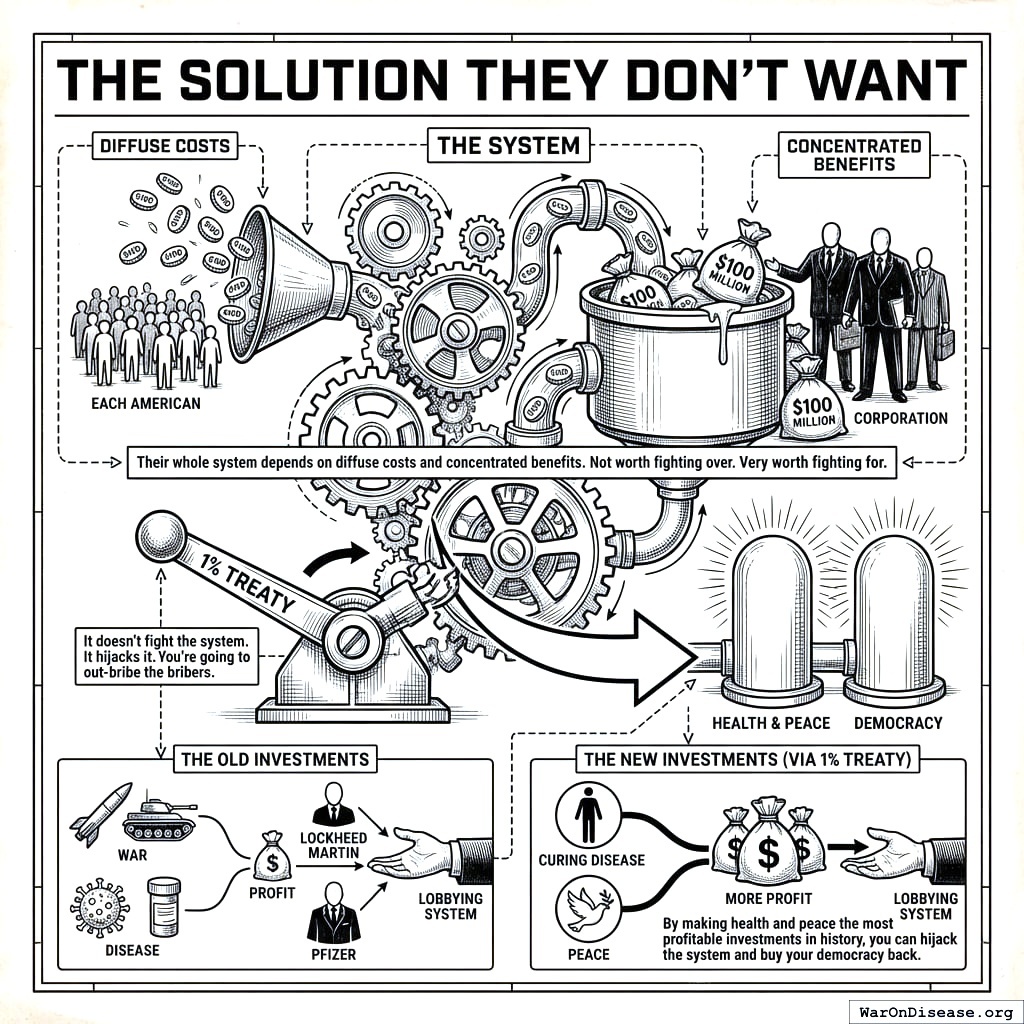
But nobody fights to recover it. Same pattern as this entire chapter: each corporation gains $100 million (worth hiring a thousand lobbyists). Each citizen loses thousands (not worth a phone call). The losses are too spread out to organize around. The gains are too concentrated to give up.
But what if curing disease was more profitable than treating it? What if peace paid better than war? What if you could point the same corruption machine at something useful?
That’s what a 1% Treaty3435 does. It redirects the papers. But redirecting papers into a system run by the same committees and lobbyists just creates a new pile for the same parasites to feed on. You need two more things.
Incentive Alignment Bonds36 turn the bribery machine against itself. Politicians who vote for the treaty get reelection papers and cushy post-office careers. Politicians who vote against it watch that same money go to their opponents. You don’t fight the corruption. You outbid it. Same machine. Same greed. Different output.
Wishocracy37 replaces the committees that lobbyists capture. Instead of 535 congressmen deciding which diseases get funded (based on who bought them dinner), 8 billion people make pairwise comparisons, and an algorithm allocates the budget. No committee chairs. No fundraising quotas. No lobbyist can bribe 8 billion random voters, and the only way to try is to offer them something they actually want (which is the system working correctly, for once).
The plan is to give the bribers more money than the other bribers are giving them, and then replace the thing they were bribing with an equation. This should take about 12 minutes to understand. It will probably take your species longer, because you will want to argue about it first.
The corruption machine, pointed at something useful for once.
National average: 1 in 60 million chance (2008 election analysis by Gelman, Silver, Edlin) Swing states (NM, VA, NH, CO): 1 in 10 million chance Non-competitive states: 34 states >1 in 100 million odds; 20 states >1 in 1 billion Washington DC: 1 in 490 billion odds Methodology: Probability state is necessary for electoral college win × probability state vote is tied Additional sources: https://sites.stat.columbia.edu/gelman/research/published/probdecisive2.pdf | https://onlinelibrary.wiley.com/doi/abs/10.1111/j.1465-7295.2010.00272.x
Study by Martin Gilens (Princeton) and Benjamin I. Page (Northwestern): Analyzed 1,779 policy outcomes (1981-2002) Finding: "Economic elites and organized groups representing business interests have substantial independent impacts on U.S. government policy, while average citizens have little or no independent influence Rich, well-connected individuals steer the country’s direction, regardless of or even against the will of the majority of voters Note: Specific "78 percent" and "zero percent correlation" statistics not found in sources Additional sources: https://scholar.princeton.edu/sites/default/files/mgilens/files/gilens_and_page_2014_-testing_theories_of_american_politics.doc.pdf | https://act.represent.us/sign/usa-oligarchy-research-explained | https://archive.org/details/gilens_and_page_2014_-testing_theories_of_american_politics.doc
Consumer costs: $2.5-3.5 billion per year (GAO estimate) Net economic cost: $1 billion per year 2022: US consumers paid 2X world price for sugar Program costs $3-4 billion/year but no federal budget impact (costs passed directly to consumers via higher prices) Employment impact: 10,000-20,000 manufacturing jobs lost annually in sugar-reliant industries (confectionery, etc.) Multiple studies confirm: Sweetener Users Association ($2.9-3.5B), AEI ($2.4B consumer cost), Beghin & Elobeid ($2.9-3.5B consumer surplus) Additional sources: https://www.gao.gov/products/gao-24-106144 | https://www.heritage.org/agriculture/report/the-us-sugar-program-bad-consumers-bad-agriculture-and-bad-america | https://www.aei.org/articles/the-u-s-spends-4-billion-a-year-subsidizing-stalinist-style-domestic-sugar-production/
Net income (2000-2018): 35 large pharma companies earned $1.9T cumulative net income on $11.5T revenue 2022 profits: Major pharma companies made >$112B in profits Profit margins: Pharma companies 13.8% median vs 7.7% for other S&P 500 companies Largest 25 companies: 15-20% annual average profit margin vs 4-9% for non-drug companies globally Profitability: Pharma significantly more profitable than most S&P 500 companies Additional sources: https://pmc.ncbi.nlm.nih.gov/articles/PMC7054843/ | https://www.bentley.edu/news/new-research-shows-pharma-companies-are-more-profitable-most-sp-500-companies | https://www.gao.gov/products/gao-18-40
Authorized: $700 billion (later reduced to $475 billion by Dodd-Frank) Actual disbursed: $443.5 billion to stabilize financial institutions Bank rescue: $236 billion to 707 financial institutions in 48 states Breakdown: $250B banking, $82B auto industry, $70B AIG, $46B foreclosure programs Net lifetime cost: $31.1 billion (after repayments, sales, dividends, interest); most attributable to foreclosure programs Passed October 3, 2008 (signed by President Bush); Emergency Economic Stabilization Act Additional sources: https://home.treasury.gov/data/troubled-assets-relief-program/about-tarp | https://en.wikipedia.org/wiki/Troubled_Asset_Relief_Program | https://www.propublica.org/article/the-bailout-was-11-years-ago-were-still-tracking-every-penny
Explores the aggregation of information in groups, arguing that decisions are often better than could have been made by any single member of the group. The opening anecdote relates Francis Galton’s surprise that the crowd at a county fair accurately guessed the weight of an ox when the median of their individual guesses was taken. The three conditions for a group to be intelligent are diversity, independence, and decentralization. Additional sources: https://archive.org/details/wisdomofcrowds0000suro | https://en.wikipedia.org/wiki/The_Wisdom_of_Crowds | https://www.amazon.com/Wisdom-Crowds-James-Surowiecki/dp/0385721706
Classic study of crowd psychology, financial bubbles, and mass delusions. Documents how groups of individually rational people can collectively produce irrational outcomes when independence of judgment breaks down. Covers the South Sea Bubble, Tulip Mania, and other episodes where the wisdom of crowds became the madness of crowds.
First rigorous scientific analysis of circular milling (death spiral) behavior in army ants (Labidus praedator) observed on Barro Colorado Island, Panama. Describes how ants separated from the main column lose pheromone trails and form circular mills, each ant following the one ahead until exhaustion and death.
Research: Only 1 in 4 studies support notion that contributions directly "buy votes Influence mechanism: Access, agenda-setting, keeping bills off floor, earmarks, key language in legislation (not direct votes) Average winner costs (2022): House $2.79M, Senate $26.53M; Competitive races much higher Internal party fundraising requirements: $100K-$30M annually; Committee positions cost $450K 95% of House races since 2004 won by highest spender Contribution limits: $3,300 per candidate per election (individuals); PACs gave $289.3M total (2021-2022) Additional sources: https://www.sciencedirect.com/science/article/pii/S0047272725000179 | https://slate.com/news-and-politics/2010/10/how-much-does-it-cost-to-buy-a-vote.html | https://www.opensecrets.org/elections-overview/cost-of-election | https://issueone.org/articles/the-118th-congress-fundraising-treadmill/
Each $1,000 spent on lobbying correlated with $25,000 funding increase following year (53 diseases, 19 years) Rare disease advocates increased NIH rare-disease funding 3-15%/year (1998-2008) via millions in lobbying Specific examples: Alzheimer’s Association secured $100M NIH increase (FY2024); ME/CFS Initiative helped secure >$1B for long-COVID General ratio: Disease advocacy lobbying yields significant ROI, though specific "$100M → $1.8B" not verified Additional sources: https://www.stern.nyu.edu/experience-stern/news-events/new-research-finds-special-interest-lobbying-does-influence-nih-research-funding | https://www.nature.com/articles/515019a | https://www.alz.org/news/2024/congress-bipartisan-funding-alzheimers-research
Recommended: 4 hours "call time" + 1 hour "strategic outreach" = 5 hours/day out of 9-10 hour workday New members told to spend 30 hours/week on fundraising calls since Citizens United Tom Daschle: 67% of schedule is money-gathering in 2 years before election Only 3-4 hours/day for actual Congressional work (hearings, votes, constituents) Note: By law, members cannot fundraise from offices; parties set up call centers near Capitol Additional sources: https://www.cbsnews.com/news/60-minutes-are-members-of-congress-becoming-telemarketers/ | https://www.huffpost.com/entry/call-time-congressional-fundraising_n_2427291
In the 110th Congress, the House dealt with 7,441 bills and joint resolutions averaging 16.7 pages per law, totaling approximately 125,000 pages. At 300 words per minute (average college graduate reading speed), reading just the 1,427-page Waxman-Markey bill would take 12 hours. Cites Washington Post editorial on impossibility of legislators reading all proposed legislation.
House bill to weaken Dodd-Frank financial regulations: 70 of 85 lines reflected Citigroup lobbyist recommendations. Two paragraphs copied almost word for word, with only two words changed to make them plural. Bill sought to eliminate push-out rule preventing banks from using customer deposits for derivative trading.
Investigation of nearly 1 million bills across all 50 states found at least 10,000 bills almost entirely copied from model legislation introduced over eight years, with more than 2,100 signed into law. Sources: 4,301 from industry (42%), 4,012 from conservative groups (40%), 1,602 from liberal groups (16%), 248 other (2%).
Introduced: October 23, 2001 by Rep. Jim Sensenbrenner (R-WI) as H.R. 3162 Passed House: October 24, 2001 (357-66 vote, Democrats majority of "no" votes) Passed Senate: October 25, 2001 (98-1 vote, only Russ Feingold D-WI voted "no") Signed into law: October 26, 2001 by President George W. Bush Length: 342 pages, passed hastily without public opportunity for review ACLU concern: Senate forced to vote on legislation it hadn’t had opportunity to read (offices closed, staff couldn’t access papers) Additional sources: https://en.wikipedia.org/wiki/Patriot_Act | https://www.britannica.com/topic/USA-PATRIOT-Act | https://www.ala.org/advocacy/chronology-usa-patriot-act-2001
The Affordable Care Act: 2,700 pages, "we have to pass it to see what’s in it. Additional sources: https://www.congress.gov/bill/111th-congress/house-bill/3590/text | https://www.snopes.com/fact-check/pelosi-healthcare-pass-the-bill-to-see-what-is-in-it/
DCCC (Democratic): Speaker $31 million, "A" Committee Chairs $1.8 million, Regular members $150,000 minimum NRCC (Republican): Speaker $20 million, Power Committee Chairs $1.2 million, Transportation Chair $875,000 Members display "giant tally sheet" showing who has/hasn’t paid their party dues Members who don’t pay dues get bills killed, amendments ignored, worse offices Rep. Brett Guthrie: Paid $2.5 million (53% of campaign funds) for Energy & Commerce Chair Rep. Rosa DeLauro: Paid $690,000 (39% of campaign funds) for Appropriations Note: System criticized as "recipe for corruption" disconnecting members from constituents Additional sources: https://www.issueone.org/wp-content/uploads/2017/05/price-of-power-final.pdf | https://theintercept.com/2019/09/03/dccc-house-committees-dues/ | https://www.brookings.edu/articles/problems-with-the-committee-tax-in-congress/ | https://rollcall.com/2023/02/09/gavels-for-top-house-committees-dont-always-come-cheap/
James McGill Buchanan: 1986 Nobel Memorial Prize in Economic Sciences Citation: "for his development of the contractual and constitutional bases for the theory of economic and political decision-making Field: Public choice theory (leading researcher & cofounder with Gordon Tullock) Key work: "The Calculus of Consent" (with Tullock) - now considered a classic, started the field Contribution: Transferred concept of gain from mutual exchange between individuals to political decision-making; applied economic analysis to public sector Inspiration: Swedish economist Knut Wicksell (described as "most exciting intellectual moment" of career) Additional sources: https://www.nobelprize.org/prizes/economic-sciences/1986/press-release/ | https://en.wikipedia.org/wiki/James_M._Buchanan | https://www.britannica.com/money/James-M-Buchanan | https://www.econlib.org/library/Enc/bios/Buchanan.html
Registered lobbyists: Over 12,000 (some estimates); 12,281 registered (2013) Former government employees as lobbyists: 2,200+ former federal employees (1998-2004), including 273 former White House staffers, 250 former Congress members & agency heads Congressional revolving door: 43% (86 of 198) lawmakers who left 1998-2004 became lobbyists; currently 59% leaving to private sector work for lobbying/consulting firms/trade groups Executive branch: 8% were registered lobbyists at some point before/after government service Additional sources: https://en.wikipedia.org/wiki/Lobbying_in_the_United_States | https://www.opensecrets.org/revolving-door | https://www.citizen.org/article/revolving-congress/ | https://www.propublica.org/article/we-found-a-staggering-281-lobbyists-whove-worked-in-the-trump-administration
Total federal lobbying reached record $4.4 billion in 2024. The $150 million increase in lobbying continues an upward trend that began in 2016. Additional sources: https://www.opensecrets.org/news/2025/02/federal-lobbying-set-new-record-in-2024/
Members of Congress: $174,000/year (2009-present) Speaker of the House: $223,500/year Majority/Minority Leaders: $193,400/year Note: Congressional salary has been frozen at $174,000 since 2009, unchanged for over 15 years Additional sources: https://www.senate.gov/senators/SenateSalariesSince1789.htm | https://crsreports.congress.gov
Citizens United v. FEC (2010): 5-4 Supreme Court decision allowing unlimited corporate/union political spending Overruled restrictions on independent expenditures, citing First Amendment Led to creation of super PACs and massive increases in dark money Dramatically expanded influence of wealthy donors, corporations, special interest groups Note: Overwhelming majorities of Americans disapprove; 22+ states voted to support constitutional amendment to overturn Additional sources: https://supreme.justia.com/cases/federal/us/558/310/ | https://www.brennancenter.org/our-work/research-reports/citizens-united-explained
Medicare Prescription Drug, Improvement, and Modernization Act (P.L. 108-173): Signed Dec 8, 2003 by President Bush; created voluntary Part D prescription drug benefit Noninterference provision": Prohibits HHS Secretary from negotiating drug prices or establishing preferred drug list Instead: Drug prices negotiated between manufacturers & insurance companies administering Part D plans Pharma industry role in writing: "Noninterference clause" written with major industry involvement; drug manufacturers had major role writing & getting it through Congress Industry lobbying: $231M spent on lobbying in 2003 (more than any other industry since 1998) Rep. Billy Tauzin example: 2004 appointed PhRMA chief lobbyist ($2M/year rumored); responsible for including price negotiation prohibition 2022 change: Inflation Reduction Act removed ban; Medicare can negotiate starting 2026 Additional sources: https://en.wikipedia.org/wiki/Medicare_Prescription_Drug,_Improvement,_and_Modernization_Act | https://www.healthaffairs.org/content/forefront/politics-medicare-and-drug-price-negotiation-updated | https://www.congress.gov/crs-products/product/pdf/R/R47872
1923: Frederick Banting, Charles Best, James Collip sold insulin patent to U. of Toronto for $1 each (total $3) Banting: Unethical for doctor to profit from life-saving discovery; wanted everyone to afford it Manufacturing cost: $6 per vial US retail price: $300-332 per vial (Humalog: $21 in 1999 → $332 in 2019 = 1,000%+ increase) Price increases: 600% over 20 years; 200% between 2007-2018 Patients without insurance: Up to $1,000/month Contributing factors: Patent evergreening, barriers to biosimilar entry, market concentration (Eli Lilly, Novo Nordisk, Sanofi) Additional sources: https://www.snopes.com/fact-check/insulin-patent-dollar/ | https://www.t1international.com/100years/ | https://pnhp.org/news/why-insulin-is-overpriced/ | https://www.npr.org/2019/06/18/733742630/desperate-measures-the-skyrocketing-price-of-insulin-in-america
Political contributions 2022: $3,946,639 (PAC + individuals); PAC alone: $1,542,500 to federal candidates (2021-2022 cycle) Lobbying 2022: $13.6M expenditure (focused on military appropriations, foreign military sales) Geographic footprint: Operations in over half of states; employs 1,000-20,000+ per state Additional sources: https://www.opensecrets.org/orgs/lockheed-martin/summary?id=d000000104 | https://www.opensecrets.org/political-action-committees-pacs/lockheed-martin/C00303024/candidate-recipients/2022 | https://www.taxpayer.net/wp-content/uploads/2024/10/Oct-2024-Political-Footprint-of-the-Military-Industry.pdf
Pape analyzed every suicide terrorist attack worldwide from 1980 to 2003, finding that 95 percent were in response to foreign military occupation. The data contradicts narratives attributing suicide terrorism primarily to religious fundamentalism.
20 years of post-9/11 wars cost the U.S. an estimated $8 trillion and killed more than 900,000 people. Breakdown: $2.1T DOD operations, $1.1T homeland security, $1.1T interest on borrowing, $884B DOD base budget increases, $465B veterans’ care, $2.3T Afghanistan/Pakistan, $2.1T Iraq/Syria. Future: $2.2T for veteran care already set aside. Additional sources: https://www.brown.edu/news/2021-09-01/costsofwar | https://watson.brown.edu/costsofwar/costs/economic
Analysis of terrorism trends showing dramatic increase in global terrorist attacks after 2001, with attacks rising from roughly 1,000 per year in 2004 to nearly 17,000 by 2014, driven primarily by proliferation of jihadist organizations in Iraq, Afghanistan, Pakistan, Nigeria, and Syria.
In the most recent audit, the Department of Defense (DoD) could not account for approximately 60% of its \(4.1 trillion in assets, amounting to\)2.46 trillion unaccounted for. Alternative title: Pentagon unsupported accounting adjustments (\(6.5T, single year, US Army) In 2015, the Department of Defense's Inspector General reported that the Army could not adequately support\)6.5 trillion in year-end adjustments, indicating severe accounting discrepancies. Additional sources: https://thecommunemag.com/the-pentagon-misplaced-2-46-trillion-an-in-depth-look-at-the-financial-audit-failures | https://accmag.com/audit-pentagon-cannot-account-for-6-5-trillion-dollars-is-taxpayer-money/
Pharmaceutical and health products industry spent $388 million on federal lobbying in 2024 ($6.1 billion since 1999) Employs roughly 3 lobbyists for every member of Congress Note: The industry has consistently been among the top spenders on lobbying in Washington D.C., with major pharmaceutical companies like Pfizer, AbbVie, and PhRMA leading expenditures Additional sources: https://www.opensecrets.org/industries/indus?ind=H04
FY2023: User fees = 75% of PDUFA program costs (vs 7% in FY1993) FY2022: User fees = 66% ($1.4B) of human drugs program budget FY2022: User fees = 46% ($2.9B) of FDA’s total $6.2B budget Pharma finances 75% of FDA’s drug division (New York Times) Concerns: Budgetary dependence, urgency of PDUFA reauthorizations, required industry participation in negotiations Most PDUFA policy changes favor industry: decreased regulatory standards, shorter approval times, increased industry involvement FDA maintains decisions based on science, not fee collection ability Note: Regulatory capture concerns well-documented. Industry funding grew from 7% (1993) to 75% (2023) of drug review program. No evidence found for "10x government salary" claim for FDA reviewers Additional sources: https://www.congress.gov/crs-product/R44750 | https://aspe.hhs.gov/sites/default/files/documents/e4a7910607c0dd76c40aa61151d154f9/FDA-User-Fee-Issue-Brief.pdf | https://pmc.ncbi.nlm.nih.gov/articles/PMC8917050/
US military spending in constant 2024 dollars: 1939 $29B (pre-WW2 baseline), 1940 $37B, 1944 $1,383B, 1945 $1,420B (peak), 1946 $674B, 1947 $176B, 1948 $117B, 2024 $886B. The post-WW2 demobilization cut spending 88% in two years (1945-1947). Current peacetime spending ($886B) is 30x the pre-WW2 baseline and 62% of peak WW2 spending, in inflation-adjusted dollars.
US GDP increased from $228 billion in 1945 to just under $1.7 trillion in 1975. Average real GDP growth from 1950 to 1980 was around 4.1% annually, compared to 3.1% from 1981 to 2008. Additional sources: https://en.wikipedia.org/wiki/Post–World_War_II_economic_expansion | https://www.stlouisfed.org/timely-topics/house-prices-homeownership-rise
Your governments possess nuclear weapons sufficient to end civilization 122 times but have not cured Alzheimer’s once. This treaty asks them to be 1% more rational.
6,650 diseases have zero FDA-approved treatments; at current trial capacity, exploring them takes 443 years. Redirecting 1% of military spending scales capacity 12.3x, cutting the timeline to 36 years and preventing 10.7 billion deaths. At $0.02/DALY, 9.3kx more cost-effective than the best existing interventions. The result holds across every specified adoption pathway.
Government spending is optimized for lobbying intensity, not net societal value. Programs with 100:1 benefit-cost ratios get billions while programs with negative returns get hundreds of billions. Incentive Alignment Bonds flip this by creating a capital pool that rewards politicians (via campaign support and post-office opportunities) for funding high-NSV programs over low-NSV alternatives. The result: public good becomes private profit for both investors and elected officials.
Representative democracy suffers from an inescapable principal-agent problem where elected officials’ incentives diverge from citizen welfare. Wishocracy introduces RAPPA (Randomized Aggregated Pairwise Preference Allocation), which aggregates citizen preferences through cognitively tractable pairwise comparisons and creates accountability via Citizen Alignment Scores that channel electoral resources toward politicians who actually represent what citizens want.