Treaty Financial Plan
war-on-disease, 1-percent-treaty, medical-research, public-health, peace-dividend, decentralized-trials, dfda, dih, victory-bonds, health-economics, cost-benefit-analysis, clinical-trials, drug-development, regulatory-reform, military-spending, peace-economics, decentralized-governance, wishocracy, blockchain-governance, impact-investing
Most financial plans are complicated because the writers are confused or lying. This one is complicated because you’re convincing 195 countries to voluntarily stop buying so many weapons while paying your investors forever.
The architecture is embarrassingly simple. Raise $1 billion. Spend it to pass the treaty. Manage $27.2 billion+ annually forever. Three things.
Pillar 1: The Money Part (Raise $1 billion)
The instrument is a VICTORY Incentive Alignment Bond: money in now, a fixed slice of treaty money out later, for as long as the treaty survives. It’s a revenue share backed by the treaty’s future cash flows if the treaty passes.
The bonds return 272% annually: $2.72 billion divided by $1 billion. The treaty permanently earmarks 10% of all treaty money ($2.72 billion/year) for bondholders, for as long as the treaty exists. That slice is fixed by the treaty itself, not by some manager’s annual mood. Every Ponzi scheme in history has promised returns like this. The difference is that Bernie Madoff’s repayment story was a spreadsheet he made up. Yours is a treaty that, if passed, creates $27.2 billion+ in annual public funding and routes a fixed share of it to investors.
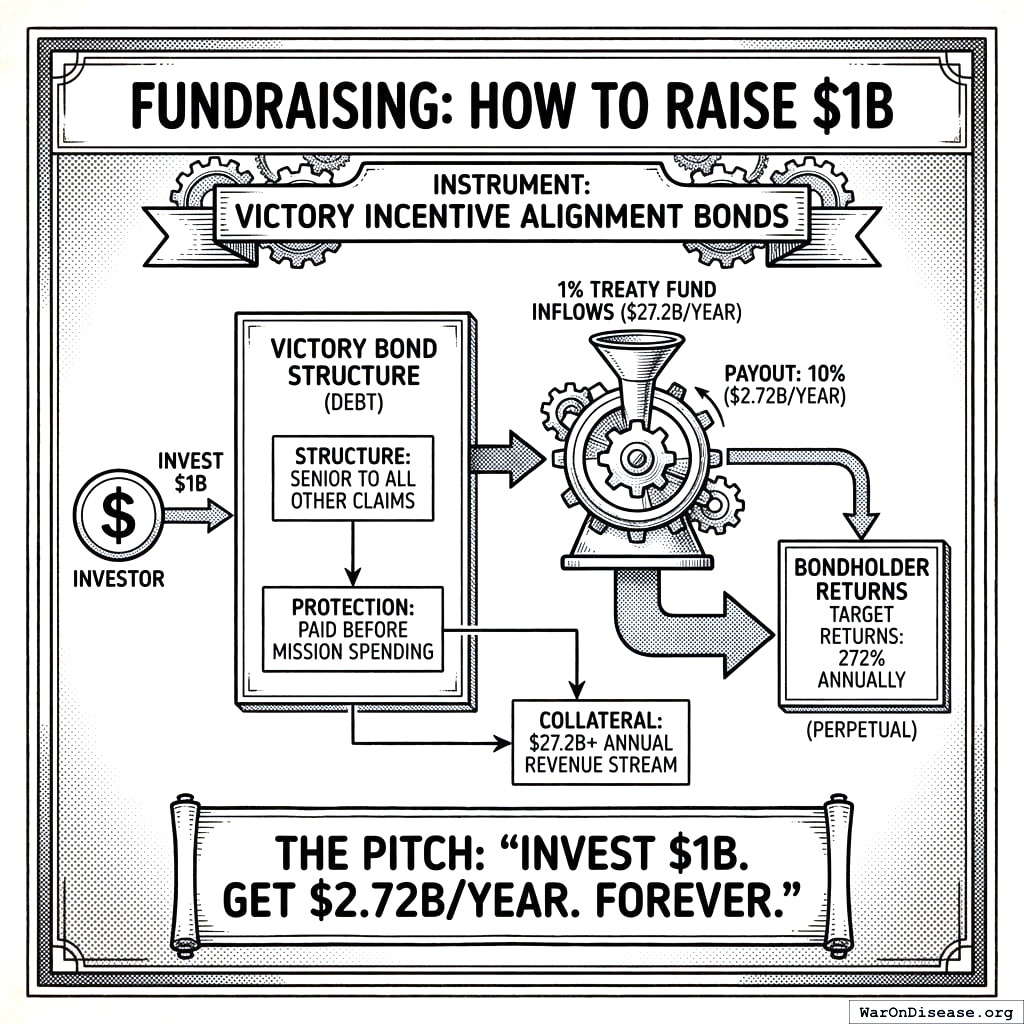
You raise $1 billion in 12-24 months. Donations require generosity. Bonds require greed. Your species has a reliable, well-documented surplus of exactly one of these.
Why $1 billion? Your opposition spends $450M/year to keep things exactly as terrible as they are (pharma lobbying at roughly $300M/year plus the military-industrial complex at roughly $150M/year). A subscription to suffering. You raise $1 billion once to pass a treaty that generates $27.2 billion/year forever. Over a 10-year campaign, opposition spends roughly $4.5B to your $1 billion. But their $450M/year is spread across thousands of contracts and dozens of incumbents. Your $1 billion is aimed at a single treaty. Concentrated offense beats diffuse defense. It’s military strategy, the only kind your species respects. These are tranches of the bond raise (the Incentive Alignment Bond product), not the Earth Optimization Fund, which is a different product for a different job: bonds fund the campaign, the Fund buys the companies. The campaign borrows like a war effort, not like a startup.
| Tranche | Amount | Activities | Milestone | Difficulty Level |
|---|---|---|---|---|
| First | $250-400M | Platform, policy frameworks, pilots | 50M verified participants | “Convince a few billionaires” |
| Second | $500M-1B | Scale to G7 nations | Majority-of-humanity path credible (51.6% (90% CI: 50.5%-52.7%) target, 3.5% (95% CI: 1%-10%) benchmark) | “Convince several countries” |
| Third | $500M-1.1B | Ratification push in major powers | First $1B disbursement | “Convince the countries with nukes” |
Ranges cover best to worst case. The $1 billion target is the base case; upper bounds cover contingencies because convincing nuclear powers to behave rationally occasionally requires overtime. The tranches are not fully additive: the $1 billion base case is the first tranche at its floor plus the second at its floor, with the third as the contingency path and the reserve absorbing overlap.
Who Funds What
“Raise $1 billion” hides several different funding problems with several different best funders. Foundations are best at funding proof. Investors are best at funding pressure. Governments are the only actors big enough to fund the permanent system.
Legally, the 501(c)(3) proof layer can describe the first referendum stage as a non-binding educational survey. Strategically, it is the first layer of the verified voter bloc you later use to make politicians sweat through their suits.
| Step | What gets funded | Best funder | Why this funder fits |
|---|---|---|---|
| Machine-building | Legal setup, first hires, data room, bond model, early prototype | Mission-aligned angels, tech billionaires, crypto whales | Fast, unrestricted capital for startup risk |
| Proof layer | Referendum platform, security audit, country models, pilot-country proof of demand | Foundations, disease philanthropies, anchor donors | Best fit for research, education, software, and non-binding survey work |
| Political machine | Global Referendum scale-up, lobbying, electoral pressure, treaty campaign | VICTORY Incentive Alignment Bonds, family offices, hedge funds, converted military contractors, major 501(c)(4) donors | This is political infrastructure, not normal philanthropy |
| Permanent system | Clinical-trial funding after ratification | Treaty signatories | Only governments can provide $27.2 billion/year at durable scale |
Pillar 2: The Spending Part (Spend $1 billion)
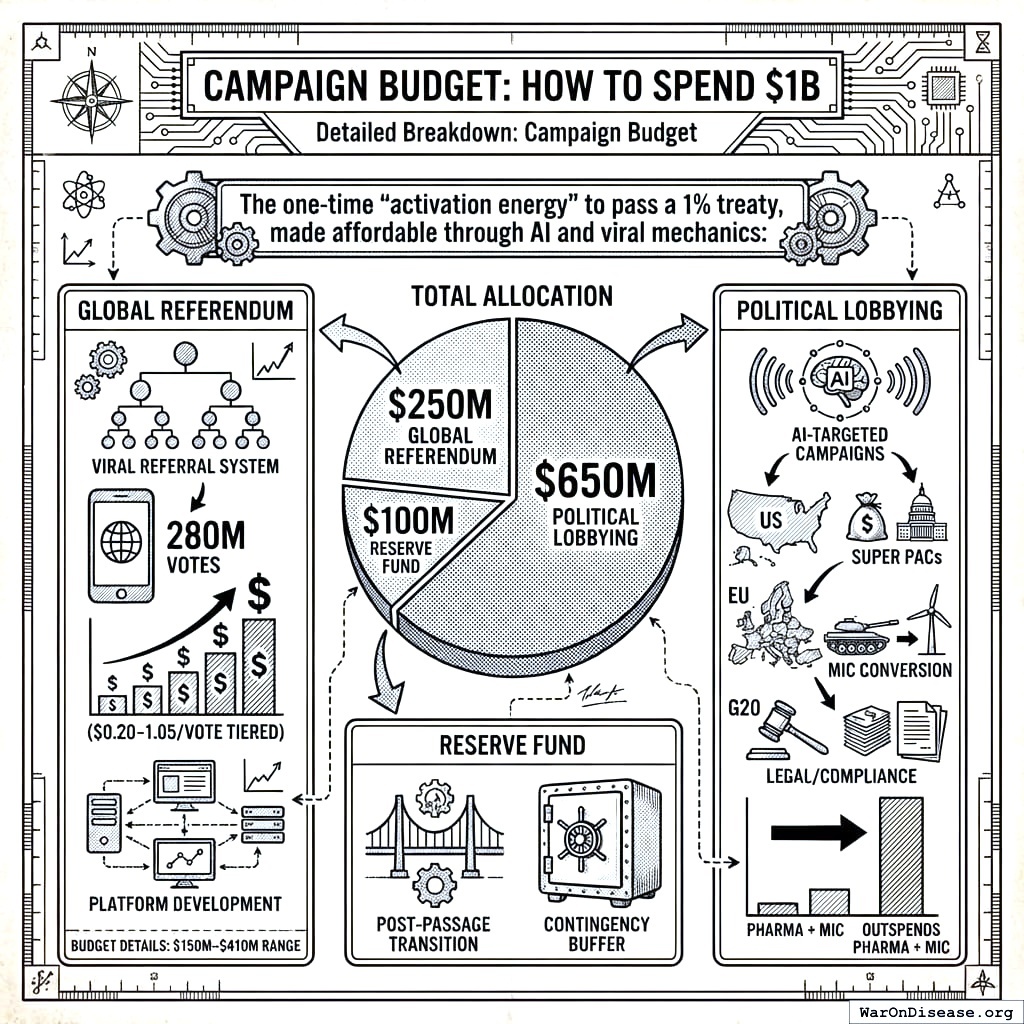
The one-time activation energy to convince 8 billion people to marginally reduce their commitment to mutual annihilation. Detailed line items here.
| Category | Amount | Purpose |
|---|---|---|
| Global Referendum | $250 million |
Viral referral system, 280 million votes, platform development. Budget details |
| Political Lobbying | $650 million |
AI-targeted campaigns (US/EU/G20), Super PACs, MIC conversion. Outspends pharma + MIC |
| Reserve Fund | $100 million |
Post-passage transition, contingency buffer |
The Part That Makes It Cheap
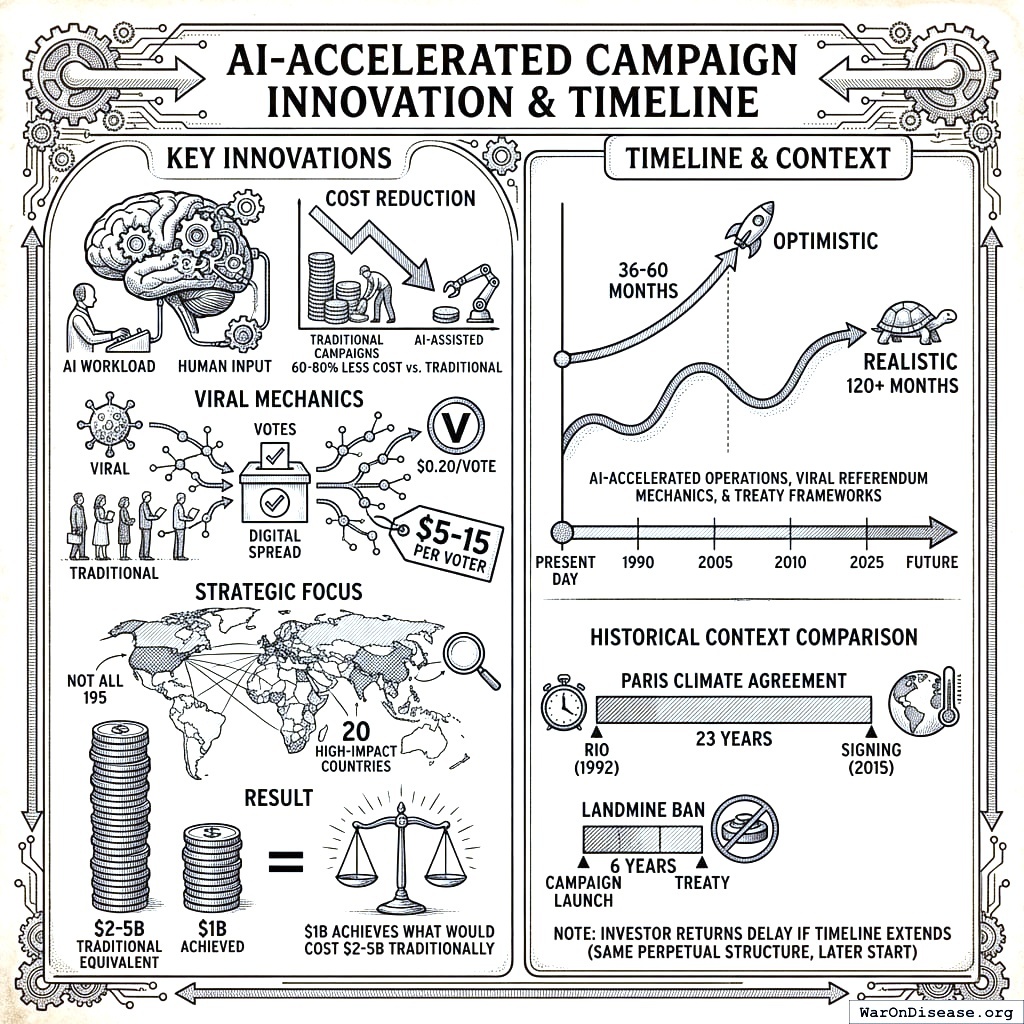
Viral referendum mechanics bring the cost down to $0.20/vote at the optimistic lower bound (base case $0.50-0.89), compared to $5-15 per voter through traditional channels. Getting someone to click “I prefer not dying” costs less than getting someone to click “I prefer Pepsi.” You also focus on 20 high-impact countries, not all 195. You don’t need Liechtenstein’s permission. Liechtenstein has 39,000 people. That’s a concert venue, not a geopolitical obstacle.
Timeline is 36-60 months (optimistic) to 120+ months (realistic, given that you’re humans). The landmine ban took 6 years, and that was just agreeing not to hide explosives in the ground, which you’d think wouldn’t require a treaty at all. You’re betting on viral referendum mechanics and existing disarmament frameworks.
Pillar 3: The Forever Part (Manage $27.2 billion+/Year)
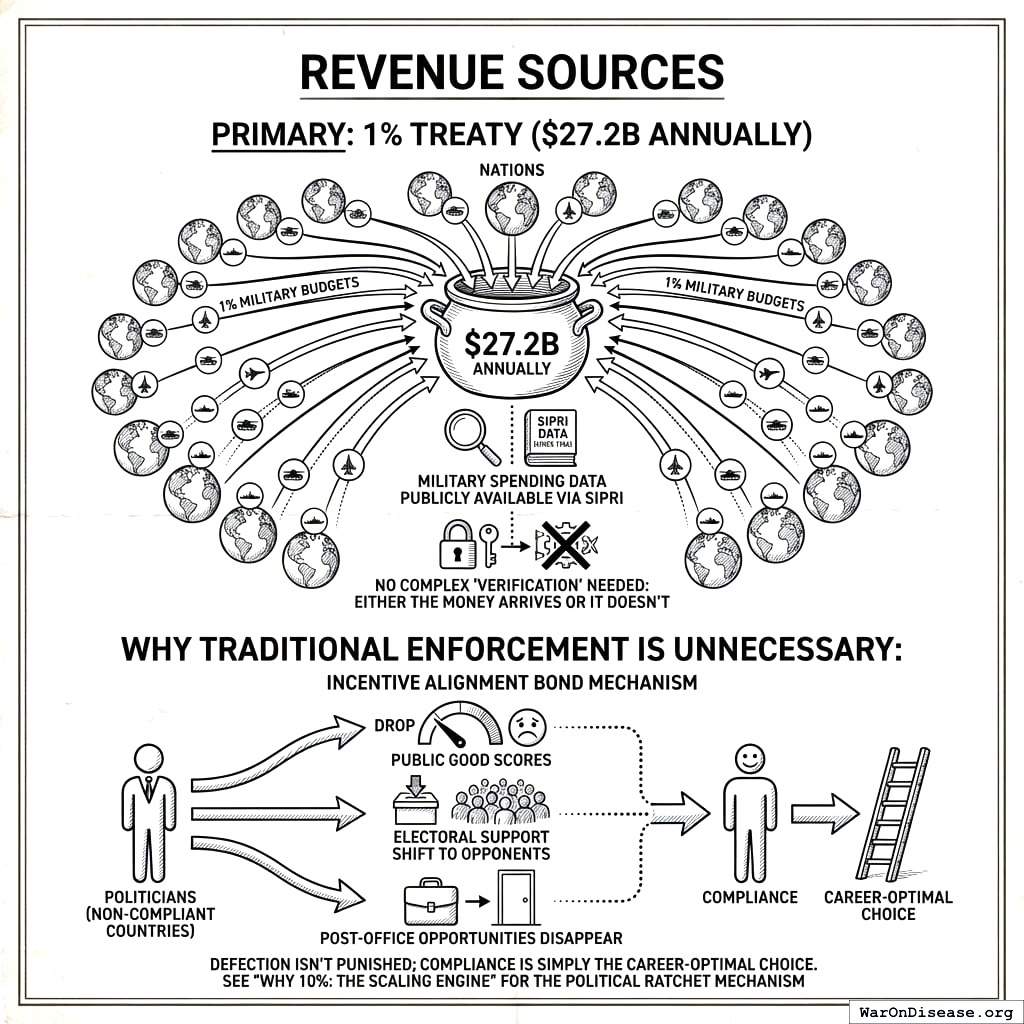
Once the treaty passes, $27.2 billion flows annually from “how to kill people” budgets into “how to stop people dying” budgets. This is the part where your financial plan stops being a financial plan and starts being a money volcano that erupts on schedule, forever.
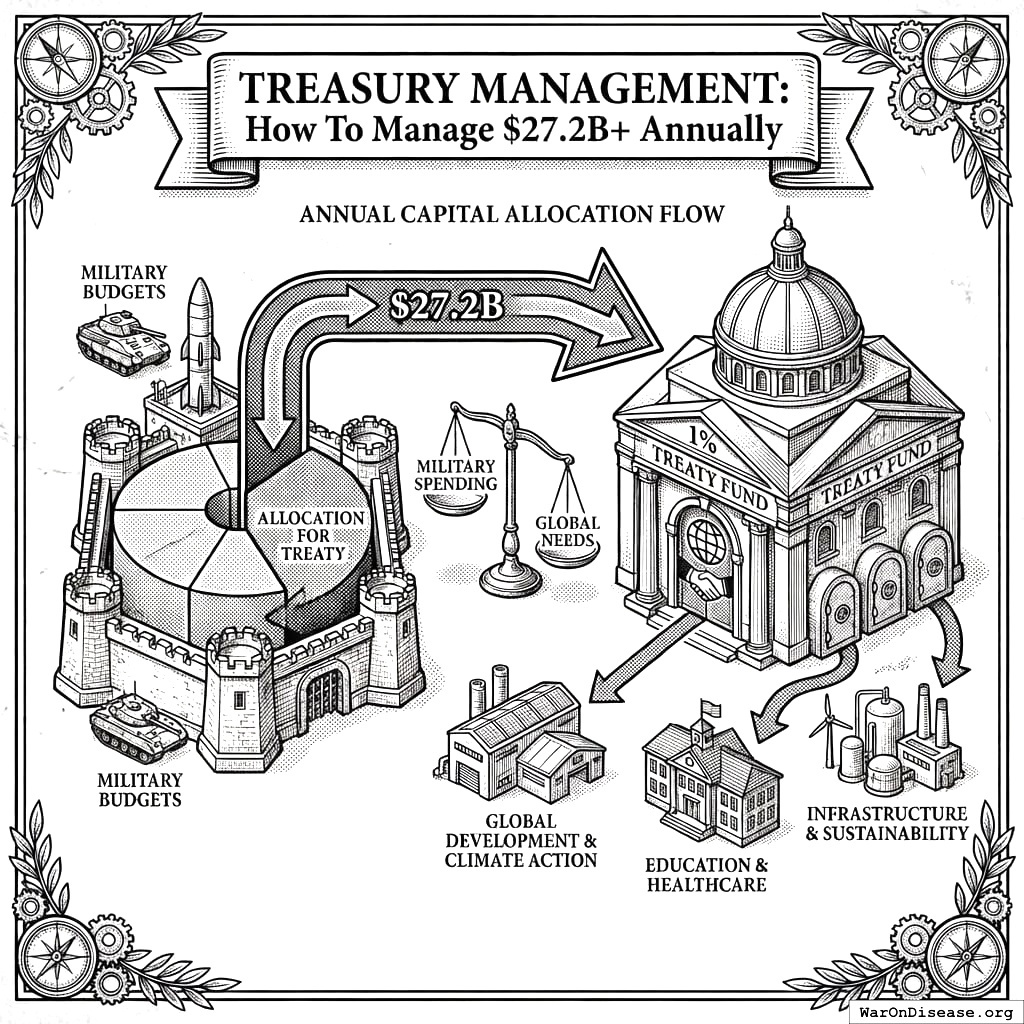
100+ nations contribute 1% of military budgets. Not because they’ve had a moral awakening. Because the Incentive Alignment Bond mechanism makes compliance self-enforcing: politicians in non-compliant countries watch their Treaty Support Scores fall (the 1% Treaty-specific subtype of the Public Good Score1 2). Independent PACs redirect millions in campaign funding to their opponents, and their post-office career options shrink from WHO boards to writing memoirs nobody reads. Compliance becomes the best career move. You don’t need politicians to be good. You just need them to be selfish in the right direction.
How the Money Gets Spent: 80/10/10
The allocation is fixed by the treaty and implemented through the fund’s governing documents. The campaign-bond corporation (the separate special-purpose company that issues the bonds) handles the money: collecting treaty payments and sending investor checks, while the political-incentive slice funds the separate scoring, electoral, and post-office entities described in the Legal Framework. No committees. No debates. No one arguing for six months about font choices on the grant application. Just math, executing on schedule, like a competent employee (something most of your governments have never experienced).
| Allocation | Percentage | Annual Amount | Purpose |
|---|---|---|---|
| Clinical Trials & Platform | Patient subsidies, research, platform | ||
| VICTORY Bond Returns | 10% |
Perpetual investor payments | |
| IAB Political Incentives | 10% |
Rewards for supporting legislators |
The 20% for bonds and political incentives is fixed by the same treaty and fund rules. Management cannot reallocate it because somebody had a better idea after lunch. Lunch has ended more good budgets than war. Where automation works, the distributions happen mechanically. Where the real world insists on banks, custodians, and auditors, the same formula still applies. Humans may run the payment systems. They do not get to improvise the percentages.
The remaining 80% ($21.8 billion/year) funds clinical trials and research infrastructure. Patients direct trial-participation spending by joining studies. Wishocracy3 governs infrastructure and other shared public-good allocations.
Dynamic Patient Subsidies
Instead of paying researchers to write about diseases, you pay patients to help cure them. You pay the sick people. On Earth this is considered a radical idea.
Base Subsidy = Medical Research Allocation / Active Trial Participants

Example with 1M participants:

$21.8 billion / 1M = ~$21,800 per patient per year

(Note: 80% of $27.2 billion goes to medical research after bond and IAB payouts)

As more patients join:

5M participants = ~$4,360 per patient
10M participants = ~$2,180 per patient
Patients organize to grow the treasury, because participating in their own survival is, for once, financially rewarded. Researchers and biotech companies compete to attract patients instead of competing to write persuasive grant applications, which is a different skill from doing science, the same way writing a restaurant review is a different skill from cooking. Insurance companies save money because trials are cheaper than decades of chronic suffering. Compare that to NIH grants: 6 months of proposal writing, committees judging the writing, universities skimming 40% overhead, and then maybe some science.
The Whole Thing on One Line
Your species spent roughly $5 billion on a particle accelerator to find a boson. This costs less and finds a cure for dying.
The five questions are at the end of the recruitment plan. Find the number that’s wrong, or forward this to someone with a checkbook and 45 minutes.