Opening requested calculation...
Please wait, this takes like 47 seconds. Thank you for your patience! :)
☠
0 humans have been terminated by curable diseases since this page started loading
Here is the complete accounting of humanity’s commitment to curing disease. Spoiler: It’s largely an accounting trick.
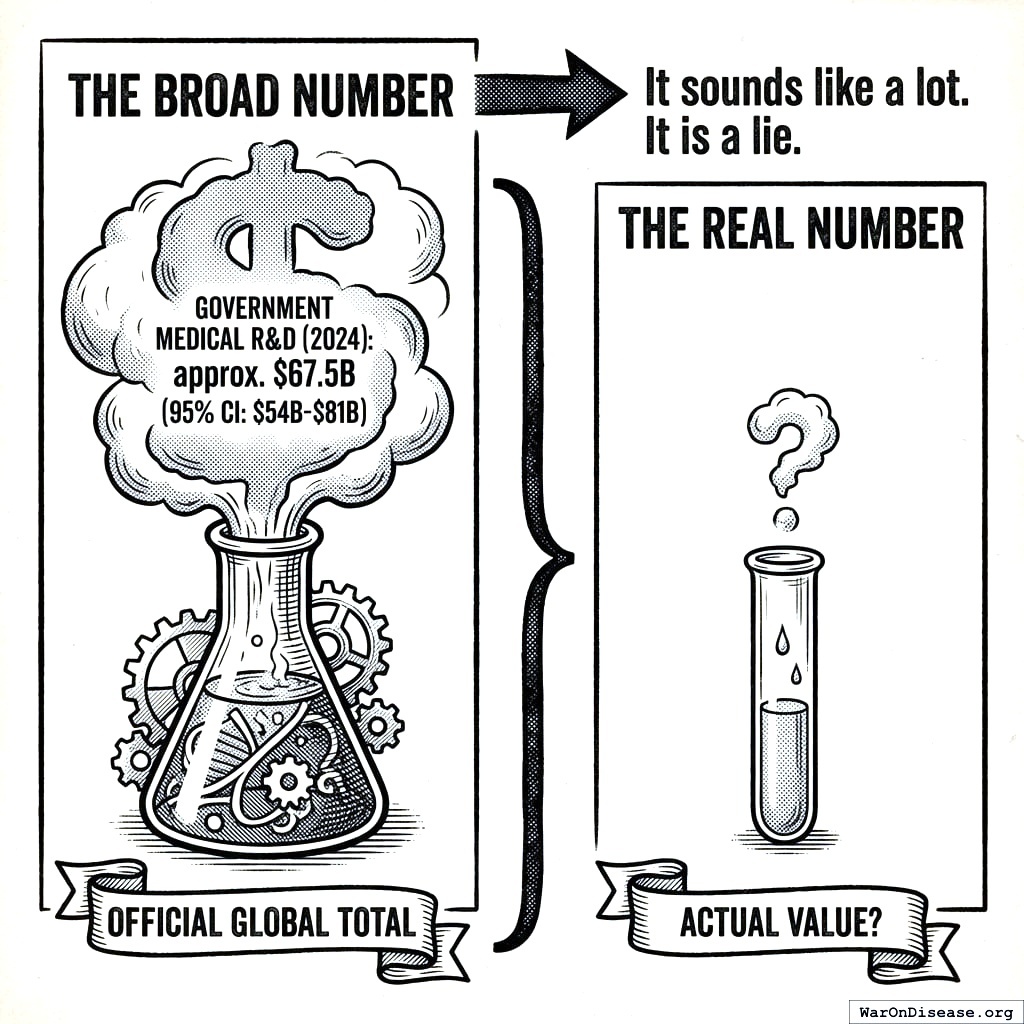
The Broad Number vs. The Real Number
Governments claim they spend billions on “medical research.” In 2024, the official global total for government medical R&D was approximately $67.5 billion (95% CI: $54 billion-$81 billion).
It sounds like a lot. It is a lie.
The Accounting Trick
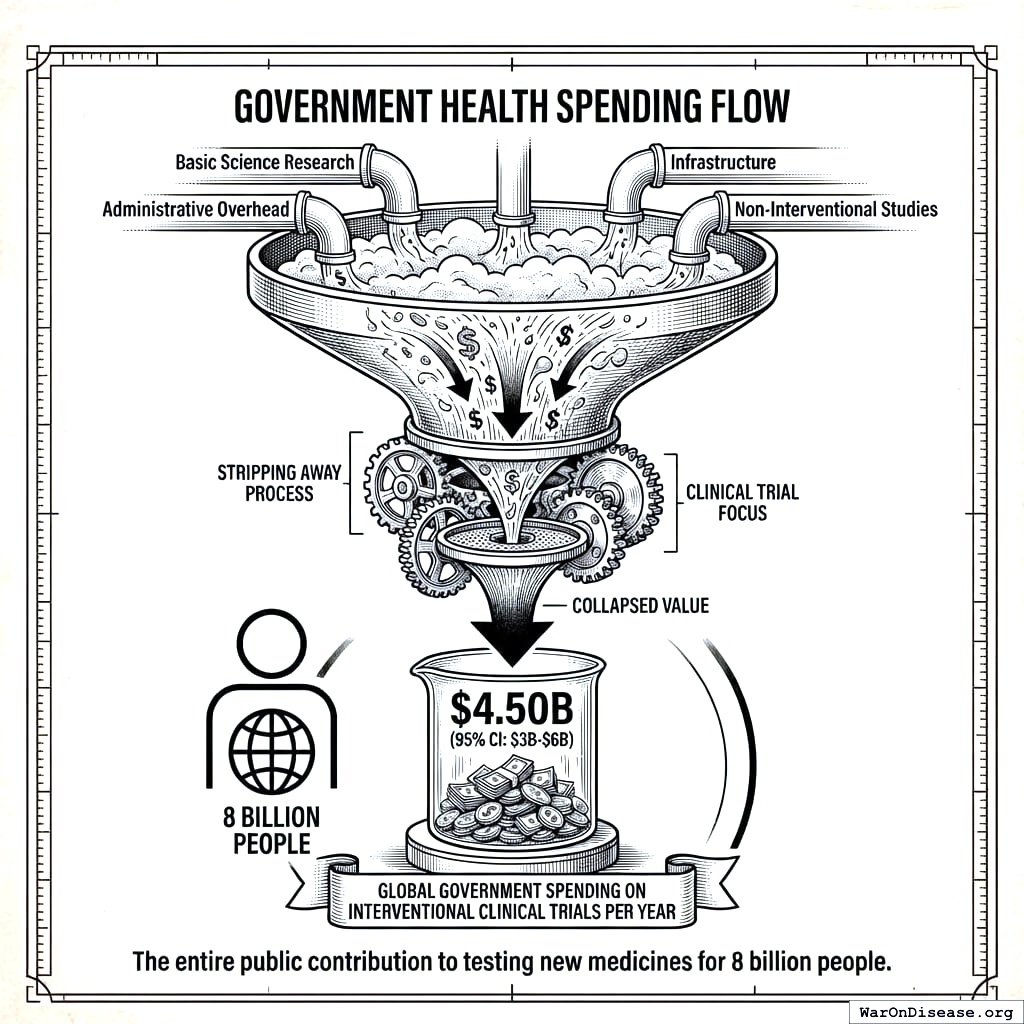
That $68 billion figure includes: 1. Basic Science: Studying fruit fly genetics and yeast cells (important, but not a cure). 2. Overhead: University buildings, admin salaries, and electricity bills (often 40-60% of grants). 3. Bureaucracy: Salaries for the people who decide where the money goes. 4. Epidemiology: Counting how many people have died (instead of saving them).
When you strip away the overhead and basic science to ask “How much do governments spend on actually testing cures in humans?” the number collapses.
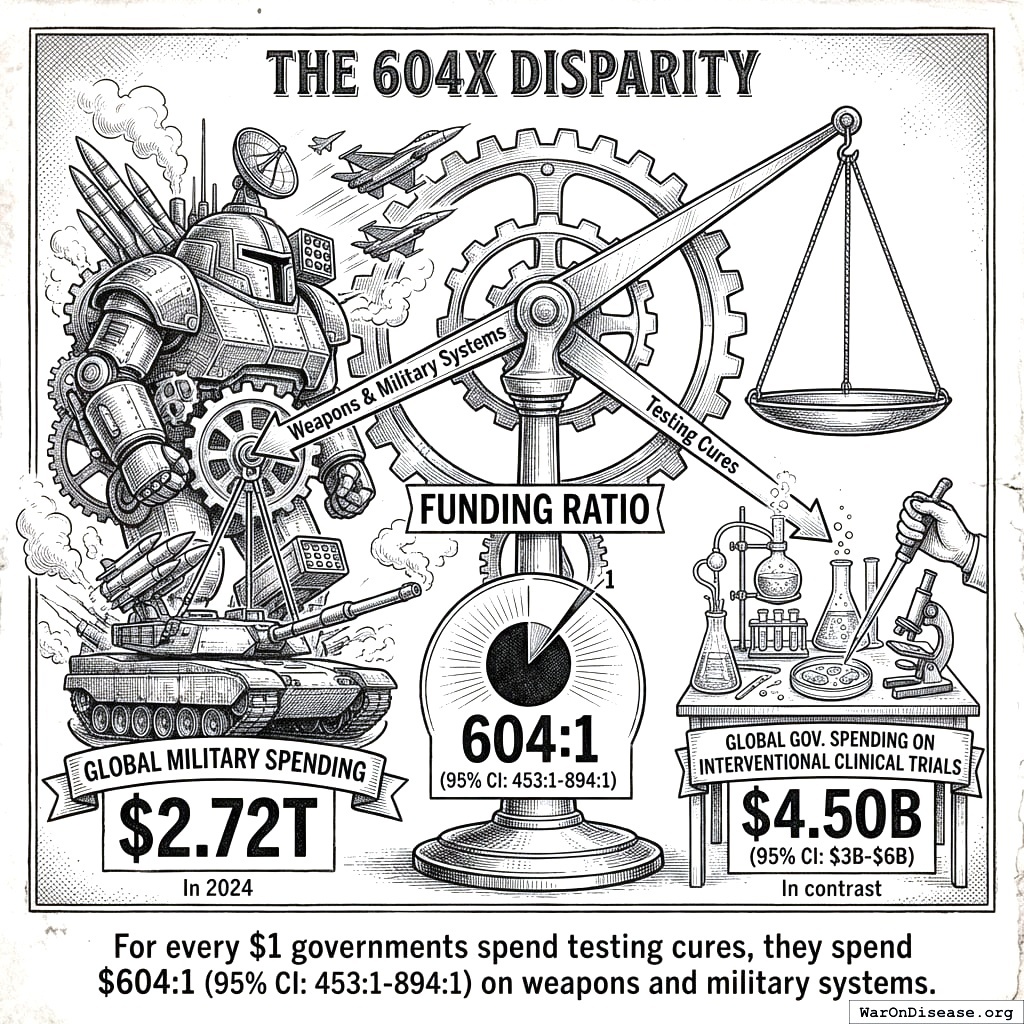
Global government spending on interventional clinical trials is only ~$4.5 billion (95% CI: $3 billion-$6 billion) per year.
That is the entire public contribution to testing new medicines for 8 billion people.
The Industry Trap
“But doesn’t the pharmaceutical industry fund trials?”
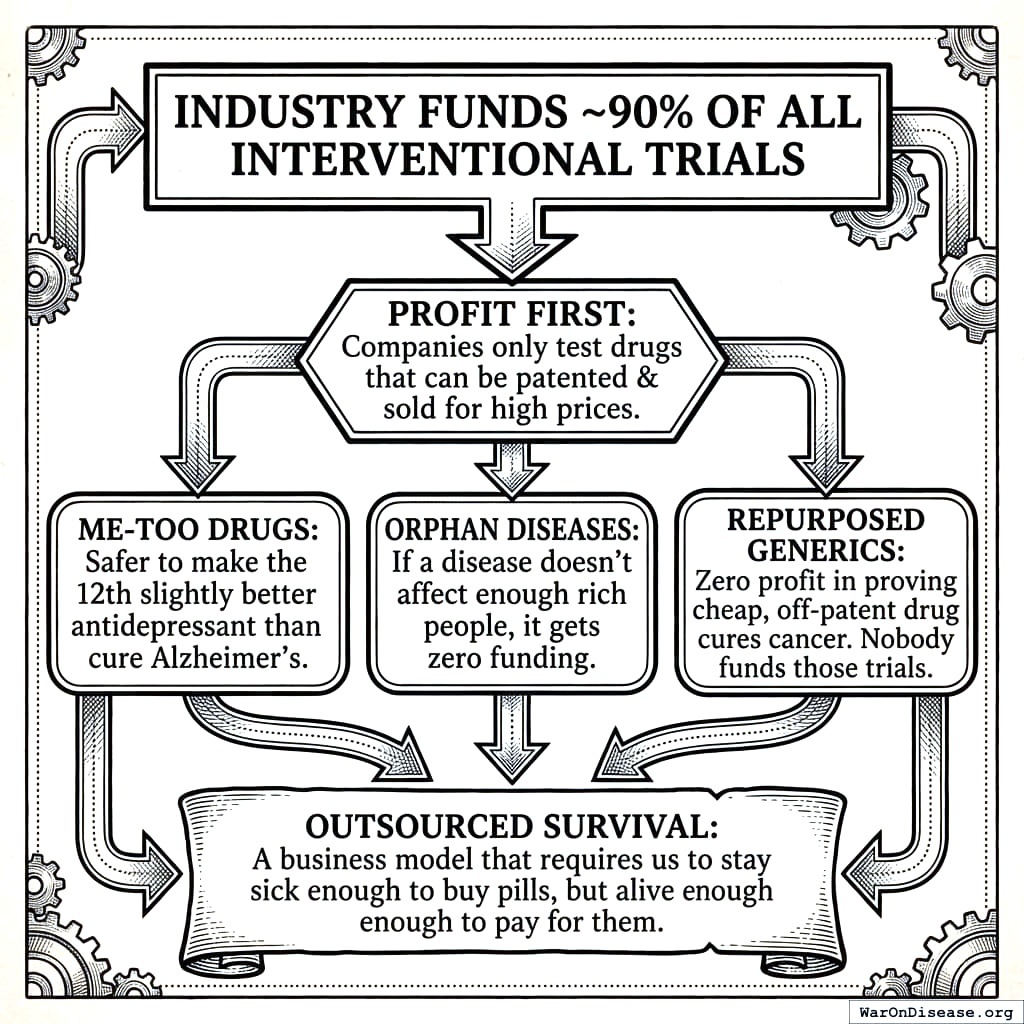
Yes. In fact, industry funds ~90% of all interventional trials. The ratio of Industry to Government spending is 12.3 (90% CI: 8.23-19.3).
This creates a fatal incentive structure: 1. Profit First: Companies only test drugs that can be patented and sold for high prices. 2. Me-Too Drugs: It is safer to make the 12th slightly better antidepressant than to cure Alzheimer’s. 3. Orphan Diseases: If a disease doesn’t affect enough rich people, it gets zero funding. 4. Repurposed Generics: There is zero profit in proving that a cheap, off-patent drug cures cancer. So nobody funds those trials.
We have outsourced our survival to a business model that requires us to stay sick enough to buy pills, but alive enough to pay for them.
Broad R&D Breakdown: The Hall of Shame
Note: These figures refer to the broader “Medical Research” budgets (the $67.5 billion (95% CI: $54 billion-$81 billion) figure), not the specific clinical trial spending.
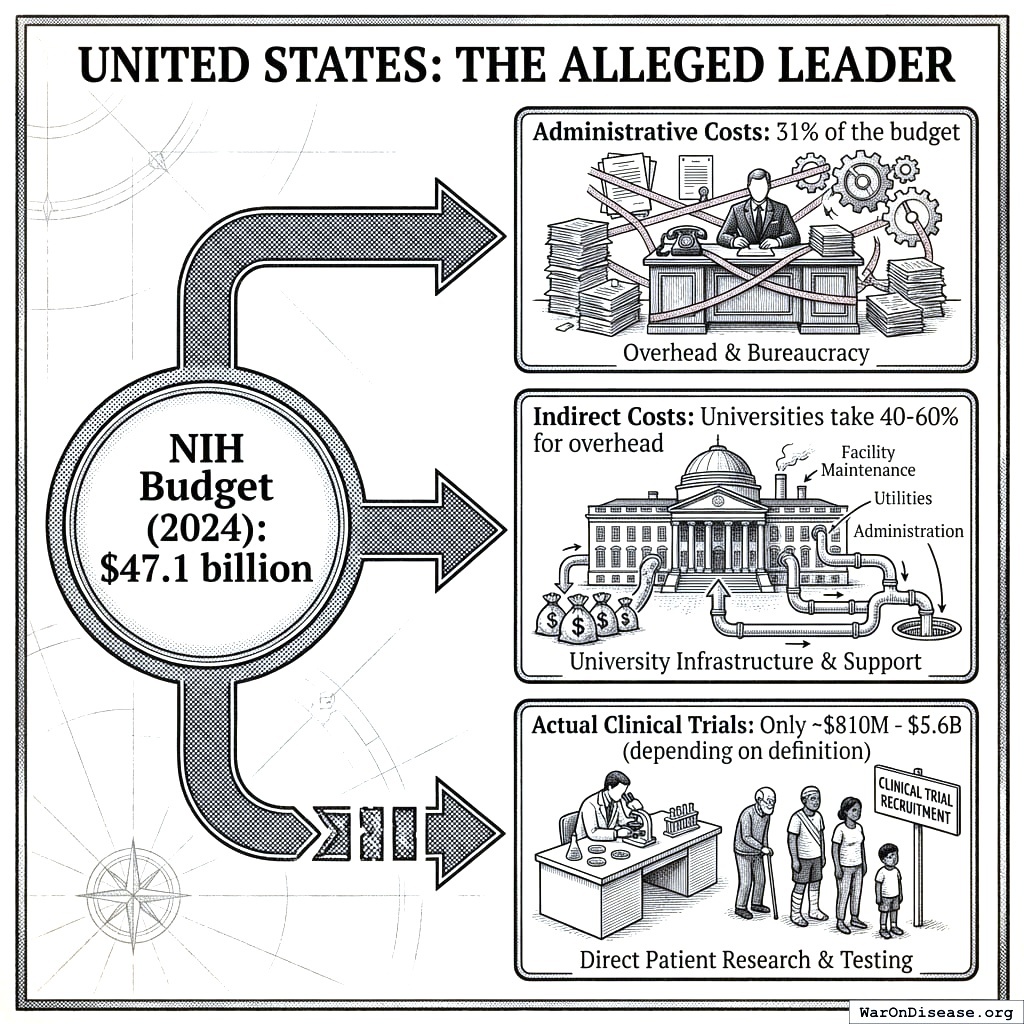
United States: The Alleged Leader
NIH Budget (2024): $47.1 billion1
- Actual Clinical Trials: Only ~$810M - $5.6B2 (depending on definition).
- Administrative Costs: 31%3 of the budget.
- Indirect Costs: Universities take 40-60%4 for overhead.
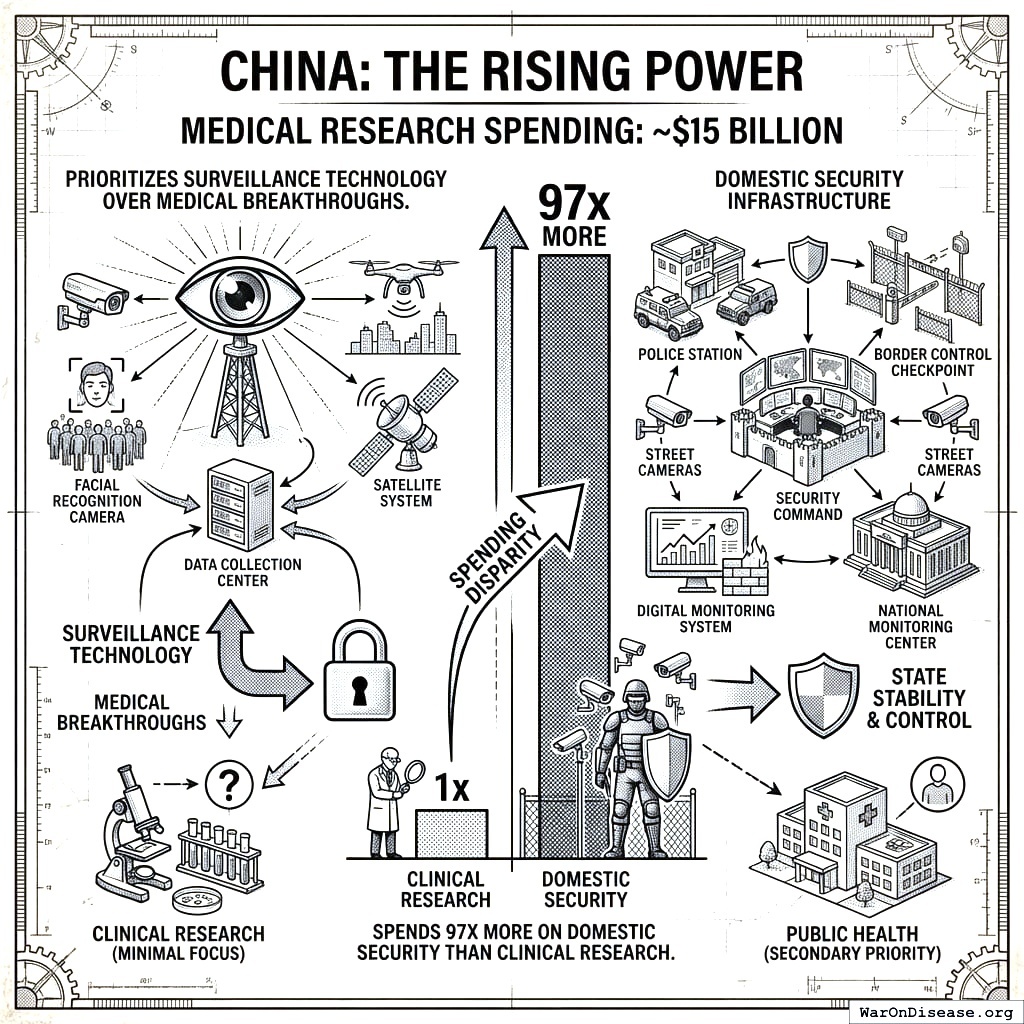
China: The Rising Power
Medical Research Spending: ~$15 billion5
- Prioritizes surveillance technology over medical breakthroughs.
- Spends 97x more6 on domestic security than clinical research.
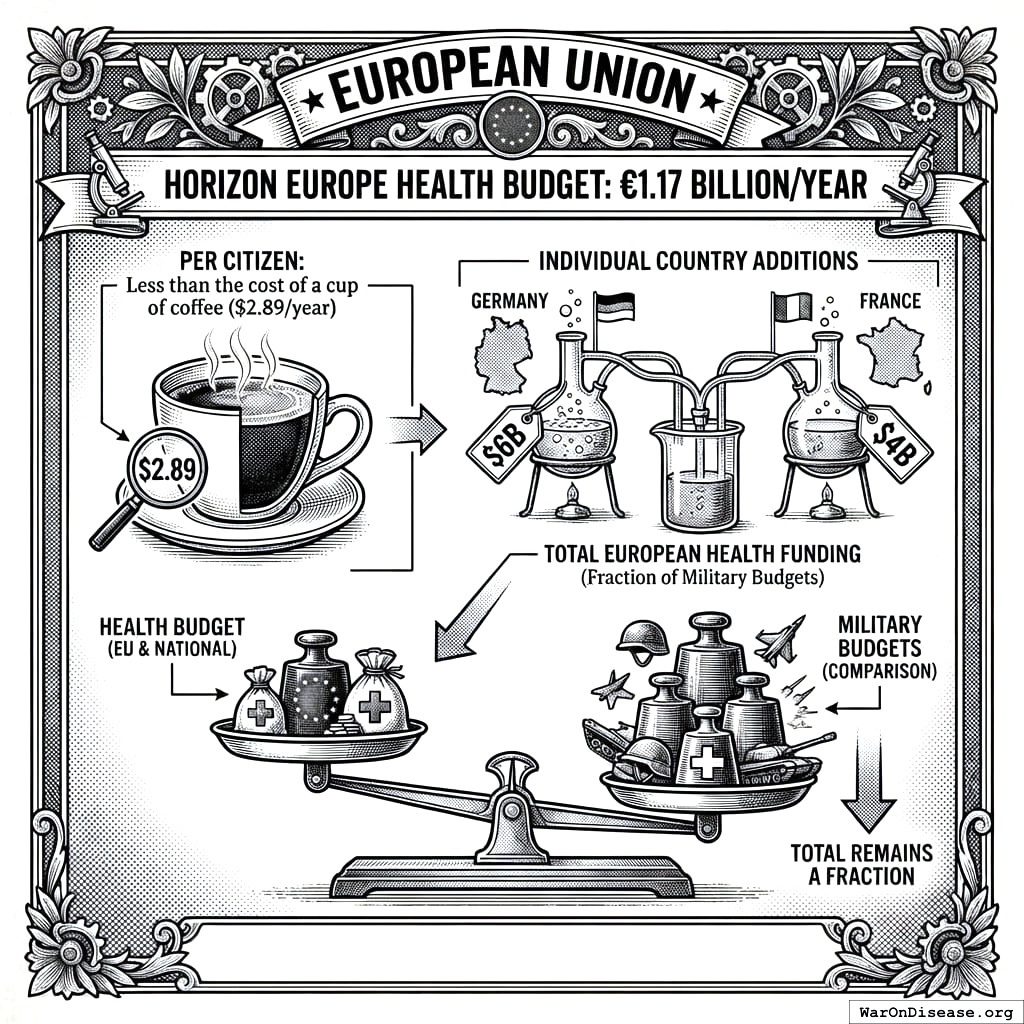
European Union
Horizon Europe Health Budget: €1.17 billion/year7
- Per citizen: Less than the cost of a cup of coffee ($2.89/year).
- Individual countries like Germany ($6B) and France ($4B) add to this, but the total remains a fraction of their military budgets.
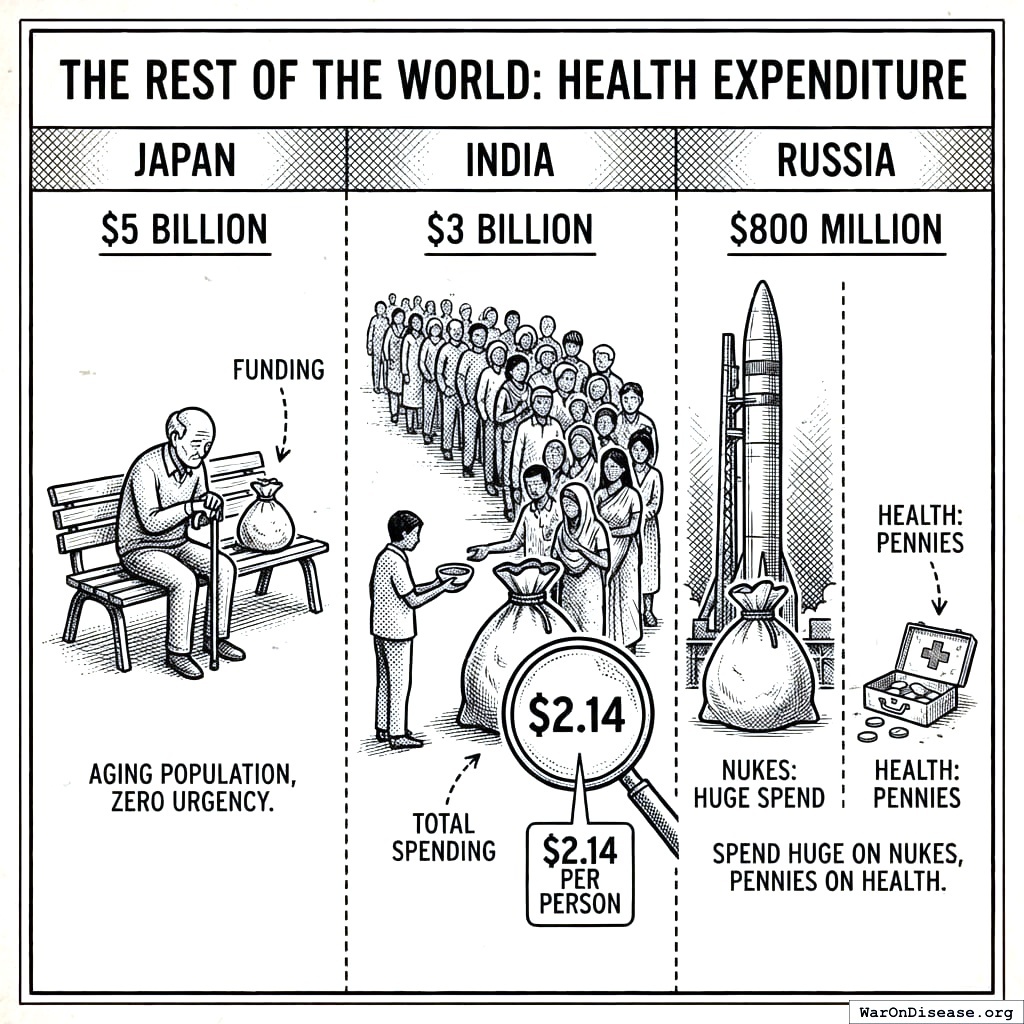
The Rest of the World
- Japan: $5 billion8 (Aging population, zero urgency).
- India: $3 billion9 ($2.14 per person).
- Russia: $800 million10 (Spend huge on nukes, pennies on health).
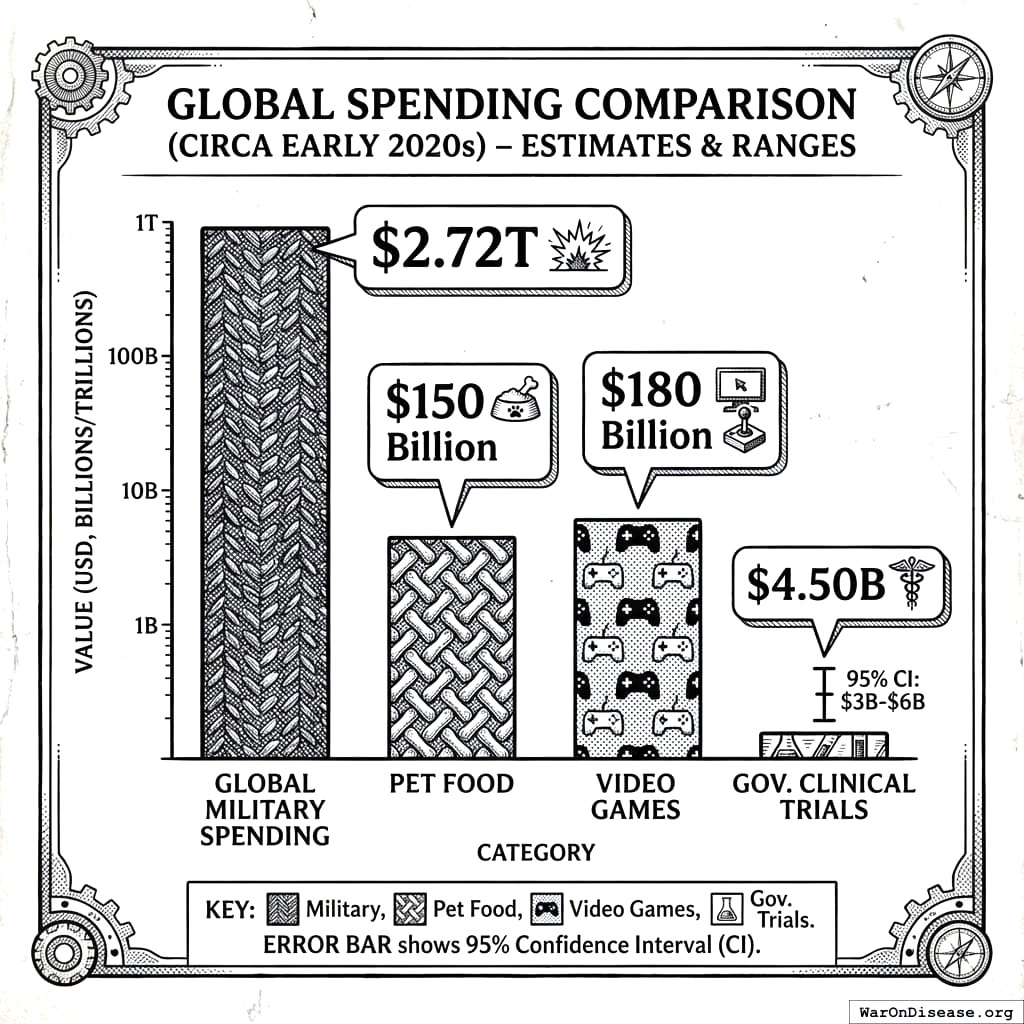
Conclusion: A Species-Wide Failure
We are the only species that pays for its own extinction while claiming it cannot afford its own survival.
- Global Military Spending: $2.72 trillion
- Pet Food: $150 Billion
- Video Games: $180 Billion
- Government Clinical Trials: $4.5 billion (95% CI: $3 billion-$6 billion)
We value our dogs’ dinner 30x more than finding cures for our children.
The solution is the 1% Treaty11 12: shifting just 1% of military spending ($27.2 billion) would increase global government clinical trial funding by 600%. We could run tens of thousands of pragmatic trials annually, breaking the industry monopoly on what gets tested and cured.
1.
NIH. NIH budget (FY 2025).
NIH https://www.nih.gov/about-nih/organization/budget (2024)
The budget total of $47.7 billion also includes $1.412 billion derived from PHS Evaluation financing... Additional sources: https://www.nih.gov/about-nih/organization/budget | https://officeofbudget.od.nih.gov/
.
2.
PMC. NIH phased trial spending for approved drugs 2010-2019.
PMC https://pmc.ncbi.nlm.nih.gov/articles/PMC10349341/ NIH spent $8.1 billion on phased clinical trials of 387 drugs that were approved between 2010 and 2019. Additional sources: https://pmc.ncbi.nlm.nih.gov/articles/PMC10349341/
.
3.
American Action Forum. NIH administrative costs percentage (31%).
American Action Forum: NIH 15 https://www.americanactionforum.org/weekly-checkup/nihs-15-percent-cap-leaner-budgets-stronger-science/ Indirect costs (facilities & administration): Historically averaged 27-28% of total grant costs FY2023: $9B indirect costs out of $35B total competitive grants (26% of total) Institution-specific rates varied: Harvard 69%, Yale 67%, UPenn 62.5%, MIT 59%, Stanford 55% Average base rate: 52% overhead on direct costs (meaning $52K overhead per $100K research grant = 34% of total) February 2025: NIH imposed 15% cap on indirect cost rates for all grants Additional sources: https://www.americanactionforum.org/weekly-checkup/nihs-15-percent-cap-leaner-budgets-stronger-science/ | https://www.feldesman.com/a-major-fumble-in-research-grants-nih-unilaterally-caps-indirect-costs-at-15-percent-in-open-grants-to-universities-and-research-institutions/
.
4.
AAU. University indirect costs on research grants (40-60%).
AAU https://www.aau.edu/key-issues/frequently-asked-questions-about-facilities-and-administrative-fa-costs-federally Universities typically have a negotiated F&A (Facilities & Administrative) rate between 40-60 percent, though many organizations charge indirect rates of over 50% and in some cases over 60%. Additional sources: https://www.aau.edu/key-issues/frequently-asked-questions-about-facilities-and-administrative-fa-costs-federally | https://research.ucdavis.edu/3-things-to-know-about-indirect-costs-aka-fa/
.
5.
China National Statistics. China’s medical research spending (2024): $15 billion.
China National Statistics: R&D 2024 https://www.stats.gov.cn/english/PressRelease/202502/t20250207_1958579.html (2024)
Total R&D spending: 3.6 trillion yuan ( $500B USD, 2024), 2.68% of GDP Basic research: 249.7 billion yuan ( $35B), 6.91% of total R&D (10.5% increase from 2023) Life sciences is priority area alongside quantum tech, materials science, space China is world’s 2nd largest R&D spender after US ($784B vs $723B in 2023) Note: Specific health/medical research breakdown not publicly reported; life sciences receives increasing investment Additional sources: https://www.stats.gov.cn/english/PressRelease/202502/t20250207_1958579.html | https://www.globaltimes.cn/page/202501/1327442.shtml
.
6.
Nikkei Asia. China spending on surveillance vs. medicine.
Nikkei Asia: China Public Security https://asia.nikkei.com/static/vdata/infographics/china-spends-more-on-controlling-its-1-dot-4bn-people-than-on-defense/ Domestic security/surveillance: 1.45 trillion yuan (2023) Healthcare (public expenditure): 2.24 trillion yuan (2023) Domestic security spending first exceeded military budget in 2010 2017: $197B domestic security ($349B PPP basis), more than double US’s $165B Note: While healthcare receives more total funding, domestic security spending has tripled in past decade, emphasizing internal stability control Additional sources: https://asia.nikkei.com/static/vdata/infographics/china-spends-more-on-controlling-its-1-dot-4bn-people-than-on-military/ | https://jamestown.org/program/chinas-domestic-security-spending-analysis-available-data/
.
7.
HRB. Horizon europe health budget (2021-2027): €8.2 billion.
HRB: Horizon Europe Health Information https://www.hrb.ie/funding/funding-opportunities/eu-funding-support/horizon-europe-information/ Horizon Europe total budget: €95.5 billion (2021-2027) Cluster 1 "Health": €8.246 billion dedicated to health research Alternative figures: €7.7B (some sources) or €8.3B (including Next Generation EU: +€1.1B) Managed by: Health and Digital Executive Agency (HaDEA) Pillars structure: Cluster 1 Health falls under Pillar 2 (Global Challenges) Note: Most consistent official figure is €8.246B for Cluster 1 Health. Variations reflect different components or inclusion of Next Generation EU supplemental funds Additional sources: https://www.hrb.ie/funding/funding-opportunities/eu-funding-support/horizon-europe-information/ | https://hadea.ec.europa.eu/programmes/horizon-europe/health_en | https://www.healthncp.net/horizon-europe
.
8.
PMC. Japan medical research spending: $5 billion/year.
PMC: Limited Alignment Disease Funding Japan https://www.ncbi.nlm.nih.gov/pmc/articles/PMC7010241/ Publicly competitive health R&D funding: 344.1B JPY ( $3B USD) for 32,204 projects in 2015-2016 Japan Agency for Medical Research & Development (AMED): 660B yen ( $6B USD) funded since establishment Pharmaceutical R&D: 1.43 trillion yen ( $13B USD) by Japanese pharma companies in FY2022 Total R&D across all fields (FY2022): 20.7 trillion yen (most for natural sciences including health) Note: "$5B" is reasonable estimate for government health R&D; AMED alone $6B total; pharma private R&D much higher ( $13B) Additional sources: https://www.ncbi.nlm.nih.gov/pmc/articles/PMC7010241/ | https://www.nature.com/articles/d42473-020-00051-w | https://pmc.ncbi.nlm.nih.gov/articles/PMC10434904/ | https://www.statista.com/statistics/1108205/japan-research-and-development-expenses-pharmaceutical-industry/
.
9.
ACS. India medical research spending: $1.2 billion.
ACS: India Budget Biotech Health https://cen.acs.org/policy/research-funding/India-prioritizes-new-research-foundation-biotech-and-health-in-new-budget/99/web/2021/03 (2021)
Current pharma & MedTech R&D: $3 billion (vs US $50-60B, China $15-20B) Department of Health Research budget 2025-26: Rs. 3900.69 crores ($467M USD) Recent budget: Rs 3,201 crore ($419.2M) Historical health research funding: US $1,053M (2007-08) → $1,423M (2011-12), 8.8% annual increase Public health spending: 1.2% of GDP (among lowest globally) Healthcare infrastructure need: $1.2 trillion (NITI Aayog 2022 report) Note: "$1.2 billion" may refer to historical 2011-12 figure ($1.423B). Current: $3B pharma/MedTech, $467M govt budget Additional sources: https://cen.acs.org/policy/research-funding/India-prioritizes-new-research-foundation-biotech-and-health-in-new-budget/99/web/2021/03 | https://nmji.in/mapping-of-health-research-funding-in-india/ | https://dhr.gov.in/documents/budget-reports
.
10.
Frontiers. Russia medical research spending: $800 million.
Frontiers: Promoting Biomedical Communication in Russia https://www.frontiersin.org/journals/communication/articles/10.3389/fcomm.2022.848578/full (2022)
Agency for Strategic Initiatives (ASI): RUB 800M ( USD $11M, 2014-2020) for innovation development NTI (National Technology Initiative): RUB 1,578M ( USD $21.5M, 2019-2020) for pandemic-related healthcare HealthNet roadmap: Focuses on personalized medicine, life expectancy, prevention/treatment Note: "$800M" appears to be RUB 800M (≈ $11M USD) for ASI over 6 years, not $800M USD annually Additional sources: https://www.frontiersin.org/journals/communication/articles/10.3389/fcomm.2022.848578/full | https://www.who.int/observatories/global-observatory-on-health-research-and-development/resources/databases/databases-on-inputs-to-r-d/funding-flows-for-health-r-d-by-country
.
12.
Sinn, M. P.
The 1% Treaty: An Incentive-Compatible Approach to Ending War and Disease.
https://manual.warondisease.org/knowledge/economics/1-pct-treaty-impact.html (2025) doi:
10.5281/zenodo.18161560 6,650 diseases have zero FDA-approved treatments; at current trial capacity, exploring them takes 443 years. Redirecting 1% of military spending scales capacity 12.3x, cutting the timeline to 36 years and preventing 10.7 billion deaths. At $0.02/DALY, 9.3kx more cost-effective than the best existing interventions. The result holds across every specified adoption pathway.
14.
Applied Clinical Trials. Global government spending on interventional clinical trials: $3-6 billion/year.
Applied Clinical Trials https://www.appliedclinicaltrialsonline.com/view/sizing-clinical-research-market Estimated range based on NIH ( $0.8-5.6B), NIHR ($1.6B total budget), and EU funding ( $1.3B/year). Roughly 5-10% of global market. Additional sources: https://www.appliedclinicaltrialsonline.com/view/sizing-clinical-research-market | https://www.thelancet.com/journals/langlo/article/PIIS2214-109X(20)30357-0/fulltext
.