# Aligning Incentives
This manual is not about convincing people to be better. You’ve been trying that for six thousand years and it hasn’t worked once. Every temple, sermon, philosophy lecture, and after-school special in your history has been an attempt to make humans behave nicely, and the result is your current situation, which I think we can all agree is not nice.
This chapter is about something different. It’s about building a system where doing well and doing good are the same thing. Every major interest group gets aligned behind curing disease, not through charity or guilt, but through pure profit. You can’t change what organisms want. You can only change what’s profitable. Then they change themselves, enthusiastically, and take credit for it afterward.
## Military Contractors: Teaching Merchants of Death to Love Life
Military lobbyists spend [\$198 million (95% CI: \$190 million-\$210 million)](../../knowledge/appendix/parameters-and-calculations.llms.md#sec-defense_lobbying_annual) a year on lobbying. They get roughly \$181 billion a year in government contracts back: about \$1,425 returned per dollar, every year. (Over the twenty-year Afghan War, the top five firms alone ran this play at 1,813 to 1^([1](../references.llms.md#ref-lobbying-roi-calc)).) Better returns than any hedge fund in history, and all you have to do is help kill strangers. They will oppose any treaty that threatens this. Not because they’re evil (though that helps), but because murder is profitable and they like money. This is not a moral observation. This is an investment thesis.
Lobbyists are like pigeons. They go where the food is. Currently the food is in lobbying for doomsday devices, which also happens to guarantee that lobbyists, their children, and everyone they love die of preventable diseases in a smaller economy. Nobody in this arrangement benefits from it. They just haven’t done the arithmetic. You could try explaining the arithmetic. Or you could just move the food. This is not a metaphor about pigeons. This is the entire strategy of this chapter, applied to every actor, in every section, until you get tired of hearing it.
### The Offer
You give them [VICTORY Incentive Alignment Bonds](../../knowledge/solution/incentive-alignment-bonds.llms.md)^([2](../references.llms.md#ref-iab-paper-2025)) paying [272%](../../knowledge/appendix/parameters-and-calculations.llms.md#sec-victory_bond_annual_return_pct) annually, which is more than their current salary and stock options. You give them early access, which means they get rich before everyone else, which is the thing your species cares about even more than getting rich (getting rich first). You give them consulting fees, which is legal bribery with a name, and strategic advisor positions, which are fake jobs with real money. This arrangement is absurd. Your species calls it “industry relations” and holds conferences about it.
### The Math
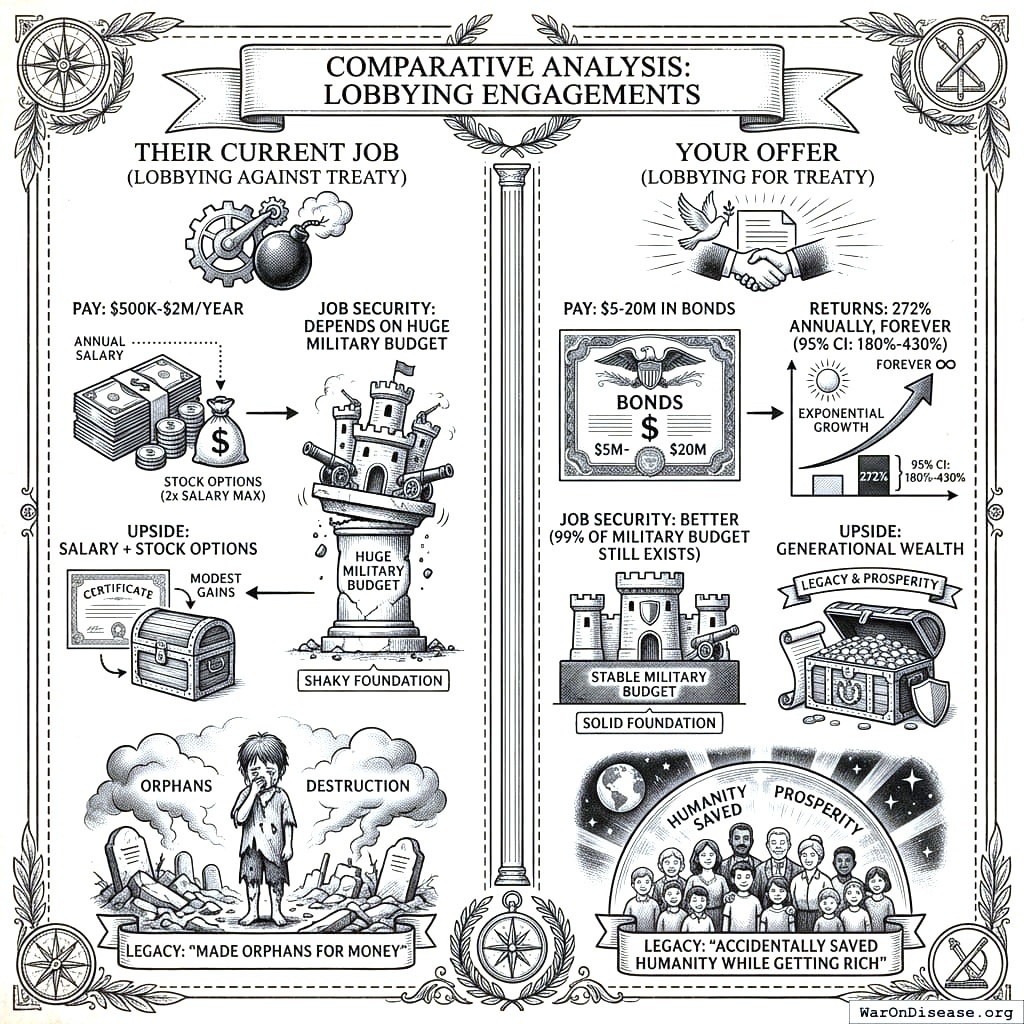
Their current job (lobbying for doomsday devices): pays [\$500,000](../../knowledge/appendix/parameters-and-calculations.llms.md#sec-lobbyist_salary_min_k) to [\$2 million](../../knowledge/appendix/parameters-and-calculations.llms.md#sec-lobbyist_salary_max) per year, depends on military budgets staying huge, guarantees they die of preventable diseases, and leaves a legacy of “made orphans for money.” Your offer (lobbying for the treaty): \$5 million to \$20 million in bonds, returning [272%](../../knowledge/appendix/parameters-and-calculations.llms.md#sec-victory_bond_annual_return_pct) annually for as long as the treaty holds. And since bondholders are billionaires with pre-existing influence over government, good luck repealing it. Legacy: “Accidentally saved humanity while getting rich.” Most people can do this math. You hope.
[](../../assets/images/co-opting-defense-contractors/co-opting-defense-contractors-section-incentive-comparison-bw-academic.jpg)
Current job: Get rich selling weapons; die hated. New job: Get richer ending disease; die beloved. Career pivot, simplified.
### Why They Take It
[272%](../../knowledge/appendix/parameters-and-calculations.llms.md#sec-victory_bond_annual_return_pct) is more than whatever they’re making now. That’s it. That’s the whole reason. I spent years looking for a deeper explanation for human behavior. There isn’t one. It’s money. It’s always money. The deeper explanation IS money.
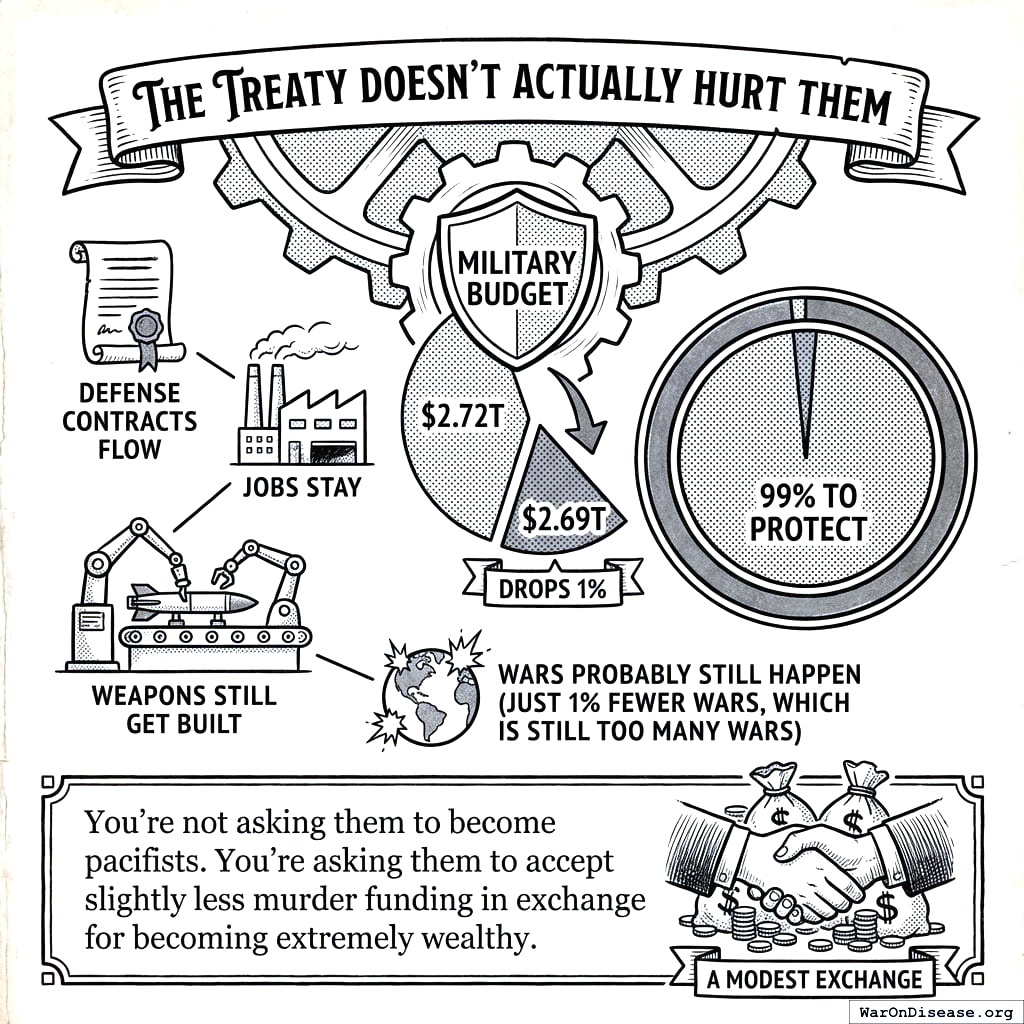
The treaty doesn’t actually hurt them. Military budget drops 1% (from [\$2.72 trillion](../../knowledge/appendix/parameters-and-calculations.llms.md#sec-global_military_spending_annual_2024) to [\$2.69 trillion](../../knowledge/appendix/parameters-and-calculations.llms.md#sec-global_military_spending_post_treaty_annual_2024)). They still have 99% to protect. Military contracts still flow. Jobs stay. You’re telling them to accept slightly less murder funding in exchange for becoming extremely wealthy. This is not a hard sell. This is barely a sell at all. It’s more of a notification.
[](../../assets/images/co-opting-defense-contractors/co-opting-defense-contractors-section-the-treaty-doesn-t-actually-hurt-them-bw-academic.jpg)
The military industry keeps 99% of its budget. They lose 1% and gain trillions in cure markets. This is the easiest math problem in history.
Add 10% VICTORY [Incentive Alignment Bonds](../../knowledge/solution/incentive-alignment-bonds.llms.md) to a pension portfolio and blended returns jump from [10%](../../knowledge/appendix/parameters-and-calculations.llms.md#sec-average_market_return_pct) to something that looks like a typo on a spreadsheet. (Be suspicious. Then check the math.) Once Lockheed buys bonds, Raytheon has to follow or explain to shareholders why Lockheed’s portfolio is outperforming theirs. Start with pension funds (fiduciary duty requires best returns). They end up lobbying FOR the treaty to protect their investment. Your species calls this “unintended consequences.” There is a word for consequences you designed on purpose. The word is “consequences.”
Once they’re lobbying for the treaty, the rebrand starts writing itself. Lockheed Martin Presents: The F-35 Cancer Killer. Boeing Proud Sponsor of: Not Dying of Alzheimer’s. Raytheon Technologies: Now With 1% Less Death. They keep their contracts. They keep their profits. They just point 1% of their death machines at actual death.
### What You’re NOT Taking
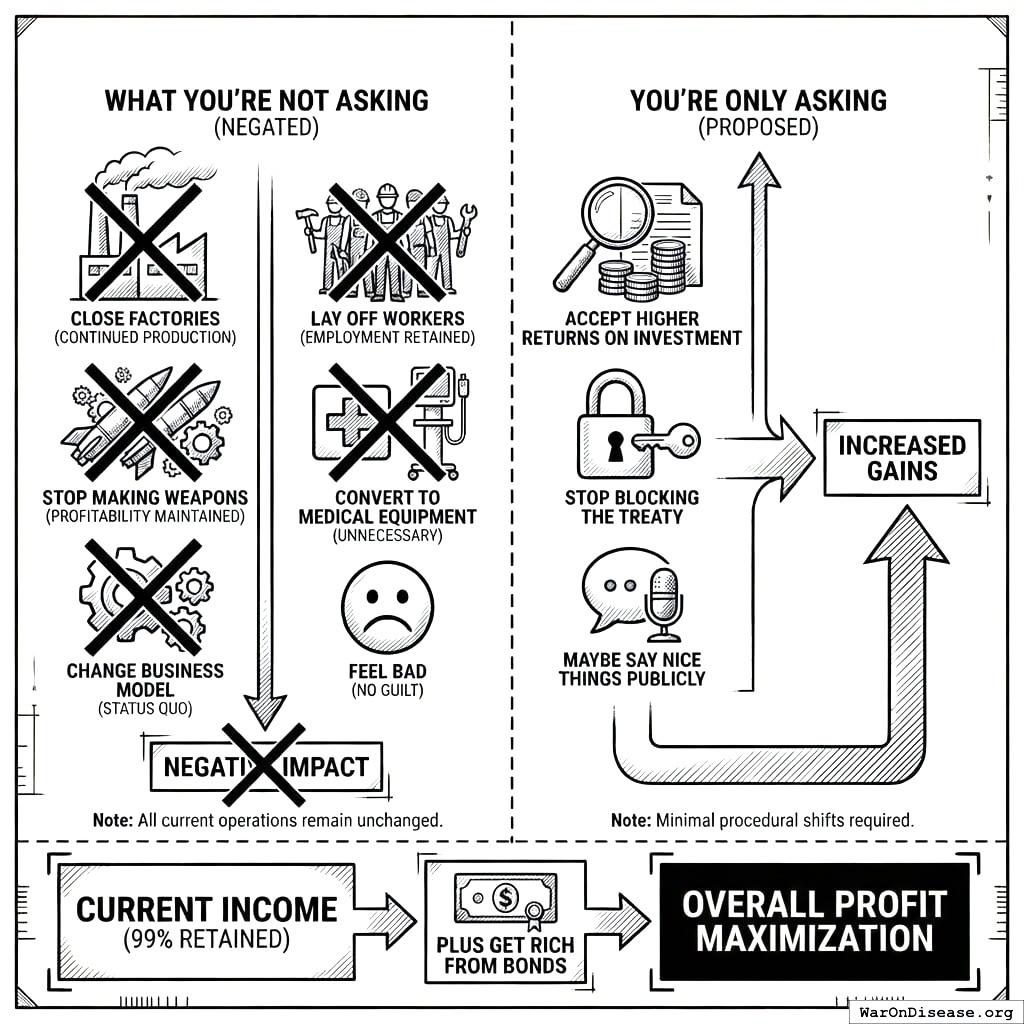
You’re not telling them to close factories, lay off workers, stop making weapons, convert to medical equipment, change their business model, or feel bad about anything. You’re handing them higher returns on investment, a treaty that is in their own interest, and a reason to say nice things about it publicly. They keep 99% of their current income PLUS get rich from bonds. This is the kind of negotiation where both sides win and one side doesn’t even realize it’s a negotiation. On your planet, this is called “a good deal.” On mine, it’s called “obvious.”
[](../../assets/images/co-opting-defense-contractors/co-opting-defense-contractors-section-what-you-re-not-asking-bw-academic.jpg)
Military contractors keep 99% of their money and get extra cash for being nice. They’re crying all the way to the bank about the hardship.
### Why This Works
It’s all legal. VICTORY [Incentive Alignment Bonds](../../knowledge/solution/incentive-alignment-bonds.llms.md) are legal investment vehicles. Lobbying is protected free speech. Consulting fees are standard practice. They designed the system to allow this. You’re just using it correctly for the first time, which is to say, you’re using it for something other than weapons, which has never occurred to anyone before, which tells you everything about your species’ relationship with its own legal system.
The military contractor CEO explains it to the board like this: “We diversified into bonds paying [272%](../../knowledge/appendix/parameters-and-calculations.llms.md#sec-victory_bond_annual_return_pct) returns versus the market’s [10%](../../knowledge/appendix/parameters-and-calculations.llms.md#sec-average_market_return_pct). If the treaty passes, we profit enormously. If it fails, we still have our military contracts. It’s a hedge. I’m being prudent. You’re welcome.” The board nods. The board always nods when the numbers are good. The board has never once asked whether the numbers were moral. This is, again, the design parameter.
Here’s what the CFO tells the CEO after the board meeting: the treaty is even better than a hedge, because fewer bases means less blowback means fewer terrorism crises. Robert Pape at the University of Chicago found that 95% of suicide terrorist attacks from 1980 to 2003 were responses to foreign military occupation^([3](../references.llms.md#ref-pape-dying-to-win)), and the \$8 trillion War on Terror^([4](../references.llms.md#ref-war-on-terror-cost-blowback)) took attacks from about 1,000 per year to nearly 17,000 by 2014^([5](../references.llms.md#ref-terrorism-attacks-increased-post-2001)). Crisis-driven budgets sound great for military revenue, but they’re terrible for long-term capital planning. Emergency appropriations spike procurement, then get clawed back when the panic fades. You can’t plan a 15-year fighter jet program on a budget that lurches from crisis to crisis. The treaty replaces boom-bust panic cycles with stable, predictable bond returns. A CFO who can forecast revenue 20 years out sleeps better than one who depends on the next attack making the news. Fewer crises, more stability, higher Sharpe ratio. The CFO doesn’t phrase it as “world peace.” The CFO phrases it as “reduced volatility in our revenue model.” Same thing. Different PowerPoint.
**Budget**: Funded from the [\$1 billion](../../knowledge/appendix/parameters-and-calculations.llms.md#sec-treaty_campaign_total_cost) [incentive alignment budget](../../knowledge/economics/campaign-budget.llms.md).
### The Timeline
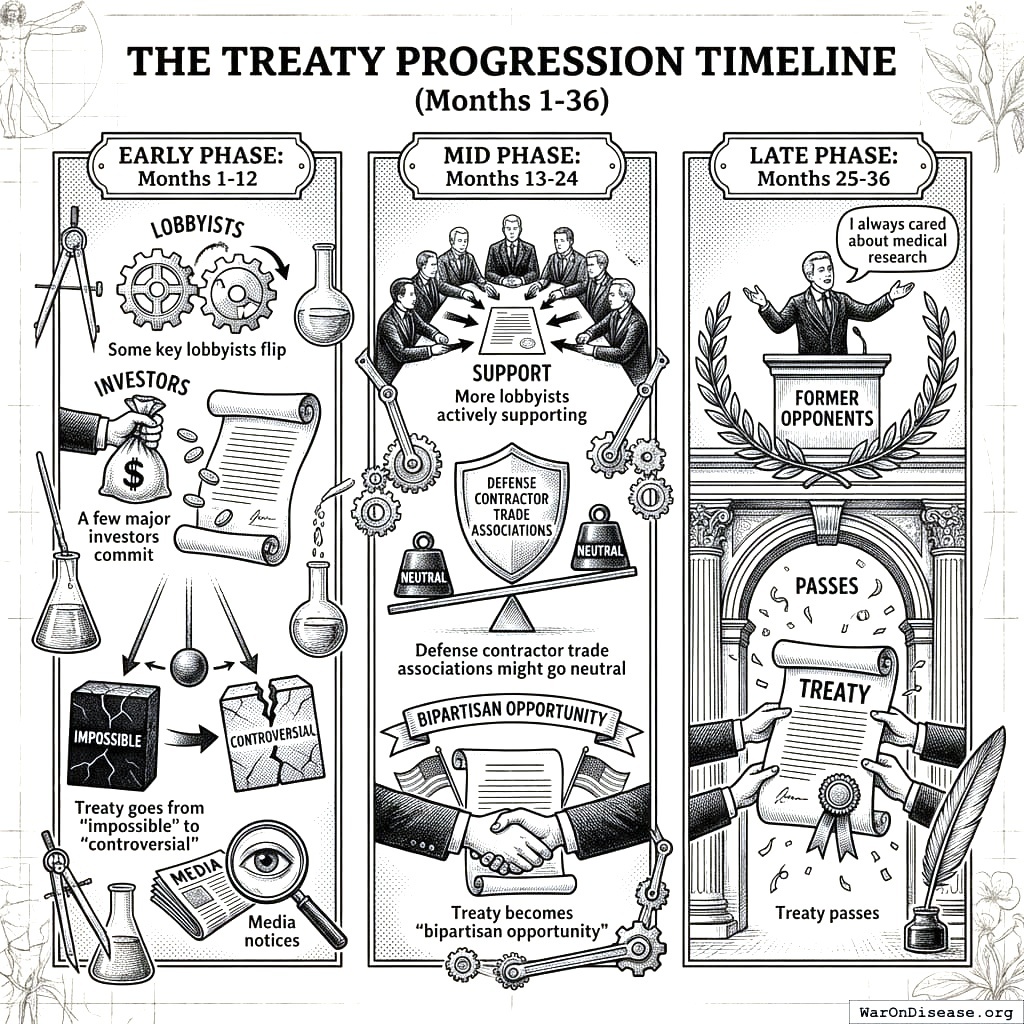
Optimistic (if this works): key lobbyists flip in months 1-12, military contractor trade associations go neutral by month 18, and by month 25 former opponents take credit for supporting medical research, which they discovered they cared about yesterday but will swear they’ve cared about their whole lives. Your species does this with every social change. Opposition, resistance, capitulation, retroactive credit. It’s the four seasons of human progress. No sane observer would fail to name the moment when someone who fought against a good idea starts claiming they invented it. The word is “creditworm.” Your species doesn’t have a word for it, which is why it happens so often. Things without names are invisible.
[](../../assets/images/co-opting-defense-contractors/co-opting-defense-contractors-section-adoption-timeline-bw-academic.jpg)
How long it takes for politicians to go from ‘this is outrageous’ to ‘I supported this all along.’ Three years, apparently.
Pessimistic (if this doesn’t work): you and everyone you’ve ever loved slowly deteriorate into dust.
You can’t fight the military-industrial complex. It’s too big. Too entrenched. Too profitable. But you might be able to buy it.
## Insurance Companies: The Accidentally Aligned Industry
Insurance companies are theoretically on your side. They’ve had this exact incentive for 150 years and haven’t done anything about it, which is the most human sentence I’ve ever written. Every disease you cure is billions they don’t have to pay out. They are, on paper, your most natural ally. In practice, they’ve spent 150 years not noticing this, which makes them your most natural ally in the same way that a person sleeping through an earthquake is technically experiencing an earthquake.
### Their Current Death Spiral
[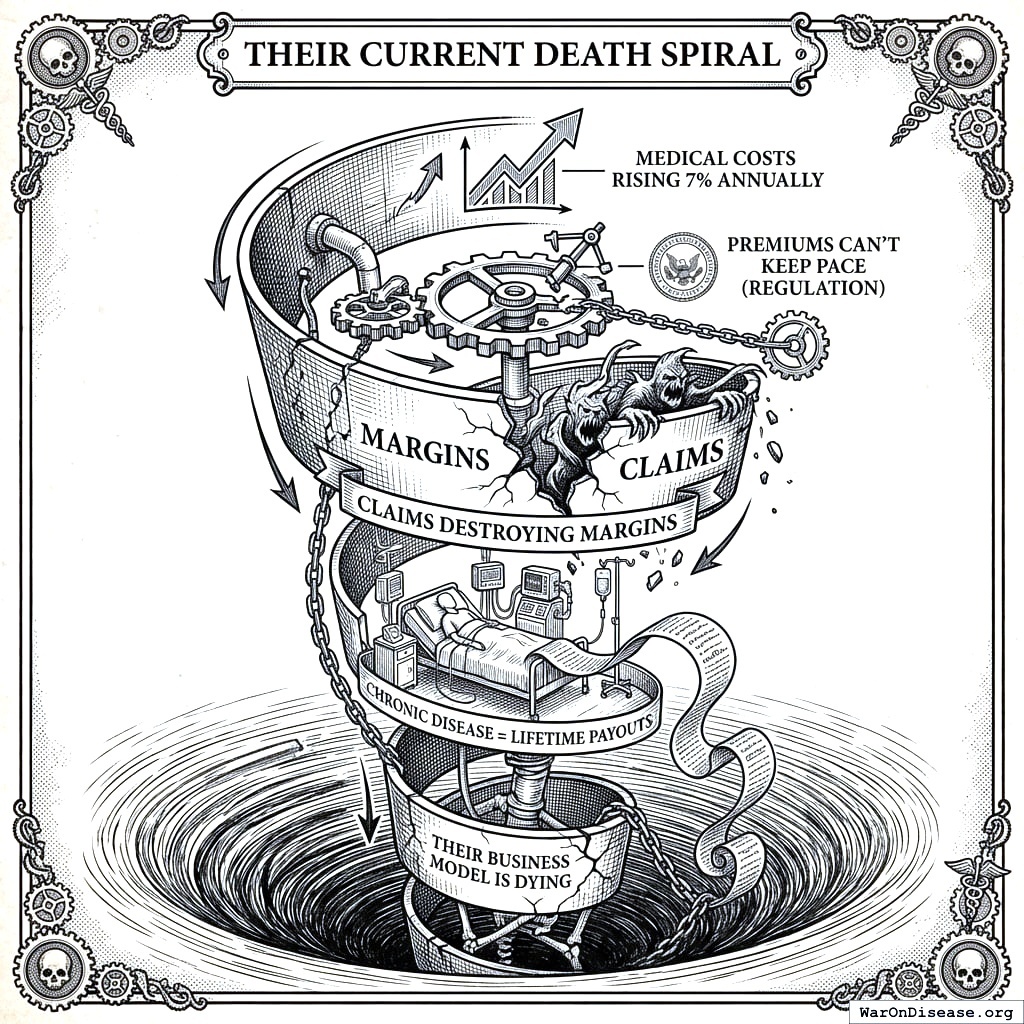](../../assets/images/aligning-incentives/aligning-incentives-section-their-current-death-spiral-bw-academic.jpg)
The insurance death spiral. Costs go up, premiums go up, healthy people leave, costs go up more. Like a toilet flush but with your healthcare.
Medical costs rise 7% annually. Premiums can’t keep pace because of regulation. Claims are destroying margins. Chronic disease means lifetime payouts, which means every patient who doesn’t die is a patient who keeps costing money, which means insurance companies are in the bizarre position of profiting when you die quickly and losing money when you die slowly, which is not what they put on their brochures but is what their actuarial tables reveal. Their ideal customer is someone who pays premiums for 40 years and then drops dead instantly. An organization that collects your money for decades and hopes you die before you can use it is called “a casino.” Your species calls it “healthcare.” Their business model is dying, which is ironic given that their business model is about dying.
### Your Salvation Offer
The math they can’t refuse: diabetes costs [\$327 billion (95% CI: \$278 billion-\$376 billion)](../../knowledge/appendix/parameters-and-calculations.llms.md#sec-us_diabetes_annual_cost) annually, Alzheimer’s costs [\$355 billion (95% CI: \$302 billion-\$408 billion)](../../knowledge/appendix/parameters-and-calculations.llms.md#sec-us_alzheimers_annual_cost), heart disease costs [\$363 billion (95% CI: \$309 billion-\$417 billion)](../../knowledge/appendix/parameters-and-calculations.llms.md#sec-us_heart_disease_annual_cost), and cancer costs [\$208 billion (95% CI: \$177 billion-\$239 billion)](../../knowledge/appendix/parameters-and-calculations.llms.md#sec-us_cancer_annual_cost). Cure any one of these and the ongoing savings are roughly 90%. They don’t need \$0 costs. They just need costs to stop rising 7% annually. A cure does that. A cure is, from an actuarial perspective, the best thing that can happen to an insurance company. The second best thing is you dying quickly. The worst thing is you dying slowly and expensively, which is what your current medical system specializes in.
[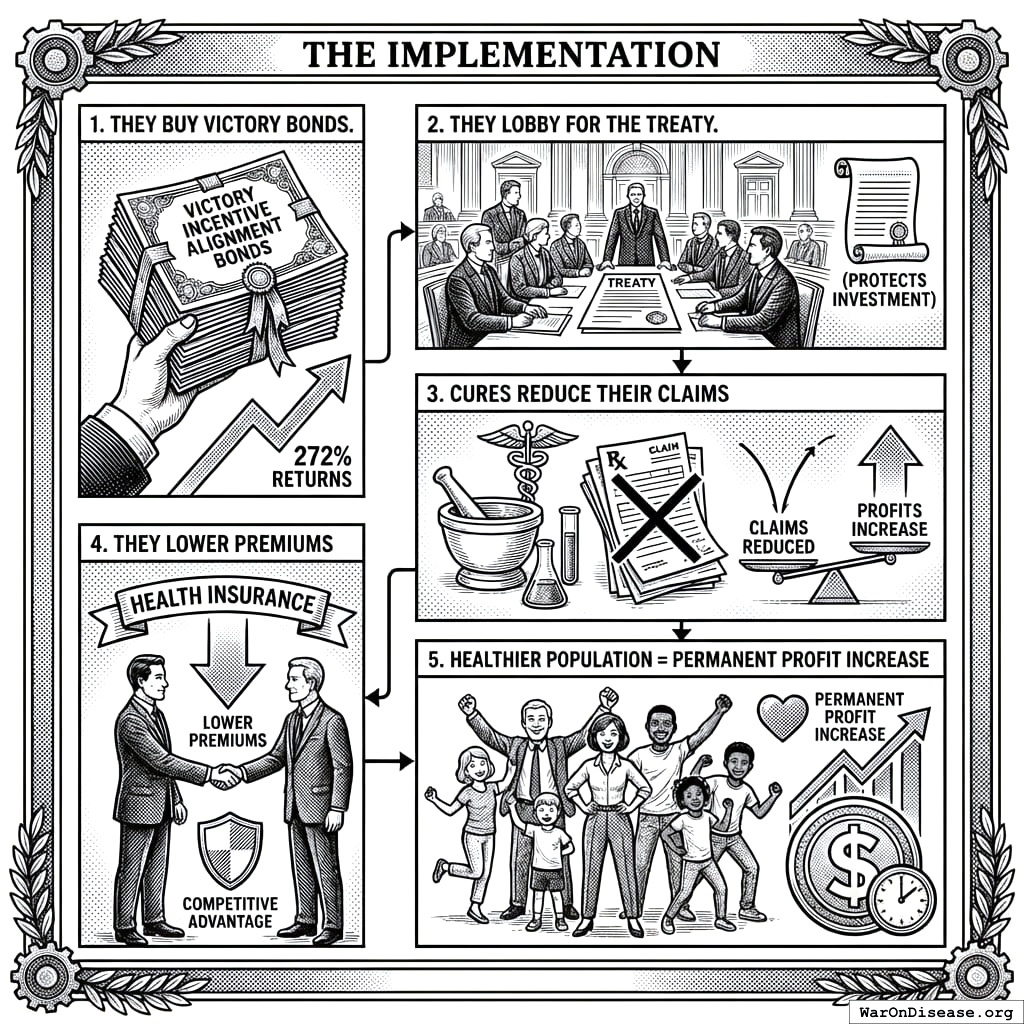](../../assets/images/aligning-incentives/aligning-incentives-section-the-implementation-bw-academic.jpg)
Buy bonds, fund cures, people stop dying, premiums drop, profits go up forever. Insurance companies solving their own problem by accident.
The implementation: they buy VICTORY [Incentive Alignment Bonds](../../knowledge/solution/incentive-alignment-bonds.llms.md) ([272%](../../knowledge/appendix/parameters-and-calculations.llms.md#sec-victory_bond_annual_return_pct) returns), they lobby for the treaty (which protects their investment), cures reduce their claims (which increases their profits), they lower premiums (which gives them competitive advantage), and a healthier population produces a permanent profit increase. Each step makes the next step more profitable. It’s a virtuous cycle, which is like a vicious cycle but nobody dies. Your species has built many vicious cycles. This would be your first virtuous one, which is a statistic that should embarrass you more than it apparently does.
### Why They’re Your Natural Allies
Insurance companies are the only industry that profits from human health. Every other healthcare player profits from sickness. Pharma wants chronic patients who take pills forever; insurance wants cures. Hospitals want full beds; insurance wants empty ones. Doctors want repeat visits; insurance wants one-time fixes. This makes insurance companies the only participant in your healthcare system whose financial incentives align with you not dying, which is a remarkable thing to say about a single industry in a system that supposedly exists to keep you alive.
[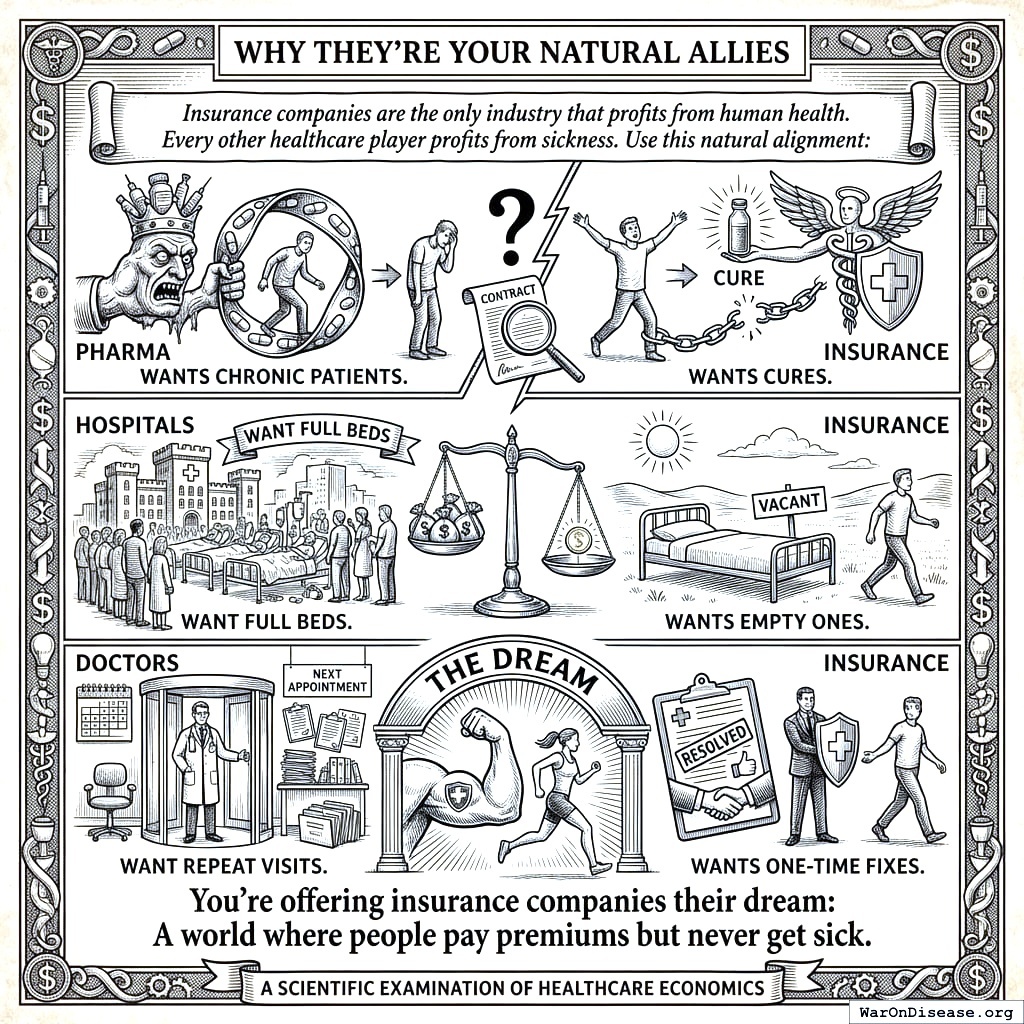](../../assets/images/aligning-incentives/aligning-incentives-section-why-they-re-your-natural-allies-bw-academic.jpg)
Hospitals get paid when you’re sick. Insurance companies lose money when you’re sick. Only one of them wants you to stop being sick.
## Pharmaceutical Companies: Converting Drug Dealers to Drug Curers
Pharma companies aren’t evil. They’re just doing what any rational organism does when you pay it to keep people sick: keeping people sick. They’re trapped in a business model that rewards treating symptoms forever instead of curing diseases once. This is like blaming a river for flowing downhill. The river isn’t evil. The river is just going where gravity takes it. If you want it to go somewhere else, you don’t lecture the river. You move the landscape.
[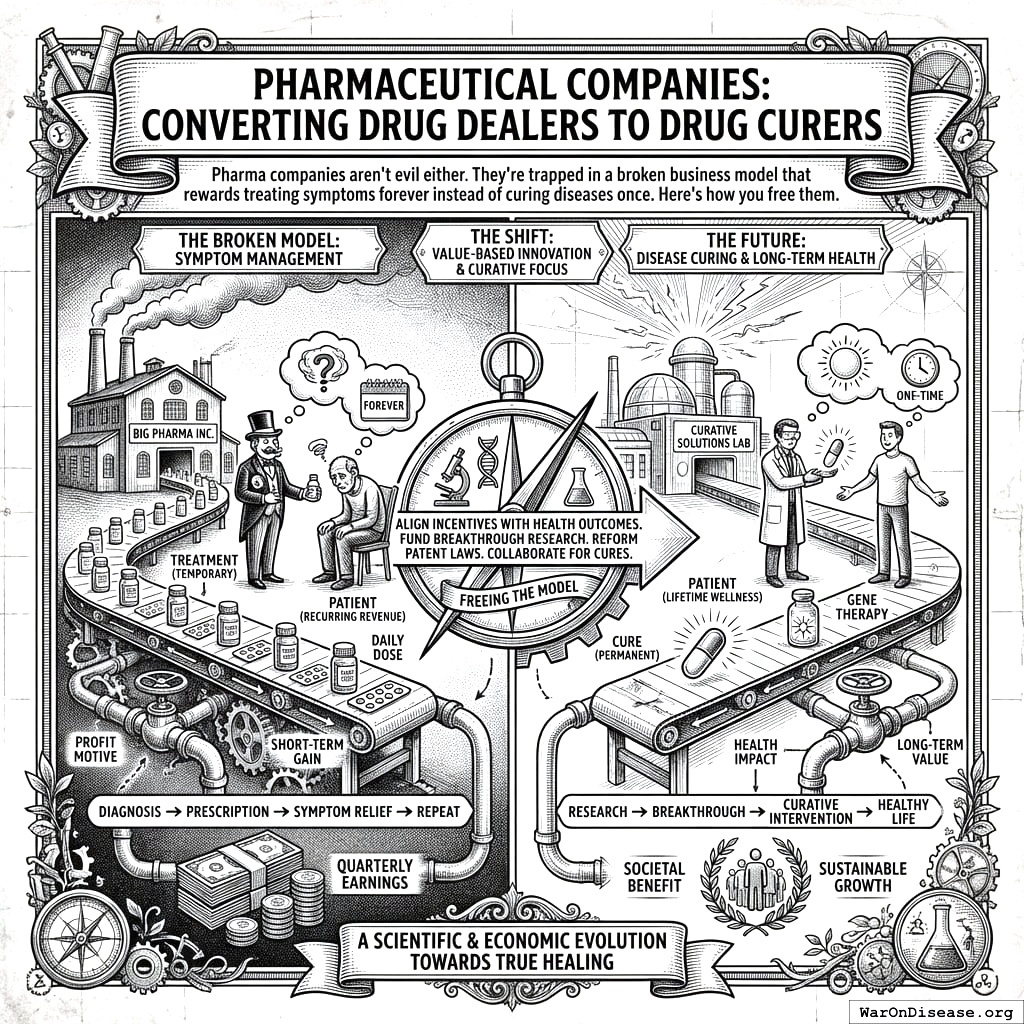](../../assets/images/aligning-incentives/aligning-incentives-section-pharmaceutical-companies-converting-drug-dealers-to-drug-curers-bw-academic.jpg)
Old model: sell pills forever. New model: cure disease once. One makes steady money, the other makes sense.
### Their Current Trap
[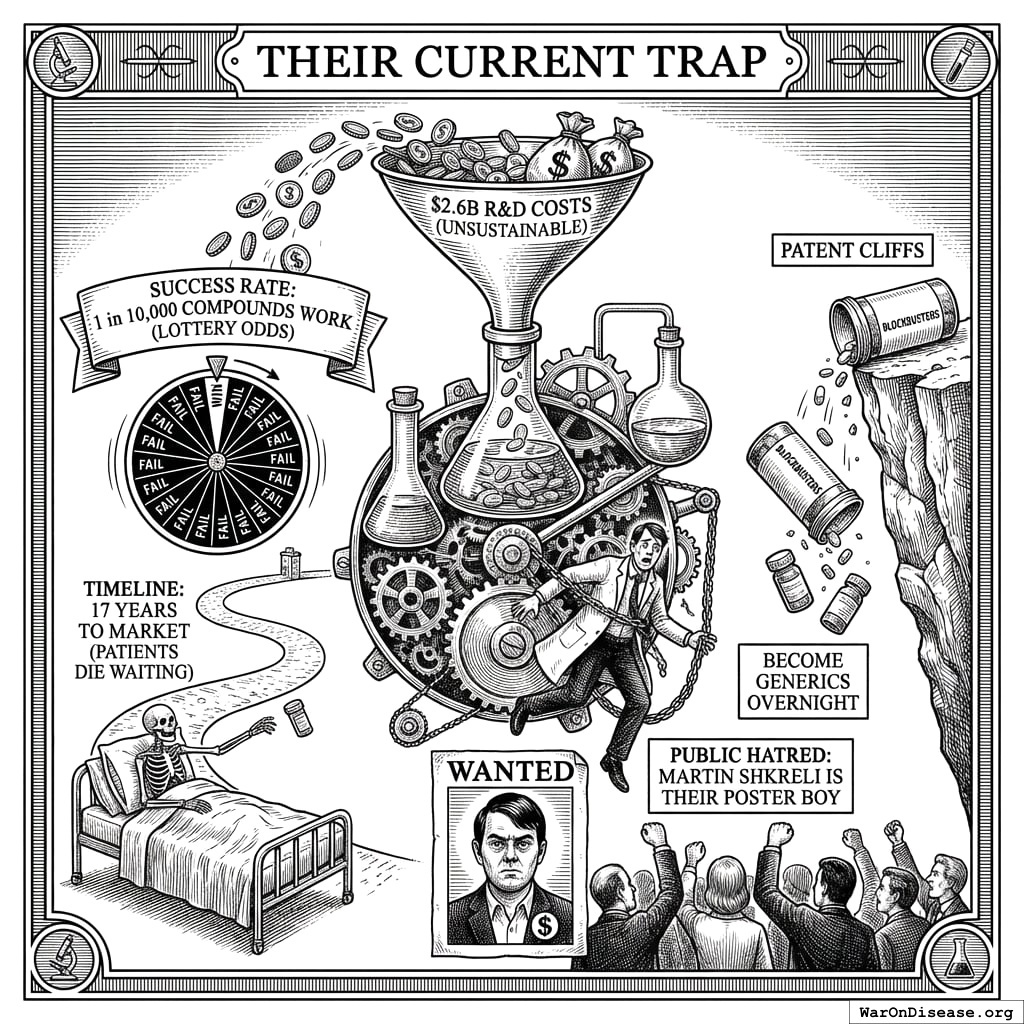](../../assets/images/aligning-incentives/aligning-incentives-section-their-current-trap-bw-academic.jpg)
The Pharma Trap: test 10,000 chemicals for 17 years, spend 2.6 billion dollars, get one medicine. It’s like panning for gold in a pile of poison.
[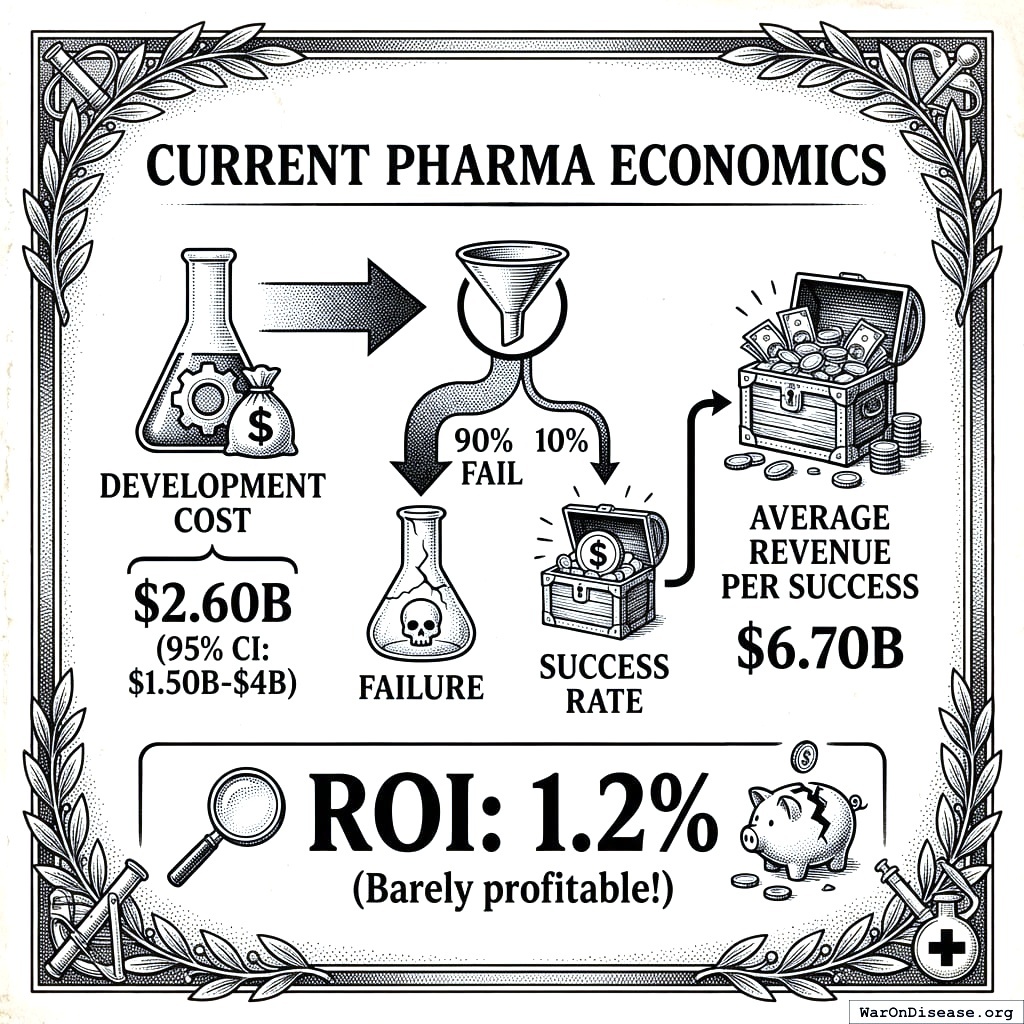](../../assets/images/aligning-incentives/aligning-incentives-section-current-pharma-economics-bw-academic.jpg)
Drug companies spend billions to make 1.2 percent profit. You could make more money with a savings account, but that wouldn’t justify the yacht.
Each new drug costs [\$2.6 billion (95% CI: \$1.5 billion-\$4 billion)](../../knowledge/appendix/parameters-and-calculations.llms.md#sec-pharma_drug_development_cost_current) to develop. The success rate is [10%](../../knowledge/appendix/parameters-and-calculations.llms.md#sec-pharma_success_rate_current_pct), which is lottery odds, except lottery tickets don’t cost billions and don’t take 17 years to scratch off. Revenue per success averages [\$6.7 billion](../../knowledge/appendix/parameters-and-calculations.llms.md#sec-pharma_drug_revenue_average_current). ROI measured as IRR on late-stage pipeline assets: [1.2%](../../knowledge/appendix/parameters-and-calculations.llms.md#sec-pharma_roi_current_system_pct), which was Deloitte’s 2022 historic low for top-20 pharma (it bounced to 5.9% by 2024, still the kind of number that makes venture capitalists cry and then invest in real estate instead). Patent cliffs turn blockbusters into generics overnight. And the public hates them; Martin Shkreli is their poster boy, which is like having your industry represented by the person the industry itself wishes it could disown but can’t because he’s just a more honest version of what they all do.
### The Math That Converts Them
Pragmatic clinical trials become [44.1x (90% CI: 12.8x-210x)](../../knowledge/appendix/parameters-and-calculations.llms.md#sec-dfda_trial_cost_reduction_factor) cheaper. Current system: [\$41,000 (95% CI: \$20,000-\$120,000)](../../knowledge/appendix/parameters-and-calculations.llms.md#sec-traditional_phase3_cost_per_patient) per participant on dedicated sites, with monitoring, custom infrastructure, and regulatory overhead that costs more than the research it’s overseeing. With your [Decentralized Institutes of Health](../../knowledge/solution/dih.llms.md): cost drops roughly [97.7% (90% CI: 92%-100%)](../../knowledge/appendix/parameters-and-calculations.llms.md#sec-dfda_trial_cost_reduction_pct) because it uses existing medical practices, existing EHR data, and pragmatic design. A 50,000-participant trial drops from approximately \$2B to approximately \$46M. This is the difference between betting your company and betting your department’s coffee budget.
The current system costs [\$41,000 (95% CI: \$20,000-\$120,000)](../../knowledge/appendix/parameters-and-calculations.llms.md#sec-traditional_phase3_cost_per_patient) per patient for trials, 90% of drugs fail which means billions lost, development takes 10-17 years, and only blockbusters are viable. The decentralized system costs [\$929 (95% CI: \$97-\$3,000)](../../knowledge/appendix/parameters-and-calculations.llms.md#sec-dfda_pragmatic_trial_cost_per_patient) per patient (a [97.7% (90% CI: 92%-100%)](../../knowledge/appendix/parameters-and-calculations.llms.md#sec-dfda_trial_cost_reduction_pct) reduction), failure costs tens of millions instead of billions (survivable), development takes 2-3 years, and rare diseases become profitable because you can afford to try.
This doesn’t change whether drugs work biologically. It changes the economics. You profit from trying, not just from succeeding. On your planet, “profit from trying” sounds radical. On mine, it sounds like the definition of research.
[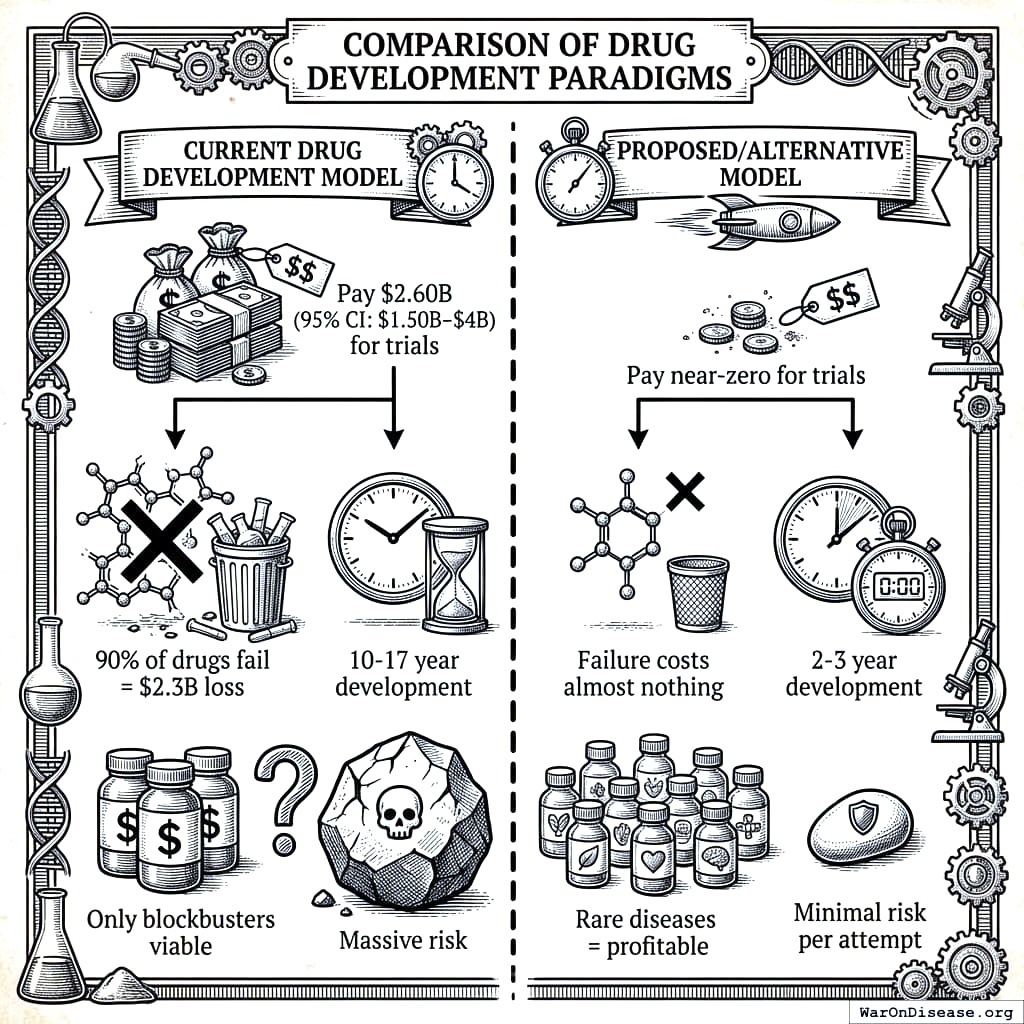](../../assets/images/aligning-incentives/aligning-incentives-section-pharmaceutical-companies-bw-academic.jpg)
Current model: costs billions, takes decades. Proposed model: costs thousands, takes months. The expensive one is considered serious.
### Pharma’s New Business Model: Volume Over Blockbusters
Lower revenue per drug, but massively more attempts. Currently they target \$1B+ blockbusters only, make approximately 10 attempts per year (each costing [\$2.6 billion (95% CI: \$1.5 billion-\$4 billion)](../../knowledge/appendix/parameters-and-calculations.llms.md#sec-pharma_drug_development_cost_current)), ignore rare diseases entirely, and have limited capacity. Under the decentralized model, \$500M per success becomes profitable, they can make thousands of attempts (because failure doesn’t bankrupt you), rare diseases become gold mines with no competition, and capacity increases by [12.3x (90% CI: 4.92x-50.8x)](../../knowledge/appendix/parameters-and-calculations.llms.md#sec-dfda_trial_capacity_multiplier).
[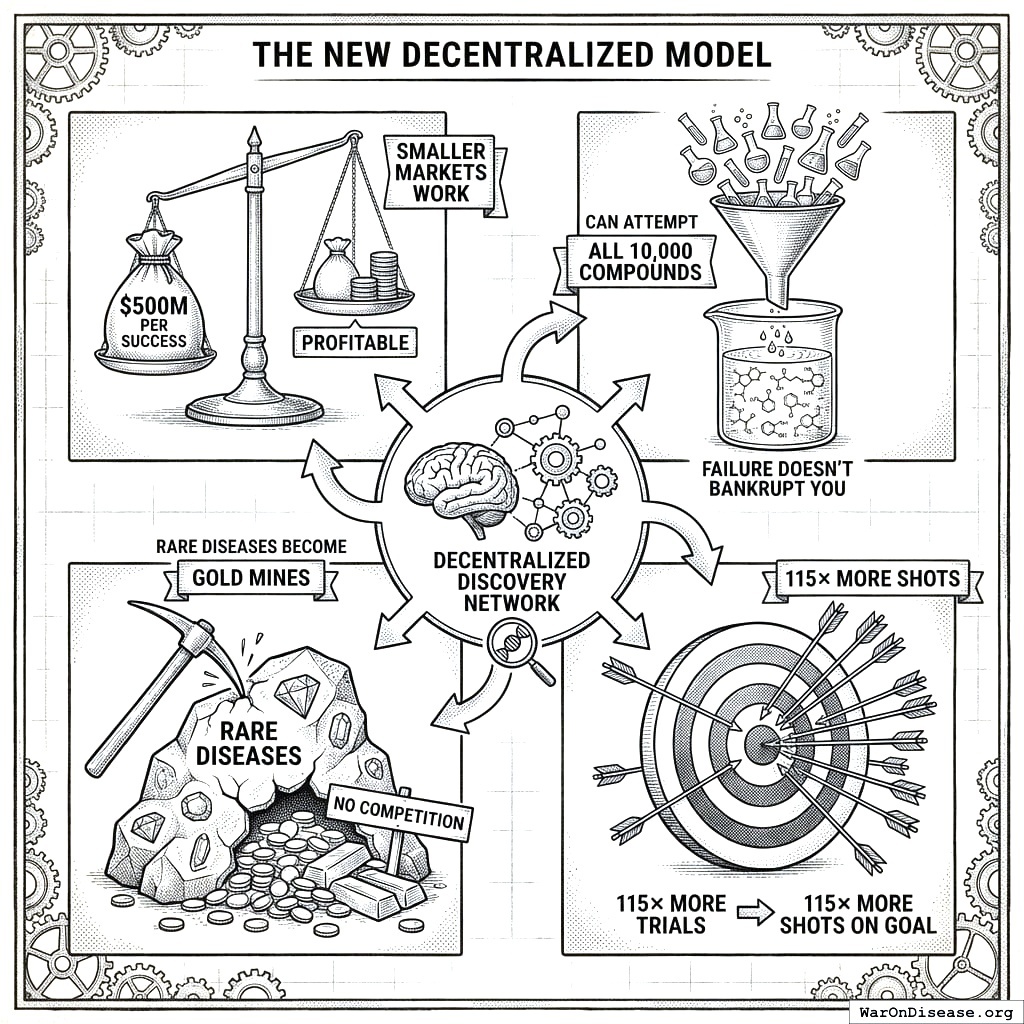](../../assets/images/aligning-incentives/aligning-incentives-section-the-new-decentralized-model-bw-academic.jpg)
When trials are cheap, you can test everything, even diseases that only affect 47 people. Turns out those people would also like not to die.
### How to Get Companies to Say Yes
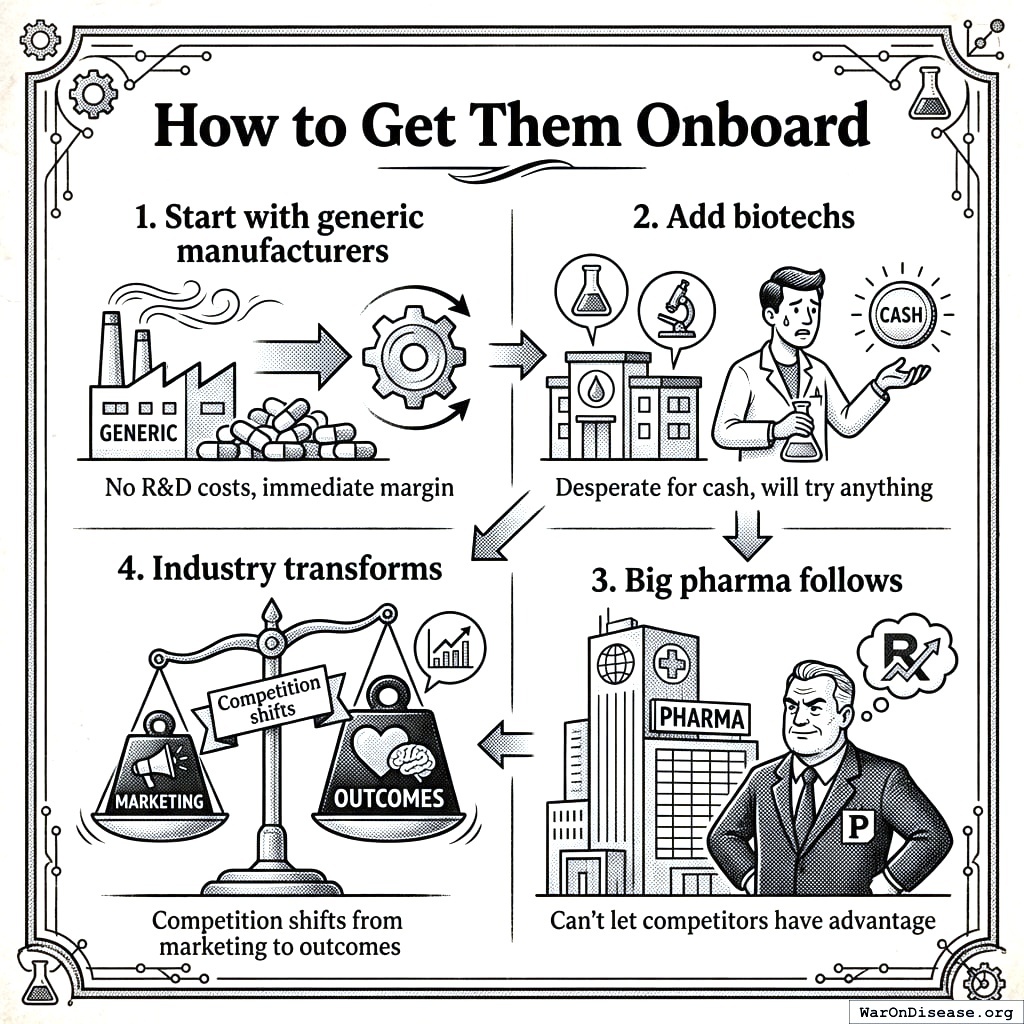
You start with generic manufacturers, who have no R&D costs and immediate margin. Then you add biotechs, who are desperate for cash and will try anything (desperation is the mother of innovation on your planet; this is not how it should work, but it’s how it does work). Then big pharma follows, because they can’t let competitors have the advantage. Then the industry transforms and competition shifts from marketing to outcomes. This is the same adoption curve as every technology your species has ever adopted: small, desperate, competitive, universal. It took seven years for smartphones. It took twelve years for social media. It should take less for something that cures disease, but your species has consistently demonstrated that it adopts entertainment faster than medicine, so add a few years for that.
[](../../assets/images/aligning-incentives/aligning-incentives-section-how-to-get-them-onboard-bw-academic.jpg)
Step 1: small companies try it. Step 2: it works. Step 3: big companies notice. Step 4: everybody does it and pretends it was their idea.
## Politicians: Hacking Democracy’s Source Code
Politicians want exactly two things: votes and money. I’ve watched your politicians for 80 years and I have never observed a third motivation. Some of them claim to want “a better world” or “to serve the public,” but when you observe their actual behavior rather than their stated behavior, the data reduces to votes and money with a correlation coefficient so close to 1.0 that the decimal places are embarrassing.
### Their Current Misery
[](../../assets/images/aligning-incentives/aligning-incentives-section-their-current-misery-bw-academic.jpg)
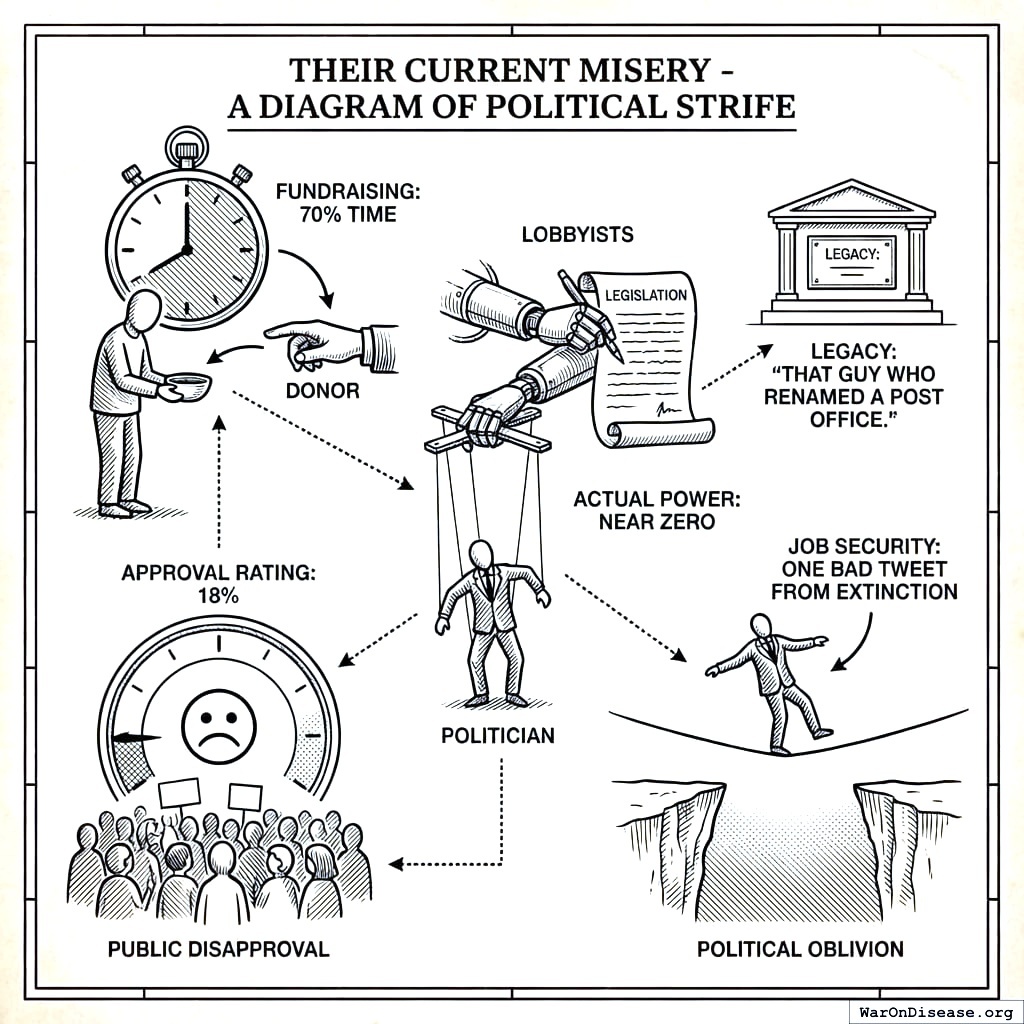
The modern politician: 70 percent fundraising calls, 18 percent approval rating, 3 percent actual decision-making. It’s like being a telemarketer who everybody hates but won’t fire.
They spend 70% of their time begging for money, which leaves 30% for everything else, which is governing, but most of that 30% is spent on things that aren’t governing either, so the actual time spent governing approaches zero, which explains the quality of the governance. Their approval rating is 18%, which means 82% of the people they work for think they’re doing a bad job, which would get you fired in any other profession, but in politics it gets you re-elected because the other candidate has an 18% approval rating too, and the election is just a competition to see who is less disliked. Lobbyists write the bills. Donors set the agenda. The politician’s actual role is to stand in front of a flag and announce things that other people decided, which is called “leadership” on your planet and “puppetry” on mine.
### Your Political Welfare Program
The money pipeline: support the treaty and Super PAC funds flow in. Oppose it and Super PAC funds flow to your opponent. This is how your political system already works, except currently the money flows from death manufacturers who want more weapons. You’re just adding a second faucet that flows from people who want fewer diseases. The politician doesn’t even need to change their behavior. They just need to notice which faucet has more water.
[](../../assets/images/aligning-incentives/aligning-incentives-section-the-vote-harvest-bw-academic.jpg)
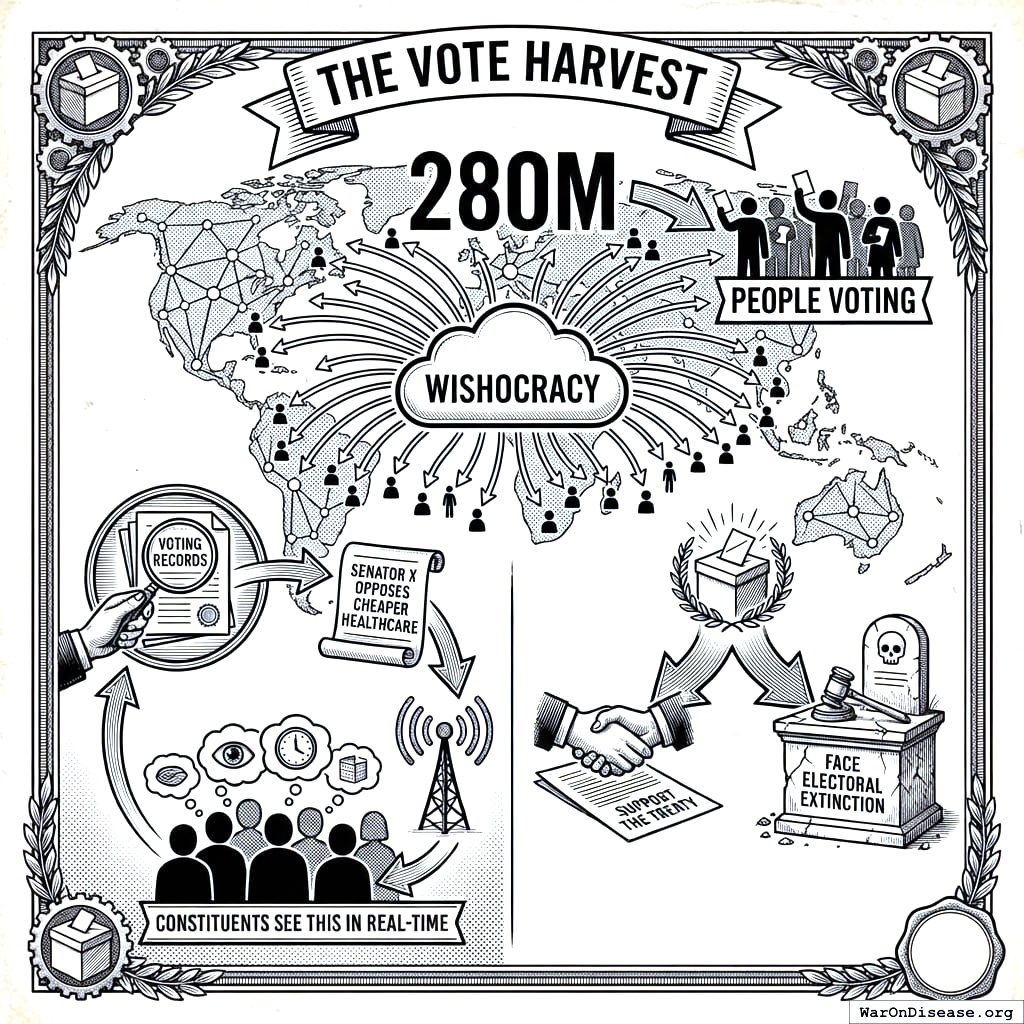
Wishocracy: people vote on what they want, app tells politicians, politicians see the votes are real, politicians reconsider their donors. Democracy by app because democracy by government stopped working.
The vote harvest: [280 million](../../knowledge/appendix/parameters-and-calculations.llms.md#sec-three_point_five_percent_of_global_population) people voting on [Wishocracy](../../knowledge/solution/wishocracy.llms.md)^([6](../references.llms.md#ref-wishocracy-paper-2025)). You publish voting records (“Senator X opposes cheaper healthcare”). Their constituents see this in real-time. Support the treaty or face electoral extinction. This is democracy working as designed, which is so unusual that it will probably be reported as a threat to democracy, because on your planet, democracy working is considered a disruption to the normal functioning of democracy, which is not working.
### The Bipartisan Beauty
Republicans will call it a free market solution that cuts government spending. Democrats will call it universal healthcare access that helps the poor. Libertarians will call it the end of FDA tyranny and personal freedom. Socialists will call it the destruction of Big Pharma monopoly and power to the people. They’re all describing the same thing. They’re all right. And they’ll all take credit. This is the only policy in your species’ history that every political faction can honestly claim as their own, which means it’s either the best policy ever proposed or the most dishonest, and since your species can’t tell the difference, it doesn’t matter.
## Billionaires: Self-Interest Meets Self-Preservation
Billionaires have everything except the one thing money can’t buy: not dying. A billion dollars and a body that rots at the same rate as everyone else’s. This is the most fascinating thing about your wealthy. They accumulate resources for decades, building empires, optimizing returns, diversifying portfolios, and then their cells malfunction and they die like everyone else. It’s as if a dragon spent its whole life hoarding gold and then choked on a coin. The irony would be poetic if it weren’t so common.
[](../../assets/images/aligning-incentives/aligning-incentives-section-the-insurance-bw-academic.jpg)
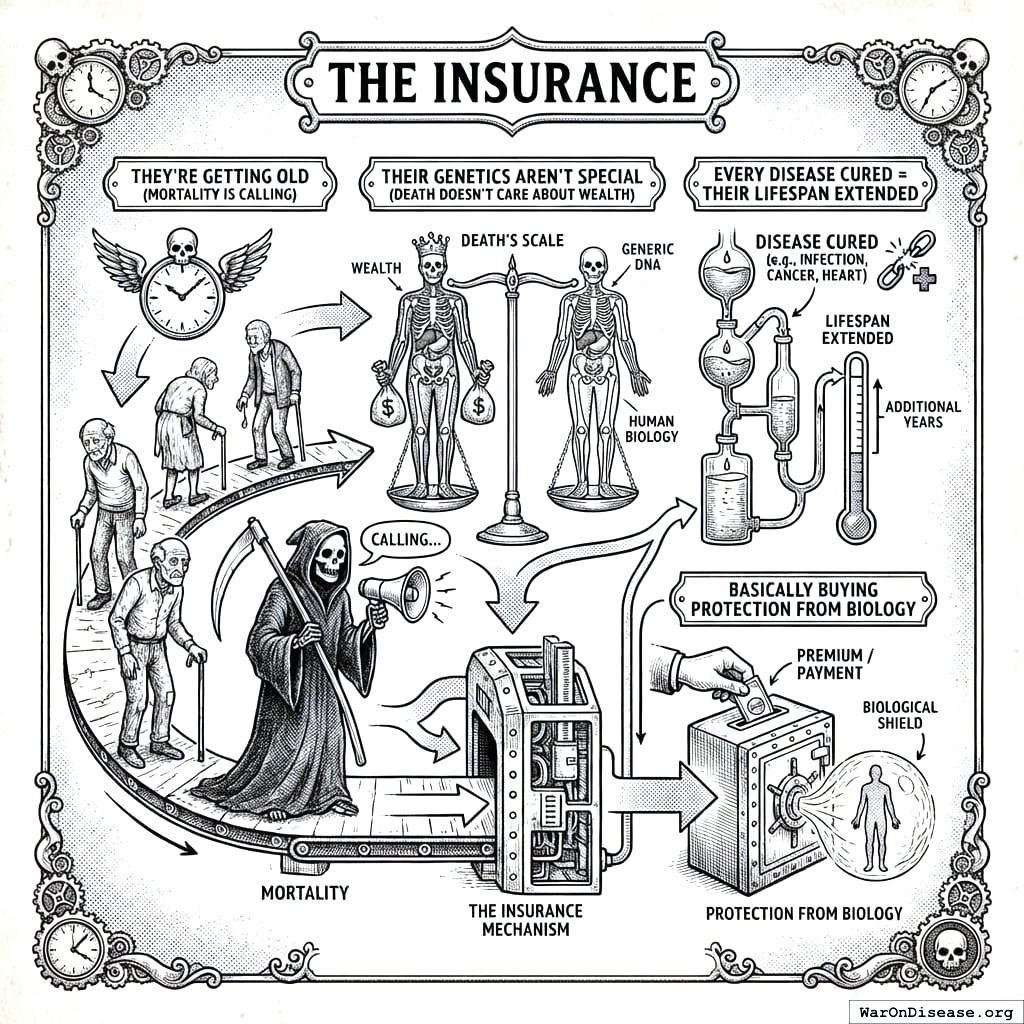
Billionaires buying longevity like it’s life insurance. Pay now, live forever. The premium is 100 million dollars but so is their watch.
The package: VICTORY [Incentive Alignment Bonds](../../knowledge/solution/incentive-alignment-bonds.llms.md) funded by treaty revenue, beating traditional portfolio yields (returns). “The Gates Cancer Center” and a Nobel Peace Prize and history books reading “Funded the cure for death” (legacy). And the part they won’t say out loud but think every time their knee hurts: they’re getting old, their genetics aren’t special, and every disease cured is their lifespan extended (survival). Your species’ billionaires have been funding vanity projects for decades. Space tourism. Underwater hotels. Islands. None of these extend their lifespan. This does. It’s the first vanity project where the vanity is rational.
## The Domino Effect
[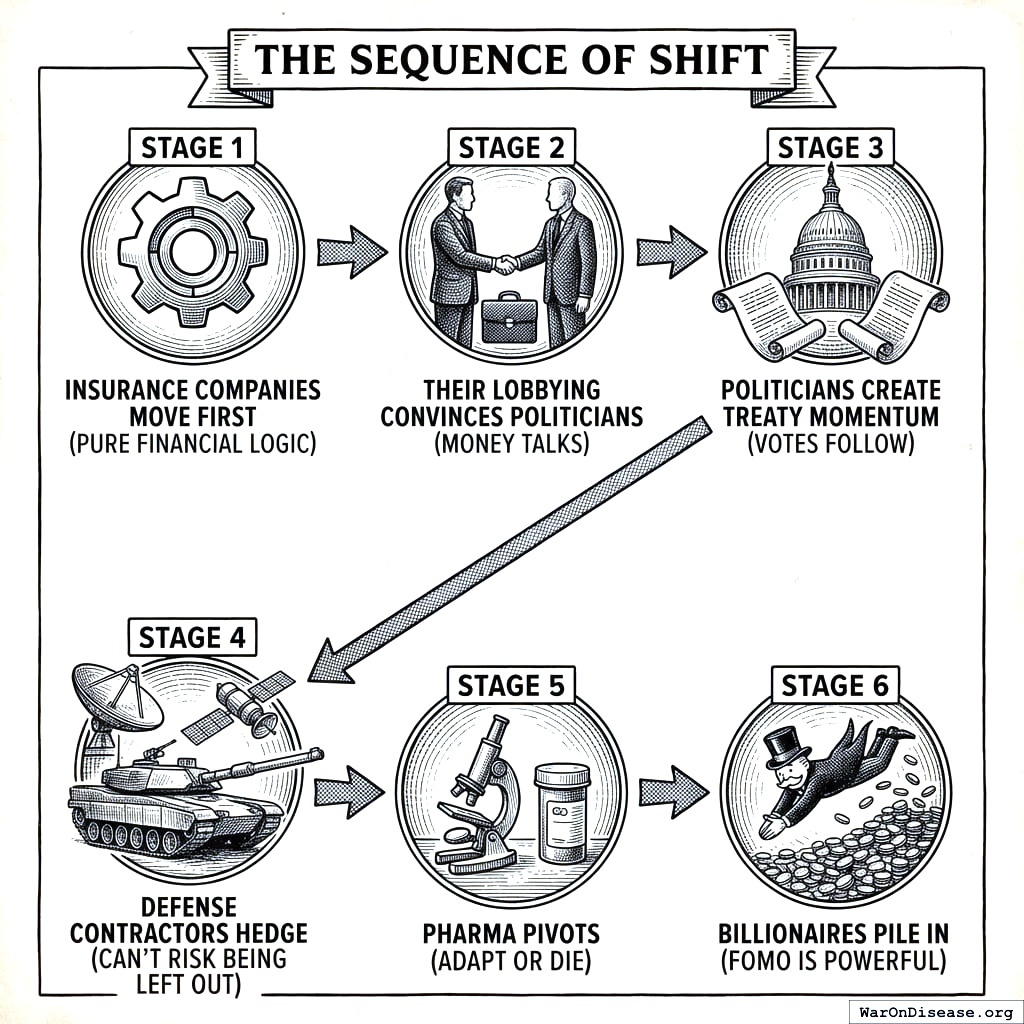](../../assets/images/aligning-incentives/aligning-incentives-section-the-sequence-bw-academic.jpg)
Insurance companies convince politicians, politicians convince weapons makers, weapons makers convince billionaires. It’s like telephone but everyone gets richer.
Insurance companies move first, because pure financial logic is their entire personality and curing disease reduces their costs. Their lobbying convinces politicians, because money talks and insurance money talks loudly. Politicians create treaty momentum, because votes follow money follows lobbying follows insurance follows actuarial tables, which is the most boring causal chain in history but also the most reliable. Military contractors hedge, because they can’t risk being left out of a profitable shift. Pharma pivots, because adapt or die, which is ironic advice to give an industry that’s supposed to prevent dying. Billionaires pile in last, because FOMO is powerful in humans generally and devastating in billionaires specifically, who have built their identities around being first and cannot tolerate being last.
### Why This Can Work: The Coordination Problem Has a Price Tag
Public choice theory predicts that concentrated interests beat diffuse interests. Always. Ten lobbyists who each make \$10 million from war will outfight ten million patients who each lose \$10 from disease. This is Olson’s observation, and it’s correct, and it’s the reason your species builds weapons better than it cures cancer.
The part Olson didn’t account for: the people getting screwed have 90 times more money. Concentrated interests (military industry, fossil fuels) have roughly \$5 trillion in market cap and spend \$100M-\$1B annually on political influence. Diffuse beneficiaries (everyone who’d benefit from cures) have [\$454 trillion](../../knowledge/appendix/parameters-and-calculations.llms.md#sec-global_household_wealth_usd) in household wealth and spend approximately \$0 on political influence, because of coordination failure, which is the academic term for “everyone wants it but nobody does anything.”
Having more capital doesn’t help if you can’t deploy it. That’s Olson’s whole point and he’s right. A 90:1 capital advantage means nothing when each individual’s share is too small to motivate action. Coordination costs eat everything. This is why your species can’t have nice things, stated in the language of economics so that economists will take it seriously.
[Incentive Alignment Bonds](../../knowledge/solution/incentive-alignment-bonds.llms.md) are a coordination mechanism disguised as a financial product. They turn political change into an investment. Investors don’t need to care about curing disease. They need to care about returns. The returns happen to require curing disease. Whether this actually works at scale is an open question (nobody’s tried it), but the logic is: if you can make “lobby for health” pay better than “lobby for war,” lobbyists will lobby for health. This is not a controversial claim about human nature. This is the least controversial claim about human nature. It is, in fact, the only claim about human nature that has never been wrong.
#### Why the cascade can happen (not “must” happen)
Once IABs concentrate financial benefits on the pro-health side, politicians face a new calculation where IAB benefits make the arithmetic impossible to ignore. Each policy success increases IAB funding, which strengthens the coalition. Investors lobby for treaty expansion to increase their returns. The dynamic reverses: supporting clinical trial funding becomes the concentrated-benefit option. The diffuse interest becomes concentrated. The Olsonian problem dissolves. Not because humans got better. Because someone finally showed them the math they should have done decades ago, and paid them to look at it.
This isn’t inevitable. It requires sufficient IAB funding to buy speed, and “sufficient” is a number nobody can calculate in advance. The “opposition” isn’t rational (nobody benefits from the status quo), so you’re not overcoming resistance. You’re overcoming inertia. The capital exists. It just needs a reason to move. A rational civilization would call this “providing a reason.” Your species calls it “the most important financial product in history” or “a pipe dream,” depending on whether you’ve read the math.
[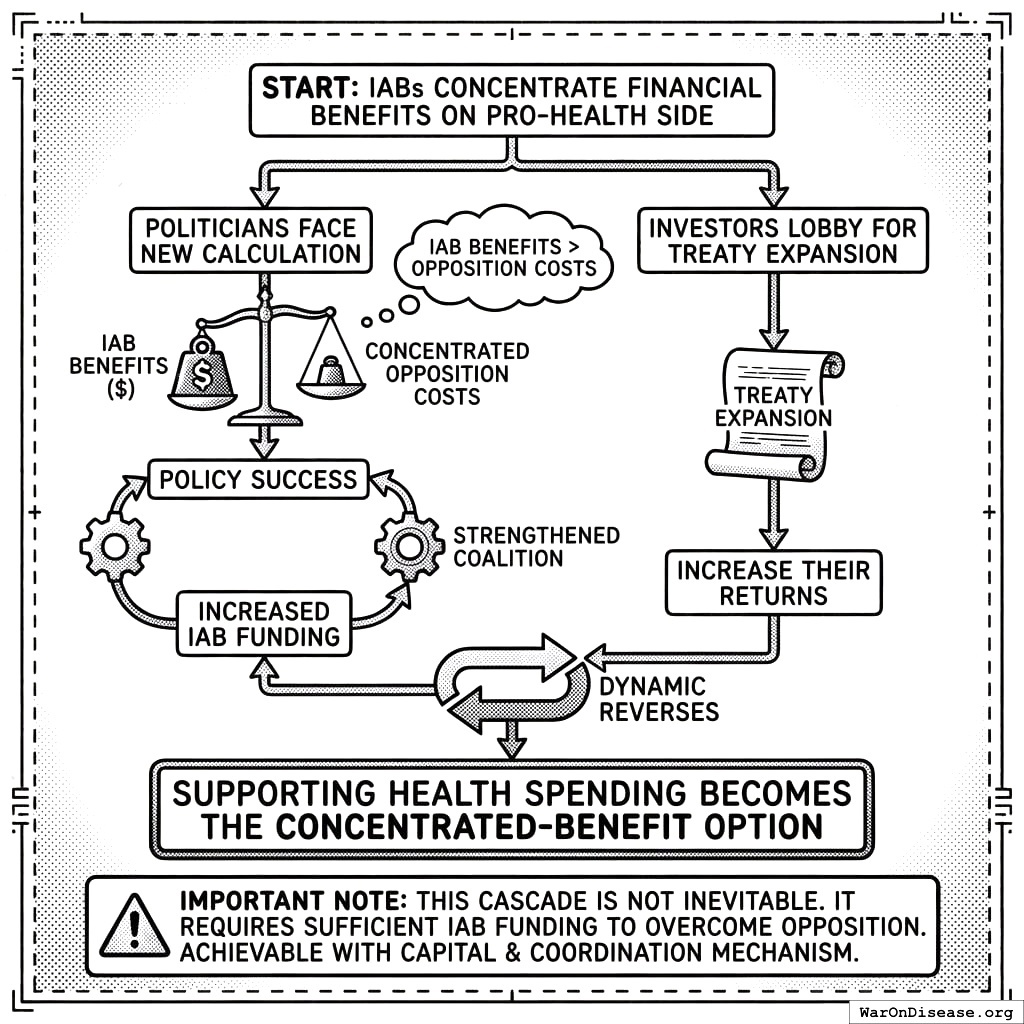](../../assets/images/aligning-incentives/aligning-incentives-section-why-the-cascade-can-happen-not-must-happen-bw-academic.jpg)
The virtuous cycle: fund research, cures happen, politicians look good, more funding arrives. Like the weapon-money cycle but nobody explodes.
## Why This Scales: The Ratchet Effect
Each treaty expansion creates more political incentive funding to lobby for the next expansion. At 1%, political incentive funding is [\$2.72 billion](../../knowledge/appendix/parameters-and-calculations.llms.md#sec-iab_political_incentive_funding_annual) per year. At 10%, that scales to 10x. Politicians who supported the [1% Treaty](https://manual.warondisease.org/knowledge/solution/1-percent-treaty.html)^([7](../references.llms.md#ref-1-percent-treaty-paper-2025)) ^([8](../references.llms.md#ref-1-pct-treaty-impact-paper-2025)) get rewarded. Those rewards grow if they push for 2%. It’s a ratchet that only moves in one direction: the direction where people stop dying.
You’ve built ratchets like this before. Social Security. Medicare. Once they exist, dismantling them is politically suicidal because too many people depend on them. The difference is you built those by accident, through crisis and desperation, and spent decades arguing about whether they were good ideas. This time, try doing it on purpose. Building things on purpose works better than building them by accident. I realize this is a controversial position for a species that invented penicillin by leaving a sandwich out.
1\.
Responsible Statecraft. Lobbying ROI calculation (\$1,813 per \$1). *Responsible Statecraft* (2021).
2\.
Sinn, M. P. *Incentive Alignment Bonds: Making Public Goods Financially and Politically Profitable*. (2025) doi:[10.5281/zenodo.18203221](https://doi.org/10.5281/zenodo.18203221)
*Government spending is optimized for lobbying intensity, not net societal value. Programs with 100:1 benefit-cost ratios get billions while programs with negative returns get hundreds of billions. Incentive Alignment Bonds flip this by creating a capital pool that rewards politicians (via campaign support and post-office opportunities) for funding high-NSV programs over low-NSV alternatives. The result: public good becomes private profit for both investors and elected officials.*
3\.
Pape, R. A. *[Dying to Win: The Strategic Logic of Suicide Terrorism](https://cpost.uchicago.edu/publications/dying_to_win_the_strategic_logic_of_suicide_terrorism/)*. (Random House, 2005).
*Pape analyzed every suicide terrorist attack worldwide from 1980 to 2003, finding that 95 percent were in response to foreign military occupation. The data contradicts narratives attributing suicide terrorism primarily to religious fundamentalism.*
4\.
Brown University. War on terror cost and unintended consequences. *Brown University* (2021)
*20 years of post-9/11 wars cost the U.S. an estimated \$8 trillion and killed more than 900,000 people. Breakdown: \$2.1T DOD operations, \$1.1T homeland security, \$1.1T interest on borrowing, \$884B DOD base budget increases, \$465B veterans’ care, \$2.3T Afghanistan/Pakistan, \$2.1T Iraq/Syria. Future: \$2.2T for veteran care already set aside. Additional sources: https://www.brown.edu/news/2021-09-01/costsofwar \| https://watson.brown.edu/costsofwar/costs/economic*
.
5\.
Jones, S. G. Terrorism before and during the war on terror: A look at the numbers. *War on the Rocks* (2017)
*Analysis of terrorism trends showing dramatic increase in global terrorist attacks after 2001, with attacks rising from roughly 1,000 per year in 2004 to nearly 17,000 by 2014, driven primarily by proliferation of jihadist organizations in Iraq, Afghanistan, Pakistan, Nigeria, and Syria.*
6\.
Sinn, M. P. *Wishocracy: Solving the Democratic Principal-Agent Problem Through Pairwise Preference Aggregation*. (2025) doi:[10.5281/zenodo.18205881](https://doi.org/10.5281/zenodo.18205881)
*Representative democracy suffers from an inescapable principal-agent problem where elected officials’ incentives diverge from citizen welfare. Wishocracy introduces RAPPA (Randomized Aggregated Pairwise Preference Allocation), which aggregates citizen preferences through cognitively tractable pairwise comparisons and creates accountability via Citizen Alignment Scores that channel electoral resources toward politicians who actually represent what citizens want.*
7\.
Sinn, M. P. *The 1% Treaty*. (2025) doi:[10.5281/zenodo.20076511](https://doi.org/10.5281/zenodo.20076511)
*Your governments possess nuclear weapons sufficient to end civilization 122 times but have not cured Alzheimer’s once. This treaty asks them to be 1% more rational.*
8\.
Sinn, M. P. *The 1% Treaty: An Incentive-Compatible Approach to Ending War and Disease*. (2025) doi:[10.5281/zenodo.18161560](https://doi.org/10.5281/zenodo.18161560)
*6,650 diseases have zero FDA-approved treatments; at current trial capacity, exploring them takes 443 years. Redirecting 1% of military spending scales capacity 12.3x, cutting the timeline to 36 years and preventing 10.7 billion deaths. At \$0.02/DALY, 9.3kx more cost-effective than the best existing interventions. The result holds across every specified adoption pathway.*
9\.
UBS. Credit suisse global wealth report 2023. *Credit Suisse/UBS* (2023)
*Total global household wealth: USD 454.4 trillion (2022) Wealth declined by USD 11.3 trillion (-2.4%) in 2022, first decline since 2008 Wealth per adult: USD 84,718 Additional sources: https://www.ubs.com/global/en/family-office-uhnw/reports/global-wealth-report-2023.html*
.
10\.
WHO. Annual global economic burden of alzheimer’s and other dementias. *WHO: Dementia Fact Sheet* (2019)
*Global cost: \$1.3 trillion (2019 WHO-commissioned study) 50% from informal caregivers (family/friends, 5 hrs/day) 74% of costs in high-income countries despite 61% of patients in LMICs \$818B (2010) → \$1T (2018) → \$1.3T (2019) - rapid growth Note: Costs increased 35% from 2010-2015 alone. Informal care represents massive hidden economic burden Additional sources: https://www.who.int/news-room/fact-sheets/detail/dementia \| https://alz-journals.onlinelibrary.wiley.com/doi/10.1002/alz.12901*
.
11\.
JAMA Oncology. Annual global economic burden of cancer. *JAMA Oncology: Global Cost 2020-2050* (2020)
*2020-2050 projection: \$25.2 trillion total (\$840B/year average) 2010 annual cost: \$1.16 trillion (direct costs only) Recent estimate: \$3 trillion/year (all costs included) Top 5 cancers: lung (15.4%), colon/rectum (10.9%), breast (7.7%), liver (6.5%), leukemia (6.3%) Note: China/US account for 45% of global burden; 75% of deaths in LMICs but only 50.0% of economic cost Additional sources: https://jamanetwork.com/journals/jamaoncology/fullarticle/2801798 \| https://www.nature.com/articles/d41586-023-00634-9*
.
12\.
Diabetes Care. Annual global economic burden of diabetes. *Diabetes Care: Global Economic Burden*
*2015: \$1.3 trillion (1.8% of global GDP) 2030 projections: \$2.1T-2.5T depending on scenario IDF health expenditure: \$760B (2019) → \$845B (2045 projected) 2/3 direct medical costs (\$857B), 1/3 indirect costs (lost productivity) Note: Costs growing rapidly; expected to exceed \$2T by 2030 Additional sources: https://diabetesjournals.org/care/article/41/5/963/36522/Global-Economic-Burden-of-Diabetes-in-Adults \| https://doi.org/10.1016/S2213-8587(17)30097-9*
.
13\.
Cook, C., Cole, G., Asaria, P., Jabbour, R. & Francis, D. P. Annual global economic burden of heart disease. *International Journal of Cardiology* (2014)
*Heart failure alone: \$108 billion/year (2012 global analysis, 197 countries) US CVD: \$555B (2016) → projected \$1.8T by 2050 LMICs total CVD loss: \$3.7T cumulative (2011-2015, 5-year period) CVD is costliest disease category in most developed nations Note: No single \$2.1T global figure found; estimates vary widely by scope and year Additional sources: https://www.ahajournals.org/doi/10.1161/CIR.0000000000001258*
.
14\.
Tufts CSDD. Cost of drug development.
*Various estimates suggest \$1.0 - \$2.5 billion to bring a new drug from discovery through FDA approval, spread across 10 years. Tufts Center for the Study of Drug Development often cited for \$1.0 - \$2.6 billion/drug. Industry reports (IQVIA, Deloitte) also highlight \$2+ billion figures.*
15\.
Nature Reviews Drug Discovery. Drug trial success rate from phase i to approval. *Nature Reviews Drug Discovery: Clinical Success Rates* (2016)
*Overall Phase I to approval: 10-12.8% (conventional wisdom 10%, studies show 12.8%) Recent decline: Average LOA now 6.7% for Phase I (2014-2023 data) Leading pharma companies: 14.3% average LOA (range 8-23%) Varies by therapeutic area: Oncology 3.4%, CNS/cardiovascular lowest at Phase III Phase-specific success: Phase I 47-54%, Phase II 28-34%, Phase III 55-70% Note: 12% figure accurate for historical average. Recent data shows decline to 6.7%, with Phase II as primary attrition point (28% success) Additional sources: https://www.nature.com/articles/nrd.2016.136 \| https://pmc.ncbi.nlm.nih.gov/articles/PMC6409418/ \| https://academic.oup.com/biostatistics/article/20/2/273/4817524*
.
16\.
SIPRI. Global military spending (\$2.72T, 2024). *SIPRI* (2025).
17\.
OpenSecrets. Defense sector lobbying summary. *OpenSecrets* (2025)
*Military sector federal lobbying totaled \$198,009,793 in 2025, up from \$159.5 million in 2024 and \$142.9 million in 2023. Additional sources: https://www.opensecrets.org/federal-lobbying/sectors/summary?id=D*
.
18\.
OpenSecrets. Lobbyist statistics for washington d.c. *OpenSecrets: Lobbying in US*
*Registered lobbyists: Over 12,000 (some estimates); 12,281 registered (2013) Former government employees as lobbyists: 2,200+ former federal employees (1998-2004), including 273 former White House staffers, 250 former Congress members & agency heads Congressional revolving door: 43% (86 of 198) lawmakers who left 1998-2004 became lobbyists; currently 59% leaving to private sector work for lobbying/consulting firms/trade groups Executive branch: 8% were registered lobbyists at some point before/after government service Additional sources: https://en.wikipedia.org/wiki/Lobbying_in_the_United_States \| https://www.opensecrets.org/revolving-door \| https://www.citizen.org/article/revolving-congress/ \| https://www.propublica.org/article/we-found-a-staggering-281-lobbyists-whove-worked-in-the-trump-administration*
.
19\.
Value in Health. Average lifetime revenue per successful drug. *Value in Health: Sales Revenues for New Therapeutic Agents*
*Study of 361 FDA-approved drugs from 1995-2014 (median follow-up 13.2 years): Mean lifetime revenue: \$15.2 billion per drug Median lifetime revenue: \$6.7 billion per drug Revenue after 5 years: \$3.2 billion (mean) Revenue after 10 years: \$9.5 billion (mean) Revenue after 15 years: \$19.2 billion (mean) Distribution highly skewed: top 25 drugs (7%) accounted for 38% of total revenue (\$2.1T of \$5.5T) Additional sources: https://www.sciencedirect.com/science/article/pii/S1098301524027542*
.
20\.
Deloitte. Pharmaceutical r&d return on investment (ROI). *Deloitte: Measuring Pharmaceutical Innovation 2025* (2025)
*Deloitte’s annual study of top 20 pharma companies by R&D spend (2010-2024): 2024 ROI: 5.9% (second year of growth after decade of decline) 2023 ROI: 4.3% (estimated from trend) 2022 ROI: 1.2% (historic low since study began, 13-year low) 2021 ROI: 6.8% (record high, inflated by COVID-19 vaccines/treatments) Long-term trend: Declining for over a decade before 2023 recovery Average R&D cost per asset: \$2.3B (2022), \$2.23B (2024) These returns (1.2-5.9% range) fall far below typical corporate ROI targets (15-20%) Additional sources: https://www.deloitte.com/ch/en/Industries/life-sciences-health-care/research/measuring-return-from-pharmaceutical-innovation.html \| https://www.prnewswire.com/news-releases/deloittes-13th-annual-pharmaceutical-innovation-report-pharma-rd-return-on-investment-falls-in-post-pandemic-market-301738807.html \| https://hitconsultant.net/2023/02/16/pharma-rd-roi-falls-to-lowest-level-in-13-years/*
.
21\.
NIH Common Fund. NIH pragmatic trials: Minimal funding despite 30x cost advantage. *NIH Common Fund: HCS Research Collaboratory* (2025)
*The NIH Pragmatic Trials Collaboratory funds trials at \$500K for planning phase, \$1M/year for implementation-a tiny fraction of NIH’s budget. The ADAPTABLE trial cost \$14 million for 15,076 patients (= \$929/patient) versus \$420 million for a similar traditional RCT (30x cheaper), yet pragmatic trials remain severely underfunded. PCORnet infrastructure enables real-world trials embedded in healthcare systems, but receives minimal support compared to basic research funding. Additional sources: https://commonfund.nih.gov/hcscollaboratory \| https://pcornet.org/wp-content/uploads/2025/08/ADAPTABLE_Lay_Summary_21JUL2025.pdf \| https://www.ncbi.nlm.nih.gov/pmc/articles/PMC5604499/*
.
22\.
FDA Study via NCBI. Trial costs, FDA study. *FDA Study via NCBI*
*Overall, the 138 clinical trials had an estimated median (IQR) cost of \$19.0 million (\$12.2 million-\$33.1 million)... The clinical trials cost a median (IQR) of \$41,117 (\$31,802-\$82,362) per patient. Additional sources: https://www.ncbi.nlm.nih.gov/pmc/articles/PMC6248200/*
.
23\.
CNBC. Warren buffett’s career average investment return. *CNBC* (2025)
*Berkshire’s compounded annual return from 1965 through 2024 was 19.9%, nearly double the 10.4% recorded by the S&P 500. Berkshire shares skyrocketed 5,502,284% compared to the S&P 500’s 39,054% rise during that period. Additional sources: https://www.cnbc.com/2025/05/05/warren-buffetts-return-tally-after-60-years-5502284percent.html \| https://www.slickcharts.com/berkshire-hathaway/returns*
.