# The Cost of Disease
## The Daily Body Count
Every single day:
- **150,000 people stop existing**
- **130,000 from disease** (diseases are very effective at their job)
- **80,000 were preventable^([1](../references.llms.md#ref-53-percent-preventable-deaths))** (the technology existed; nobody reached for it)
- **13,700 are children^([2](../references.llms.md#ref-5-million-annual-child-deaths))** (which matters if you believe children should continue existing)
That’s fifty 9/11s. Every. Single. Day.
After the first 9/11, America invaded two countries and spent \$2 trillion. After the fifty daily 9/11s, humanity shrugs and checks Instagram.
Every hour: **6,250 deaths**. Every minute: **104 deaths**. Every second: **1.7 deaths**.
If you took everyone in a decent-sized stadium and deleted them, that’s one day. Then do it again tomorrow. And the day after that. Forever. You’d run out of stadiums before you’d run out of corpses, which seems like poor urban planning.
That’s the body count. Now let’s talk about the bill.
## The Financial Cost
While you read this sentence, disease just deleted \$12.7 million of human potential from existence.
By the time you finish this paragraph, \$60 million more will evaporate into cancer treatments, heart surgeries, and funeral expenses. Also Dave from accounting’s weird rash, but that’s probably unrelated.
Humanity hemorrhages **[\$400 trillion (90% CI: \$252 trillion-\$544 trillion)](../../knowledge/appendix/parameters-and-calculations.llms.md#sec-global_disease_economic_burden_annual) annually**^([3](../references.llms.md#ref-disease-economic-burden-109t)) to diseases that are basically just engineering problems with meat robots.
That’s more than the entire global economy. Every year. You lose more money to disease than you make doing everything else combined. It’s like running a lemonade stand that costs more in lemons than the entire GDP of Earth.
“Wait,” you say, “global GDP is only \$101 trillion^([4](../references.llms.md#ref-global-gdp)). How can we lose more than everything that exists?”
Because economists forgot to include the dying part. For centuries, economics measured productivity without accounting for the people who stopped being productive on account of being dead. This is like calculating the cost of a plane crash without including the plane, the passengers, or the fact that they were going somewhere.
## The Actual Bill (Economist-Approved Misery Accounting)
Here’s what disease actually costs, translated from economist-speak into human language:
| What We’re Losing | What This Actually Means | Annual Cost |
|:---|:---|:---|
| **Direct cash costs** | Paying doctors to Google your symptoms in a room that costs \$500/hour, plus the spreadsheets sick people never make | [\$14.9 trillion (90% CI: \$11.9 trillion-\$18.3 trillion)](../../knowledge/appendix/parameters-and-calculations.llms.md#sec-global_disease_total_market_cost_annual)^([3](../references.llms.md#ref-disease-economic-burden-109t)) |
| **What the lost life is actually worth (DALYs)** | Dead people contribute zero to the economy (economists finally noticed). This is the real number; the cash above is just the part with receipts | [\$400 trillion (90% CI: \$252 trillion-\$544 trillion)](../../knowledge/appendix/parameters-and-calculations.llms.md#sec-global_disease_economic_burden_annual)^([5](../references.llms.md#ref-ihme-gbd-2019)) |
| **TOTAL DISASTER** | **More money than exists on Earth** | **[\$400 trillion (90% CI: \$252 trillion-\$544 trillion)](../../knowledge/appendix/parameters-and-calculations.llms.md#sec-global_disease_economic_burden_annual)**^([3](../references.llms.md#ref-disease-economic-burden-109t)) |
Let me explain that last one, because it’s where the real horror lives. \## How to Measure Suffering Without Feeling Feelings (The DALY)
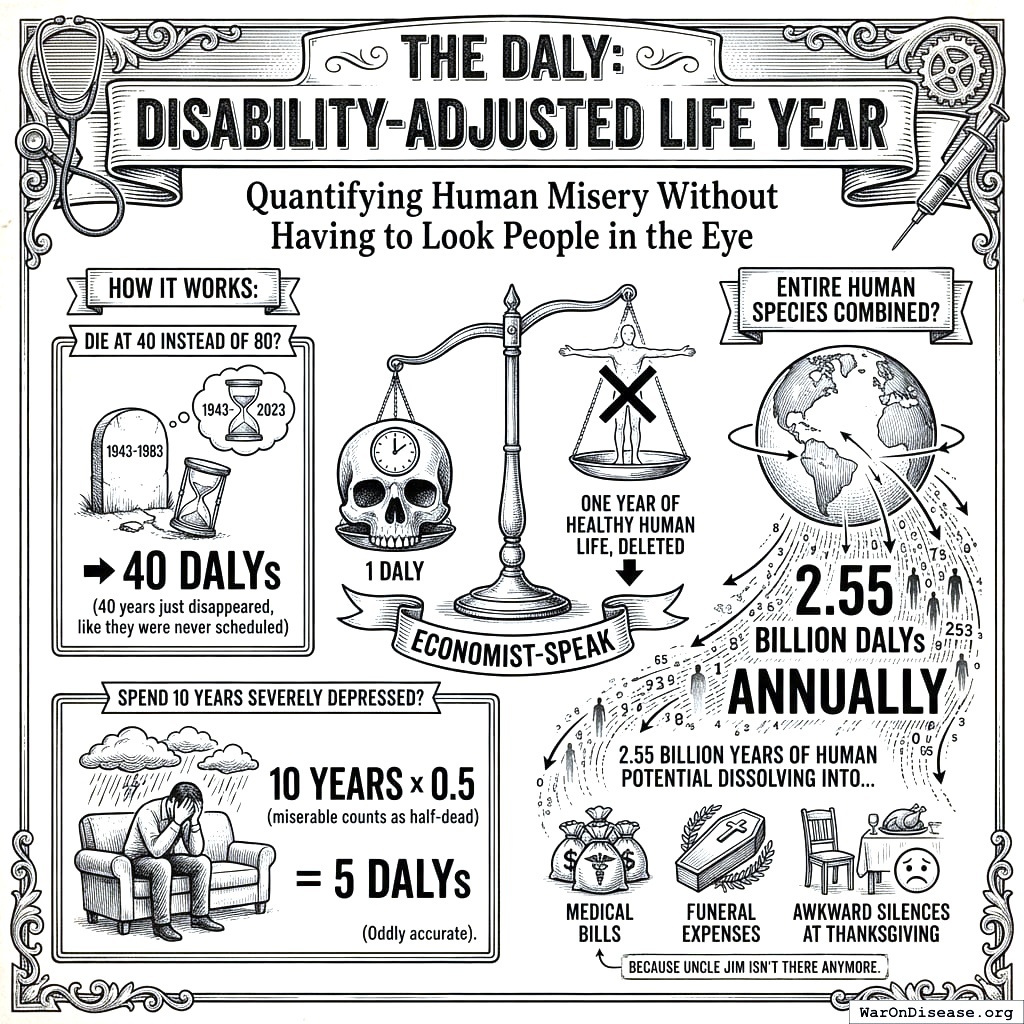
DALY stands for “Disability-Adjusted Life Year.” That’s economist-speak for “quantifying human misery without having to look people in the eye.”
[](../../assets/images/cost-of-disease/cost-of-disease-section-how-to-measure-suffering-without-feeling-feelings-the-daly-bw-academic.jpg)
DALYs measure healthy years lost. Dying at 30 instead of 80 loses 50 years. Living 50 years in a wheelchair at 50% capacity loses 25 years. The math is simple. Fixing it is apparently hard.
One DALY = One year of healthy human life, deleted.
Die at 40 instead of 80? That’s 40 DALYs. Spend 10 years severely depressed? That’s 5 DALYs (economists calculated that being miserable counts as being half-dead, which is oddly accurate).
The entire human species combined? **[2.88 billion](../../knowledge/appendix/parameters-and-calculations.llms.md#sec-global_annual_daly_burden) DALYs annually^([5](../references.llms.md#ref-ihme-gbd-2019))**. That’s [2.88 billion](../../knowledge/appendix/parameters-and-calculations.llms.md#sec-global_annual_daly_burden) years of human potential, dissolving annually into medical bills and funeral expenses.
### What the WHO Thinks You’re Worth (Less Than a Tesla)
The World Health Organization decided one year of human life is worth 1-3 times GDP per capita^([6](../references.llms.md#ref-who-choice-daly-value)). They made this calculation sober, which is surprising.
Let’s use 3x GDP per capita. We’re optimists who think humans are worth at least three years of their economic output. This is the most generous estimate bureaucrats could manage, and it’s still less than a luxury sedan.
The math is simple and horrifying:
- Value per healthy year: [\$150,000 (90% CI: \$100,384-\$198,679)](../../knowledge/appendix/parameters-and-calculations.llms.md#sec-standard_economic_qaly_value_usd) (less than a Tesla, apparently)
- Total DALYs lost annually: [2.88 billion](../../knowledge/appendix/parameters-and-calculations.llms.md#sec-global_annual_daly_burden) years, about 93% of them eventually avoidable
Multiply the avoidable years by the value:
$$ \begin{gathered} Burden_{disease} \\ = DALYs_{global,ann} \times Pct_{avoid,DALY} \times Value_{QALY} \\ = 2.88B \times 92.6\% \times \$150K \\ = \$400T \end{gathered} $$
That’s [\$400 trillion (90% CI: \$252 trillion-\$544 trillion)](../../knowledge/appendix/parameters-and-calculations.llms.md#sec-global_disease_economic_burden_annual) of human potential. We flush it annually down the toilet labeled “diseases we haven’t cured yet because the money went to bombs.”
## Let’s Break Down This Apocalypse By Time Unit
[\$400 trillion (90% CI: \$252 trillion-\$544 trillion)](../../knowledge/appendix/parameters-and-calculations.llms.md#sec-global_disease_economic_burden_annual) annually breaks down to:
- **\$1.1 trillion EVERY DAY** (more than most countries make in a year)
- **\$45.7 billion EVERY HOUR** (enough to fund a mid-size cancer research institute)
- **\$761 million EVERY MINUTE** (more than most lottery jackpots)
- **\$12.7 million EVERY SECOND** (a new Tesla Roadster worth of human potential, gone, every second, forever)
By the time you finish this chapter (about 10 minutes), disease will have cost humanity more than the entire Apollo moon program. We went to the moon for less than one chapter’s worth of disease costs. The math is, as your children say, not mathing.
## What’s Actually Deleting Everyone (The Greatest Hits)
Here’s what’s killing people while you read about what’s killing people:
| Disease | Annual Deaths | Daily Deaths | Will Die Reading This Chapter |
|----|----|----|----|
| Heart Disease | 20 million^([7](../references.llms.md#ref-death-causes-vs-fear)) | 54,800 | 500 |
| Cancer | 10.4 million^([8](../references.llms.md#ref-cancer-deaths-10m-annually)) | 28,500 | 260 |
| Respiratory Disease | 6.5 million^([9](../references.llms.md#ref-respiratory-disease-deaths-6-9m-annually)) | 17,800 | 160 |
| Dementia | 2.6 million^([10](../references.llms.md#ref-alzheimers-deaths-2-6m-annually)) | 7,100 | 65 |
| Diabetes | 3.4 million^([11](../references.llms.md#ref-diabetes-deaths-2m-annually)) | 9,300 | 85 |
| Kidney Disease | 1.4 million^([12](../references.llms.md#ref-kidney-disease-deaths-1-4m-annually)) | 3,800 | 35 |
| Tuberculosis | 1.3 million^([13](../references.llms.md#ref-tuberculosis-deaths-1-3m-annually)) | 3,600 | 33 |
| **TOTAL** | **[55 million](../../knowledge/appendix/parameters-and-calculations.llms.md#sec-global_annual_deaths_curable_diseases)^([14](../references.llms.md#ref-who-daily-deaths))** | **150,000** | **1,370** |
1,370 humans will permanently stop existing while you read this chapter. That’s five 747s crashing. Every 10 minutes. Forever. If this happened to actual planes, you’d ground all flights within an hour and the 24-hour news cycle would collapse from overuse. But because it’s disease, you call it “natural causes” and go back to arguing about parking.
While you’re busy testing 0.000003% of potential cures:
- **10 million people annually^([15](../references.llms.md#ref-amr-10m-2050))** will die from antimicrobial resistance by 2050 (bacteria evolved faster than we did, which is embarrassing)
- **600,000 people annually^([16](../references.llms.md#ref-malaria-deaths-600k-annually))** die from malaria (mosquitoes: 600,000, humanity: 0)
- **10.4 million people annually^([8](../references.llms.md#ref-cancer-deaths-10m-annually))** die from cancer (your own cells killing you because they forgot how to die). That’s more than the population of Sweden. Sweden is being eliminated by cancer every twelve months and nobody has declared war on it. Well, Nixon did, in 1971. Cancer won.
- **20 million people annually^([7](../references.llms.md#ref-death-causes-vs-fear))** die from cardiovascular disease (hearts that gave up on humanity, can’t blame them)
Each death represents:
- Someone’s entire universe ending
- A grandmother who won’t meet grandchildren
- A scientist who might have cured the thing that killed them
- \$4 million in lost economic value (if we’re being cold about it, which economists always are)
- Infinite sadness if you’re the one dying, mild inconvenience if you’re not
## Your Body Is Not Magic, It’s Just Broken
Your body is a machine. Not mystical, not “in balance with the universe.” A biological machine made of 37 trillion cells. And like all machines, it breaks.
**Machines can be fixed.**
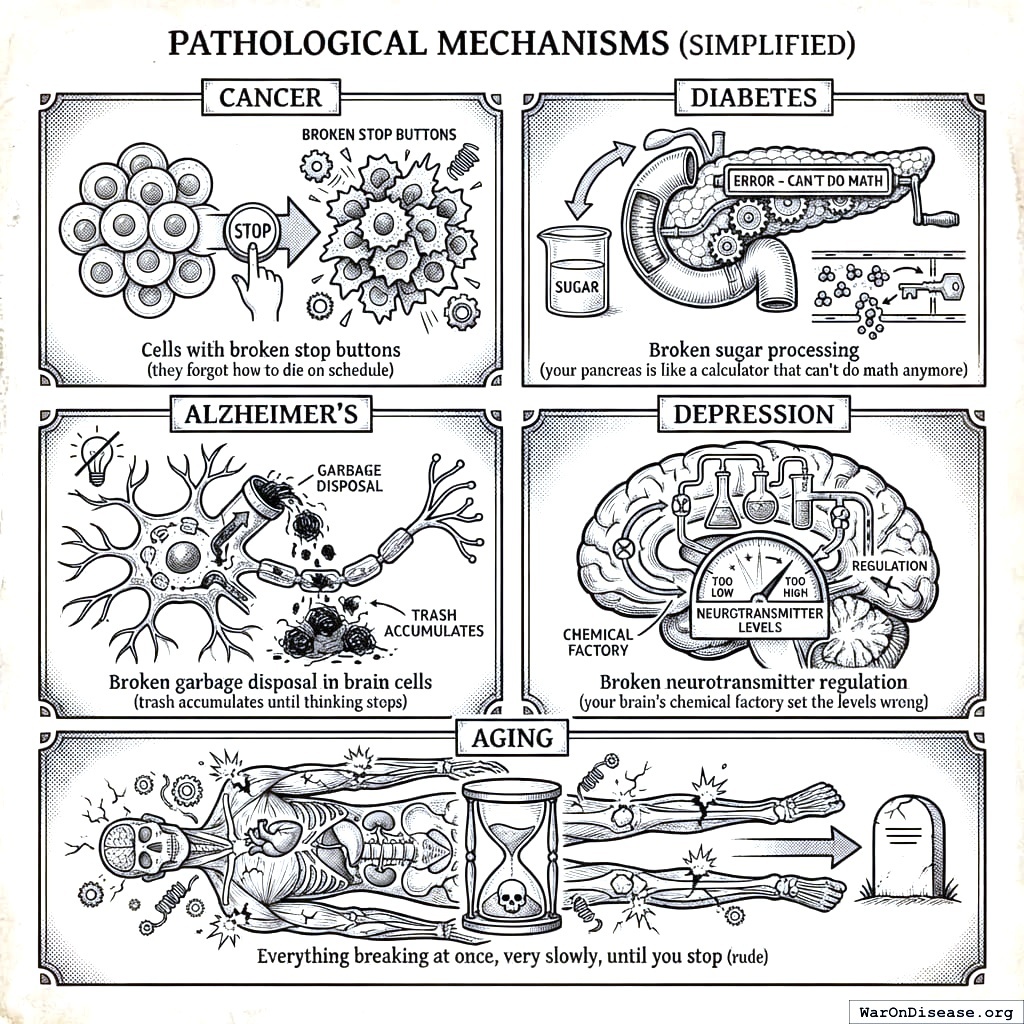
Every disease is just a broken part: cancer is cells with broken stop buttons, Alzheimer’s is broken garbage disposal in brain cells, aging is everything breaking at once very slowly (rude).
These don’t get fixed because 99.999997% of the repair tools are untested. There are 166 billion possible molecules. Humanity has tried ~0.003% of them. That’s like looking for your car keys by checking one pocket then giving up forever.
[](../../assets/images/cost-of-disease/cost-of-disease-section-disease-mechanics-infographic-bw-academic.jpg)
Heart disease is like a clogged pipe. Cancer is like cells that forgot how to stop. Diabetes is like a broken thermostat. Everyone understands pipes. Nobody can fix the pipes inside them.
## What This Actually Costs
The [\$400 trillion (90% CI: \$252 trillion-\$544 trillion)](../../knowledge/appendix/parameters-and-calculations.llms.md#sec-global_disease_economic_burden_annual) “Disease Tax” is optional. Not optional like “you can skip it,” but optional like “it’s not a law of physics, just a choice humanity keeps making.” It’s the price of humanity being too slow to fix its own broken meat robots.
Every day you delay costs another **\$1.1 trillion** in human potential dissolving into medical bills, funeral expenses, and GoFundMe campaigns. Meanwhile, politicians argue whether you can “afford” to test molecules.
### Your Priorities, Written in Your Budgets
- **Military budget:** Gets \$7.4 billion daily^([17](../references.llms.md#ref-sipri2024)) to practice ending human life
- **Medical research:** Gets \$185 million daily^([18](../references.llms.md#ref-global-gov-med-research-spending)) to practice extending it
That’s a **40:1 ratio in favor of death over life.**
If aliens intercepted your budget spreadsheets, they’d conclude you’re a death cult that occasionally dabbles in medicine as a hobby. (We have intercepted them. This is accurate.)
### The Future You’re Paying For
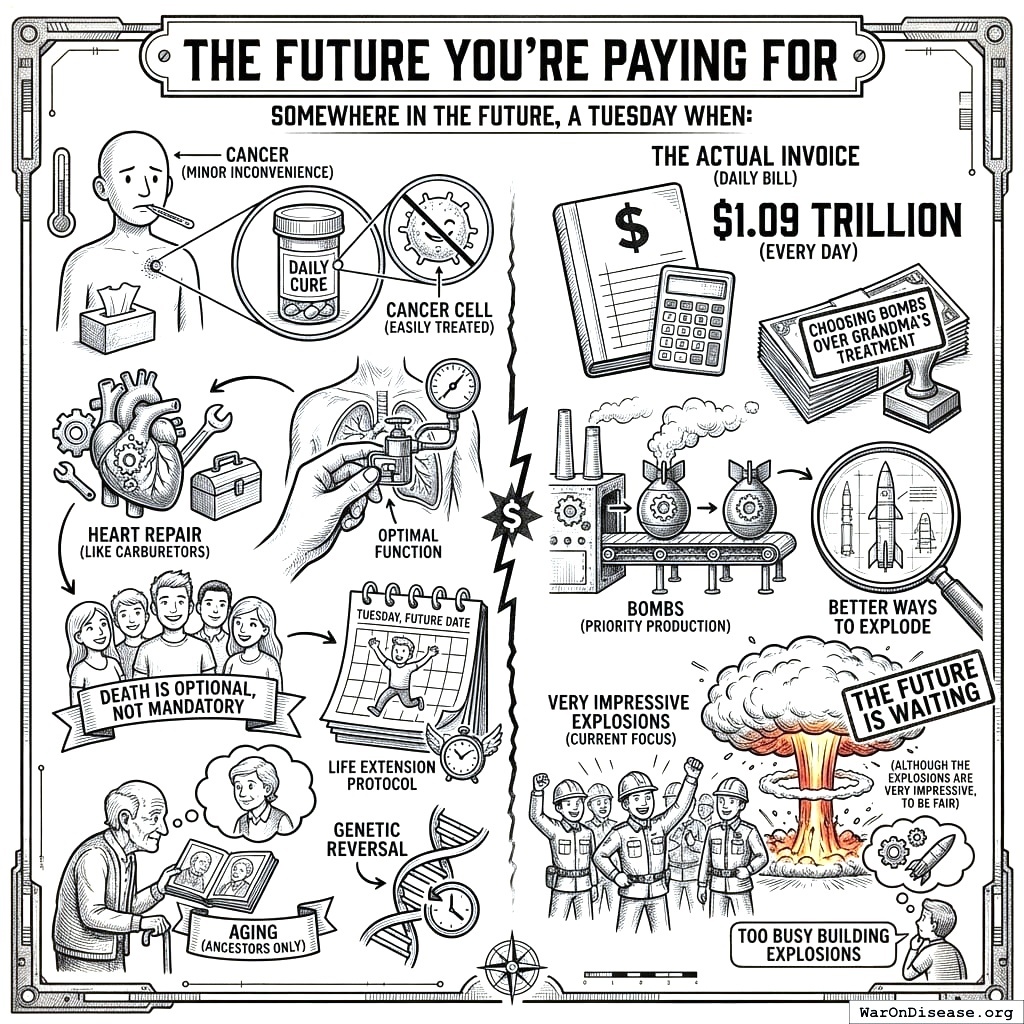
Somewhere in the future, there’s a Tuesday when:
- Cancer is a minor inconvenience like a cold
- Hearts are as repairable as carburetors
- Death is optional, not mandatory
- Aging is something that happened to your ancestors
Every day between now and that Tuesday costs you \$1.1 trillion. That’s the real invoice. The actual bill for choosing bombs over grandma’s cancer treatment.
[](../../assets/images/cost-of-disease/cost-of-disease-section-the-future-you-re-paying-for-bw-academic.jpg)
Every day of military spending delays the cancer cure by another day. It’s been delayed for 75 years now. The cancer is very patient.
The future is waiting. Humanity’s just too busy building better ways to explode each other to notice. The explosions are very impressive, though. Full marks for spectacle.
1\.
CDC. [Percentage of preventable deaths](https://www.cdc.gov/mmwr/volumes/73/ss/ss7302a1.htm). vol. 73 (2024)
*80,000 were preventable (53% of deaths are preventable)*
.
2\.
UNICEF. [Annual child deaths statistic](https://data.unicef.org/resources/levels-and-trends-in-child-mortality-2024/). (2024)
*15,000 are children (based on 5 million annual child deaths)*
.
3\.
Calculated from IHME Global Burden of Disease (2.55B DALYs) and global GDP per capita valuation. \$109 trillion annual global disease burden.
*The global economic burden of disease, including direct healthcare costs (\$8.2 trillion) and lost productivity (\$100.9 trillion from 2.55 billion DALYs × \$39,570 per DALY), totals approximately \$109.1 trillion annually.*
4\.
Statista. Global GDP (\$101T, 2022). *Statista* (2023)
*The global economy is projected to grow from about 101 trillion U.S. dollars in 2022 to about 139 trillion U.S. dollars in 2027. Additional sources: https://www.statista.com/statistics/268750/global-gross-domestic-product-gdp/*
.
5\.
Institute for Health Metrics and Evaluation (IHME). IHME global burden of disease (2.55B DALYs, 2019). *Institute for Health Metrics and Evaluation (IHME)* (2020)
*Globally, in 2019, the total number of DALYs from all causes was 2.55 billion. Additional sources: https://vizhub.healthdata.org/gbd-compare/ \| https://www.healthdata.org/research-analysis/about-gbd \| https://pubmed.ncbi.nlm.nih.gov/33069326/*
.
6\.
World Health Organization. *World Health Organization*
*In the CHOICE project, we have used a threshold of three times GDP per capita for an intervention to be considered ’cost-effective’ and a threshold of one times GDP per capita to be considered ’very cost-effective’. Additional sources: https://www.who.int/activities/choosing-interventions-that-are-cost-effective-(who-choice*
.
7\.
IHME. Death causes vs fear (heart disease vs terrorism). *IHME: CVD Deaths 2023* (2023)
*Cardiovascular disease: 19.2-20.5 million deaths annually (2023 data) Terrorism: approximately 25,000 deaths per year CVD accounts for 1 in 3 global deaths - the leading cause for over 30 years Note: CVD deaths increased 60% from 12.1M (1990) to 20.5M (2021). 4 in 5 CVD deaths occur in low- and middle-income countries Additional sources: https://www.healthdata.org/news-events/newsroom/news-releases/report-cardiovascular-diseases-caused-1-3-global-deaths-2023 \| https://world-heart-federation.org/wp-content/uploads/World-Heart-Report-2023.pdf*
.
8\.
The Lancet. Annual deaths from cancer (10 million). *The Lancet: Global Cancer Deaths 2023* (2023)
*Cancer deaths: 10.4 million globally in 2023 (9.7 million in 2022) 18.5 million new cancer cases in 2023 65.8% of deaths occur in low- to upper-middle-income countries Note: Cancer is the second leading cause of death globally after cardiovascular diseases. Projected to reach 18.6 million deaths by 2050 (74.5% increase) Additional sources: https://www.hematologyadvisor.com/news/globally-18-5-million-incident-cancer-cases-and-10-4-million-deaths-reported-in-2023/ \| https://www.who.int/news/item/01-02-2024-global-cancer-burden-growing–amidst-mounting-need-for-services*
.
9\.
WHO. Annual deaths from respiratory disease. *WHO: COPD Fact Sheet)* (2019)
*Chronic respiratory diseases: 4.0 million deaths annually (2019) COPD specifically: 3.5 million deaths (2021) - 4th leading cause of death globally Pneumonia: 2.5 million deaths including 672,000 children (2019) Combined respiratory deaths: 6.5 million annually Note: 90% of COPD deaths in those under 70 occur in low- and middle-income countries. COPD affects over 380 million people globally Additional sources: https://www.who.int/news-room/fact-sheets/detail/chronic-obstructive-pulmonary-disease-(copd \| https://www.healthdata.org/research-analysis/library/global-burden-chronic-respiratory-diseases-and-risk-factors-1990-2019*
.
10\.
Alzheimer’s Association. Annual deaths from alzheimer’s and other dementias. *Alzheimer’s Association* (2024)
*Alzheimer’s \| 2.6M deaths/year Additional sources: https://www.alz.org/alzheimers-dementia/facts-figures \| https://www.cdc.gov/nchs/fastats/alzheimers.htm*
.
11\.
International Diabetes Federation. Annual deaths from diabetes. *International Diabetes Federation* (2024)
*Diabetes \| 2M deaths/year Additional sources: https://diabetesatlas.org/ \| https://www.who.int/news-room/fact-sheets/detail/diabetes*
.
12\.
National Kidney Foundation. Annual deaths from kidney disease. *National Kidney Foundation: Global Facts* (2022)
*Direct CKD deaths: 1.2M (2017), 1.53M (2021); increased from 591,800 (1990) to 1,425,670 (2019) CKD-attributable cardiovascular deaths: Additional 1.4M deaths from CVD attributable to impaired kidney function (7.6% of all CVD deaths, 2017) Combined impact: 4.6% of total global mortality CKD: 12th leading cause of death globally; one of few NCDs showing increased deaths over past 2 decades Additional sources: https://www.kidney.org/global-facts-about-kidney-disease \| https://pmc.ncbi.nlm.nih.gov/articles/PMC9073222/ \| https://www.thelancet.com/journals/lancet/article/PIIS0140-6736(20)30045-3/fulltext \| https://www.healthdata.org/news-events/newsroom/news-releases/chronic-kidney-disease-global-killer-plain-sight*
.
13\.
WHO. Annual deaths from tuberculosis. *WHO* (2024)
*Tuberculosis \| 1.3 million Additional sources: https://www.who.int/news-room/fact-sheets/detail/tuberculosis \| https://www.who.int/teams/global-programme-on-tuberculosis-and-lung-health/tb-reports/global-tuberculosis-report-2024*
.
14\.
World Health Organization. The top 10 causes of death. *WHO Fact Sheets* (2024)
*Approximately 150,000 people die every day worldwide. The majority of these deaths (over 100,000) are from non-communicable diseases including cardiovascular diseases, cancers, chronic respiratory diseases, and diabetes.*
15\.
Review on Antimicrobial Resistance. Antimicrobial resistance deaths projection. *Review on Antimicrobial Resistance* (2016).
16\.
WHO. Annual deaths from malaria. *WHO* (2024)
*600,000 people per year die from malaria (a disease spread by a bug we can’t figure out how to properly swat) Additional sources: https://www.who.int/teams/global-malaria-programme/reports/world-malaria-report-2024*
.
17\.
Stockholm International Peace Research Institute. [Trends in world military expenditure, 2023](https://www.sipri.org/publications/2024/sipri-fact-sheets/trends-world-military-expenditure-2023). (2024).
18\.
Component country budgets. Global government medical research spending (\$67.5B, 2023–2024). *See component country budgets: NIH Budget* .
19\.
Institute for Health Metrics and Evaluation (IHME). IHME global burden of disease 2021 (2.88B DALYs, 1.13B YLD). *Institute for Health Metrics and Evaluation (IHME)* (2024)
*In 2021, global DALYs totaled approximately 2.88 billion, comprising 1.75 billion Years of Life Lost (YLL) and 1.13 billion Years Lived with Disability (YLD). This represents a 13% increase from 2019 (2.55B DALYs), largely attributable to COVID-19 deaths and aging populations. YLD accounts for approximately 39% of total DALYs, reflecting the substantial burden of non-fatal chronic conditions. Additional sources: https://vizhub.healthdata.org/gbd-results/ \| https://www.thelancet.com/journals/lancet/article/PIIS0140-6736(24)00757-8/fulltext \| https://www.healthdata.org/research-analysis/about-gbd*
.
20\.
ICER. Value per QALY (standard economic value). *ICER* (2024)
*Standard economic value per QALY: \$100,000–\$150,000. This is the US and global standard willingness-to-pay threshold for interventions that add costs. Dominant interventions (those that save money while improving health) are favorable regardless of this threshold. Additional sources: https://icer.org/wp-content/uploads/2024/02/Reference-Case-4.3.25.pdf*
.
21\.
World Health Organization. WHO global health estimates 2024. *World Health Organization* (2024)
*Comprehensive mortality and morbidity data by cause, age, sex, country, and year Global mortality: 55-60 million deaths annually Lives saved by modern medicine (vaccines, cardiovascular drugs, oncology): 12M annually (conservative aggregate) Leading causes of death: Cardiovascular disease (17.9M), Cancer (10.3M), Respiratory disease (4.0M) Note: Baseline data for regulatory mortality analysis. Conservative estimate of pharmaceutical impact based on WHO immunization data (4.5M/year from vaccines) + cardiovascular interventions (3.3M/year) + oncology (1.5M/year) + other therapies. Additional sources: https://www.who.int/data/gho/data/themes/mortality-and-global-health-estimates*
.